Learn More
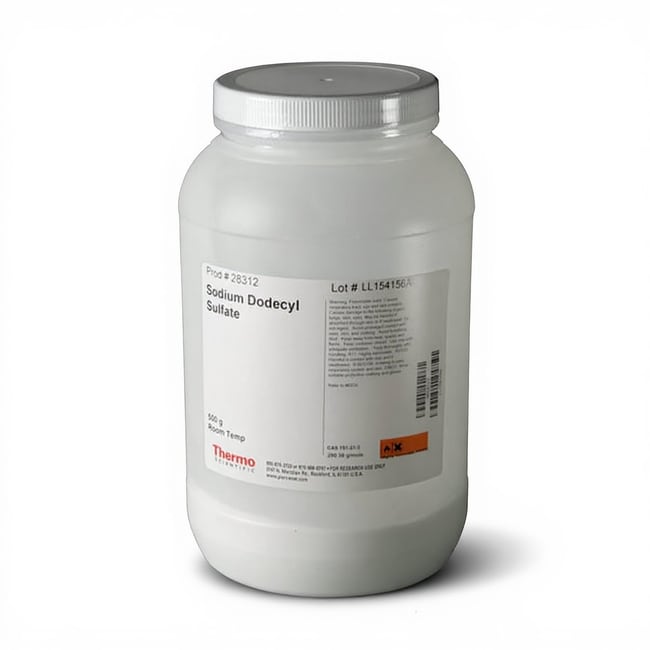
Thermo Scientific™ Sodium Dodecyl Sulfate (SDS), C12
Description
Thermo Scientific™ Sodium Dodecyl Sulfate (C12) is a highly purified form of SDS that is especially suited for protein experiments requiring tightly controlled solubility parameters.
Highlights:
- Popular anionic detergent for protein electrophoresis and solubilization
- Component of many cell lysis buffer formulations
- Specially purified formulation is >98% C12 alkyl sulfate
- Contains low levels of hexadecyl sulfate (C16), which inhibits protein renaturation
Detergent properties (pure C12):
- Molecular Weight: 288.5
- Detergent Class: Ionic (anionic)
- Aggregation Number: 62
- Micelle Molecular Weight: 18,000
- Critical Micelle Concentration (CMC): 6 to 8mM (0.1728 to 0.2304%, w/v)
- Cloud Point: >100°C
- Dialyzable: No
Specifications
Specifications
| Product Type | Detergent |
| Content And Storage | Store in original container protected from direct sunlight in a dry, cool and well-ventilated area, between the following temperatures: 20°C to 25°C. |
| Form | Powder |
| Reagent Type | Detergent (Pure) |
| Quantity | 500 g |
Frequently Asked Questions (FAQs)
Ionic detergents, or those that carry a charge, are the most likely to be denaturing to proteins. Denaturing detergents can be anionic such as sodium dodecyl sulfate (SDS) or cationic such as ethyl trimethyl ammonium bromide. These detergents totally disrupt membranes and denature proteins by breaking protein-protein interactions through changes in the three-dimensional structure of the proteins. Nondenaturing detergents can be divided into nonionic detergents (i.e., Triton X-100), bile salts (i.e., cholate), and zwitterionic detergents (i.e., CHAPS).
Detergents are amphipathic molecules containing both a nonpolar “tail” having aliphatic or aromatic character, and a polar “head”. The ionic character of the polar head group forms the basis for broad classification of detergents as ionic, nonionic, or zwitterionic.
For Research Use Only. Not for use in diagnostic procedures.