Learn More
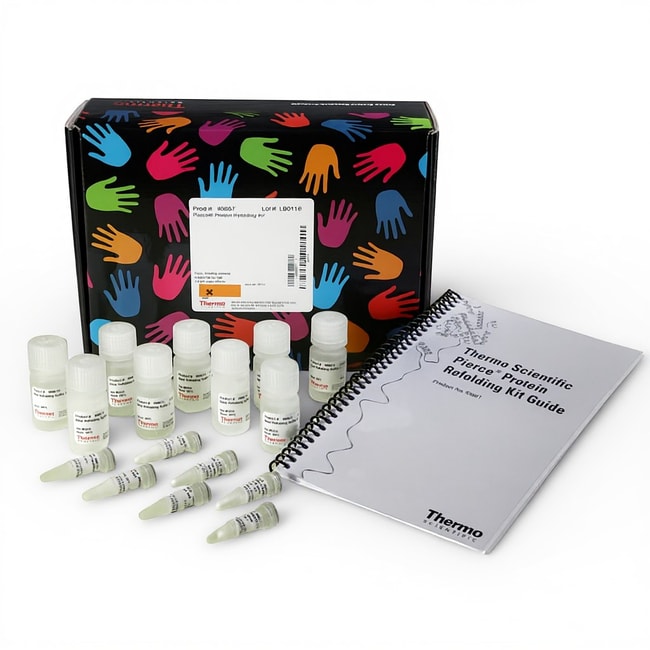
Thermo Scientific™ Pierce™ Protein Refolding Kit
Description
Thermo Scientific™ Pierce Protein Refolding Kit includes high-purity reagents and detailed instructions for using a matrix strategy to determine optimal buffer conditions for refolding recombinant proteins that have been denatured and solubilized from inclusion bodies.
Highlights:
Robust – conditions and components examined are limited to those having the most significant and general utility as folding buffers
Convenient – three-level matrix design significantly reduces the amount of secondary optimization required and increases the ease of data interpretation
Adjustable matrix format – allows refolding experiments to be customized to the target protein; known positive and negative interactions between buffer components are addressed, minimizing unnecessary analyses
High-purity reagents – reagents are formulated using stringent standards so that consistent results are attained
Includes:
Nine different Base Refolding Buffers (10mL each), convenient amounts of seven additives, and a comprehensive Refolding Guidebook
Compatible with:
Thermo Scientific Inclusion Body Solubilization Reagent (Part No. 78115)
Specifications
Specifications
| Product Type | Protein Refolding Kit |
| Content And Storage | Upon receipt store at -20°C. Product may be stored at 4°C for up to two months. Product is shipped on dry ice. |
| Form | Liquid, Powder |
| Product Line | Pierce |
| Reagent Type | Chaotrope, Denaturant |
| Quantity | 100 Reactions |
Frequently Asked Questions (FAQs)
Please read our suggestions below:
-Maintain low protein concentrations 10-50 µg/mL.
-Disulfide bonds help to stabilize native proteins; add a redox pair such as GSH (reduced glutathione)
-GSSG (oxidized glutathione) at a ratio of 10:1 with GSH concentration of 2-5 mM. Such a redox pair is helpful to create an oxidizing potential to break and build new S-S bonds during the folding process.
-Remove denaturants slowly by dilution or dialysis; glycine (50 mM, pH 9.0, 5 mM EDTA) helps to solubilize the proteins. If GuHCl (guanidinium HCl) is used, add 2 M urea because urea helps to stabilize the protein folding, too.
-Add detergents at a very low concentration such as 0.1-0.5% NP-40 or 0.005% (v/v) Tween 20.
-Include co-solvents to stabilize the proteins such as glycerol (5-20%) or PEG 8000 or glucose or sucrose. (10 %)
-Certain anions (e.g., phosphate or sulfate) or cations (e.g., MES or HEPES) have positive effects, too; include salt and maintain a neutral pH such as 100 mM KCl, or 150-500 mM NaCl, 2 mM MgCl2.
-Avoid protein degradation by adding protease inhibitors such as 0.5 mM PMSF, 0.005-2 µg/mL aprotinin, 2 µg/mL Pepstatin, or 2-5 µg/mL leupeptin.
-Dialysis of a phosphate buffer when against calcium will result in a calcium phosphate precipitate. If CaCl2 is needed for subsequent enterokinase digestion (10 mM Tris pH 8, 10 mM CaCl2), remember to add CaCl2 after dialysis is complete.
Alternatively, you can use the Pierce Protein Refolding kit (cat. No. 89867)
For Research Use Only. Not for use in diagnostic procedures.