missing translation for 'onlineSavingsMsg'
Learn More

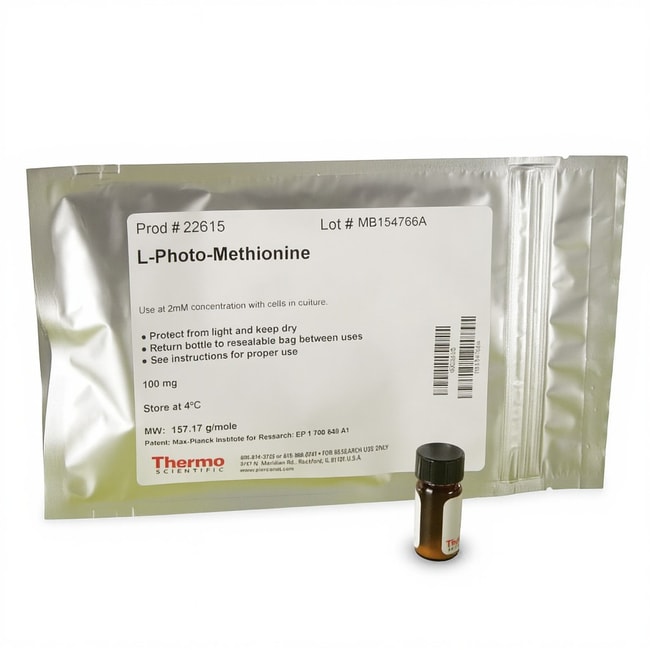
Thermo Scientific™ L-Photo-Methionine

Catalog No. PI22615
Change view
Click to view available options
Quantity:
100 mg
1 product options available for selection
Product selection table with 1 available options. Use arrow keys to navigate and Enter or Space to select.
Catalog No. Quantity
PI22615 100 mg
Use arrow keys to navigate between rows. Press Enter or Space to select a product option. 1 options available.
1 options
Catalog No. PI22615 Supplier Thermo Scientific™ Supplier No. 22615
Only null left

Diazirine analogs of leucine and methionine to express proteins in cell culture that will crosslink their protein interactors upon UV-light activation in vivo.

Thermo Scientific™ Pierce Photoreactive Amino Acids are analogs of L-Leucine and L-Methionine that can be incorporated into proteins during synthesis and then light-activated to covalently crosslink interacting proteins in cells.

Thermo Scientific L-Photo-Leucine and L-Photo-Methionine are analogs of L-Leucine and L-Methionine amino acids that have activatable diazirine side chains capable of chemical crosslinking to adjacent molecules when exposed to ultraviolet light. Like their naturally occurring counterparts, these photo-reactive amino acids can be endogenously incorporated into the primary sequence of proteins during synthesis. Protein-protein interaction domains involving the synthesized proteins in their native environments can then be covalently crosslinked by activating the diazirine groups. Traditional crosslinking experiments require adding bifunctional chemical crosslinkers and associated reagent solvents, which can adversely affect the cell biology being studied. Using photo-reactive amino acids minimizes these potentially adverse effects and enables both stable and transient protein interactions in cells to be studied and characterized with a high degree of confidence.When used in combination with specially formulated limiting cell media that is devoid of leucine and methionine, the photo-activatable derivatives are treated like naturally occurring amino acids by the protein synthesis machinery. As a result, they can be substituted for leucine or methionine in the primary sequence of proteins. When exposed to UV light the diazirine rings become reactive intermediates that form covalent bonds with nearby protein side chains and backbones. Naturally associating binding partners are then instantly trapped. Crosslinked protein complexes are detected by decreased mobility on SDS-PAGE followed by Western blot detection, size-exclusion chromatography, sucrose density-gradient sedimentation or mass spectrometry.

Highlights:

  • In vivo labeling – incorporate photo-reactive group into proteins using normal cellular machinery

  • In vivo crosslinking – find interacting proteins in the native cellular environment

  • Increased specificity compared to traditional methods – crosslink interacting proteins correctly positioned at their interfaces within protein interaction domains

  • Complementary to traditional methods – provides detailed characterization of protein interactions when compared to results with formaldehyde and other more general crosslinking approaches

  • Efficient recovery – 90% protein recovery in cell lysates after crosslinking

  • Compatible – crosslink proteins expressed in a wide variety of cell lines, including HeLa, 293T, COS7, U2OS, A549, A431, HepG2, NIH 3T3 and C6

  • Easy to use – reagents are photo-stable under normal laboratory lighting, eliminating the need to work in the dark

Specifications

Chemical Reactivity Nonselective-NA (Metabolic labeling)
Cleavable No
Description L-Photo-Methionine
Molecular Weight (g/mol) 157.17
PEGylated No
Spacer Arm Length 0.0 Å
Content And Storage Upon receipt store at 4°C protected from light.
Cell Permeability Yes
Shipping Condition Ambient
Product Line Pierce
Labeling Method Chemical Labeling, Metabolic Labeling
Crosslinker Type Heterobifunctional
Reactive Moiety Diazirine
Spacer Short (<10 Å)
Form Solid
Quantity 100 mg
Solubility Water
Format Standard
Water Soluble Yes
Product Type Crosslinker
Show More Show Less
Apart from proteins, will the Photoreactive Amino Acids crosslink to other molecules?

Photoreactive amino acids are incorporated into proteins during synthesis; but upon UV activation, they can crosslink to other biomolecules within proximity.

How stable are the Photoreactive Amino Acids in DMEM-LM?

Long-term stability of the photoreactive amino acids in media has not been determined but should be comparable to their natural analogs, if protected from light. For best results, store the photoreactive amino acids at -20°C as a dry compound. Just before use, add the photoreactive amino acids to the minimal volume of DMEM-LM supplemented with dialyzed serum.

How long do I need to incubate the Photoreactive Amino Acids with my cells?

Incubate the photoreactive amino acids in DMEM-LM with cells for 24 hours. For proteins with high turnover, a minimum incubation of 8 hours is needed for detectable crosslinking levels. Incubation for longer than 24 hours might significantly affect cell growth or viability.

My cells will not grow in DMEM, what other type of culture media can be used with the Photoreactive Amino Acids?

Some cells types can be adapted to grow in DMEM before using the DMEM-LM supplemented with the photoreactive amino acids. Currently we do not offer any other leucine- and methionine-depleted culture medium.

Can I use the Photoreactive Amino Acids to crosslink peptides?

Peptides can be synthesized using the N-termini-protected (Boc or Fmoc) photoreactive amino acid derivatives.

Have Photoreactive Amino Acids been tested in organisms other than mammalian cells?

Both leucine and methionine are essential mammalian amino acids that can be substituted by these photo-reactive analogs. We have not tested cells from other organisms.

Do Photoreactive Amino Acids lose mass after activation?

Yes, photoactivation of the amino acids leads to carbene free radical formation and loss of N2 gas, which is 28 Da.

Can I use a 6-Watt Lamp for photoactivation of the Photoreactive Amino Acids?

For best results, use UV lamps that irradiate from 320 to 370 nm with an 8-watt minimum output. Using lower-wattage hand-held lamps will result in lower crosslinking efficiencies.

When using both L-Photo-Leucine and L-Photo-Methionine, do I need to add the native analogs as well?

No, only supplement DMEM-LM medium with the photoreactive amino acids. Adding native analogs will compete for incorporation, thereby reducing crosslinking efficiency.

May I use only one of the Photoreactive Amino Acids?

For optimal crosslinking efficiency, use L-Photo-Leucine and L-Photo-Methionine in combination. If you wish to use only one of the photoreactive amino acids, supplement DMEM-LM media with 105 mg/L of tissue-culture grade L-Leucine or 30 mg/L of L-methionine, depending on which amino acid is deficient.

What are the recommended final concentrations of the Photoreactive Amino Acids in the culture media?

For best results, use 2 mM L-Photo-Methionine and 4 mM L-Photo-Leucine. These concentrations may be reduced when using cell types that do not tolerate such levels.

How do the Photoreactive Amino Acids work?

L-Photo-Leucine and L-Photo-Methionine are amino acid analogs of L-leucine and L-methionine that are endogenously incorporated into the primary sequence of proteins during synthesis and then activated by ultraviolet (UV) light to covalently crosslink within protein-protein interaction domains. The powerful method enables characterization of stable and transient protein interactions without using completely foreign chemical crosslinkers and associated solvents that can adversely affect the native environment.

What photoreactive amino acids do you offer?

L-photo-leucine (Cat no. 22610) and L-photo-methionine (Cat no. 22615) are amino acid derivatives that possess diazirine rings for UV photo-crosslinking of proteins. When used in combination with specially formulated limiting media, these photo-activatable derivatives of leucine and methionine are treated like the naturally occurring amino acids by the protein synthesis machinery within the cell. As a result, they can be substituted for leucine or methionine in the primary sequence of proteins during synthesis. 


For Research Use Only. Not for use in diagnostic procedures.