Learn More
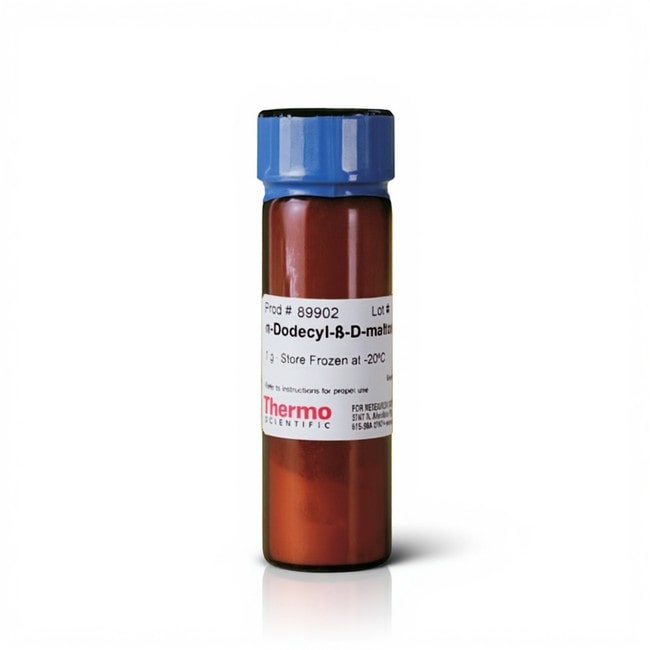


Thermo Scientific™ High-Purity Maltoside Detergents
Description
Maltoside detergents are a class of nonionic surfactants that are commonly utilized in the field of membrane protein solubilization. Several studies have shown that these surfactants are highly effective in extracting and stabilizing membrane proteins. Maltosides also aid in the purification and characterization of membrane proteins, facilitating downstream applications such as structural determination and functional analysis, making them an essential tool for researchers and scientists working in this area.
Features of maltoside detergents:
- Lipid-like nonionic detergent
- Especially useful for isolating and stabilizing hydrophobic membrane proteins
- Preserves activity of membrane protein better than most of the detergents
- High-purity compounds with low UV absorptivity
n-Dodecyl-β-D-Maltoside
n-Dodecyl-β-D-Maltoside (DDM) is especially useful for solubilizing membrane proteins to preserve their activity. This water-soluble nonionic detergent is most often used for the isolation of hydrophobic membrane proteins. Multiple studies have shown that n-dodecyl-β-D-maltoside is a gentle detergent that is often able to preserve protein activity better than many commonly used detergents, including NP-40, CHAPS, and octyl-β-glucoside.
Properties of DDM
- Aggregation number: 98 (average), 70 to 140 range
- Micelle molecular weight: 50,000 g
- CMC: 0.17 mM (0.009%, w/v) in water ; 0.12 mM (0.006%, w/v) in 0.2 M NaCl
DDM/CHS Solution
DDM/CHS Solution (10:1) is a ready-to-use solution for solubilization of membrane proteins while maintaining structural integrity and activity. The stable pre-formulated solution contains a mixture of dodecyl-β-D-maltoside (DDM) (100 mg/mL) and cholesteryl hemisuccinate (CHS) (10 mg/mL) in deionized water with final concentrations of 10% and 1%, respectively. Typical working concentrations are 1% DDM/0.1% CHS for protein extraction and 0.1% DDM/0.01% CHS for protein purification. The mixture of nonionic detergent, DDM, with dual hydrophobic/hydrophilic properties and anionic detergent, CHS, aid in the stabilization of large unilamellar vesicles and is suitable for protein solubilization and stabilization for single particle cryo-EM analysis.
Additional properties of CHS
- Molecular formula: C31H50O4 · C4H11NO3
- Molecular weight: 607.9 g/mol
- Detergent: ionizable anionic
- Function: stabilizes large unilamellar vesicles
Lauryl Maltose Neopentyl Glycol
Lauryl Maltose Neopentyl Glycol (LMNG) is an amphiphilic detergent ideally suited to improve solubilization of integral membrane proteins while maintaining structural integrity and activity.
LMNG has two linked hydrophobic chains of equal length and two hydrophilic maltoside groups to better mimic the integral membrane protein environment. Micelles are known to aid in solubilization of membrane proteins while preserving structure and function, including G-protein coupled receptors (GPCRs). LMNG is suitable for protein solubilization and stabilization for single particle cryo-EM analysis.
Properties of LMNG
- Chemical name: 2,2-didecylpropane-1,3-bis-β-D-maltopyranoside
- Molecular weight: 1005.19 g/mol
- CMC: (H2O) ∼ 0.01 mM, (0.001%)
- Purity: ≥98% all anomers (by HPLC analysis)
LMNG/CHS Solution
LMNG/CHS Solution (10:1) is a ready-to-use formulation for the solubilization of integral membrane proteins while maintaining structural integrity and activity. The stable pre-formulated solution contains a mixture of lauryl maltose neopentyl glycol (LMNG) (5%) and cholesteryl hemisuccinate (CHS) (0.5%) in deionized water. Typical working concentrations for protein extraction are 1% LMNG/0.1% CHS and 0.01% LMNG/0.001% CHS for protein purification and structure determination. LMNG/CHS micelles aid in solubilization of membrane proteins while preserving structure and function, including G-protein coupled receptors (GPCRs), and is suitable for protein solubilization and stabilization for single particle cryo-EM analysis.
n-Undecyl-β-D-Maltopyranoside
n-Undecyl-β-D-Maltopyranoside (UDM) has an undecyl (C11) alkyl chain attached to the maltose headgroup. The longer alkyl chain length of UDM contributes to its enhanced solubilization efficiency for certain membrane proteins. The increased hydrophobicity of the undecyl chain may facilitate stronger interactions with hydrophobic regions of membrane proteins, leading to improved solubilization and stabilization. The longer undecyl chain length in UDM may also result in a higher CMC compared to maltosides with shorter alkyl chains. This can affect the formation and stability of micelles in solution.
Properties of UDM
- CMC: (H2O) ~0.59 mM(1) (0.029%)
- Aggregation number: ~71 (100 mM NaCl, 20 mM HEPES pH 7.5)
- Purity: ≥99% β+α (by HPLC analysis)
n-Nonyl-Beta-Maltoside
n-Nonyl-Beta-Maltoside (NM) has a nonyl (C9) alkyl chain attached to the maltose headgroup. This specific chain length provides NM with distinct solubilization and stabilization properties compared to other maltosides with different alkyl chain lengths, such as octyl or decyl maltoside. The specific alkyl chain length of NM influences its micelle properties and contributes to a relatively low CMC. This property allows for the formation of stable micelles at lower concentrations, important for maintaining the stability and integrity of membrane proteins during solubilization and subsequent experiments.
Properties of NM
- CMC: (H2O) ~ 6 mM (0.28%)
- Aggregation number: ~55 (100 mM NaCl, 20 mM HEPES pH 7.5)
- Purity: ≥99% β+α (by HPLC analysis)
n-Octyl-β-D-Maltopyranoside
n-Octyl-β-D-Maltopyranoside (OM) has an octyl (C8) alkyl chain attached to the maltose headgroup. The specific alkyl chain length of OM sets it apart from other maltosides with different alkyl chain lengths, such as nonyl or decyl maltoside. The octyl chain length in OM contributes to a relatively low CMC, allowing for the formation of stable micelles at lower concentrations. This property is important for maintaining the stability and integrity of membrane proteins during solubilization and subsequent experiments. OM is versatile and finds applications in various areas of membrane protein research, protein crystallization, and biochemical studies. It can be used in a wide range of experimental conditions, buffer systems, and pH ranges. OM offers flexibility and compatibility with different experimental setups.
Properties of OM
- CMC: (100 mM NaCl, 20 mM HEPES pH 7.5) ~ 19.5 mM(1) (0.89%)
- Aggregation number: ~47 (100 mM NaCl, 20 mM HEPES pH 7.5)
- Purity: ≥99% β+α (by HPLC analysis)
Specifications
Specifications
| Product Type | Detergent |
| Content And Storage | Store below –20°C. |
| Form | Powder |
| Reagent Type | n-Dodecyl-β-D-Maltoside |
| Quantity | 1 g |
| Molecular Weight (g/mol) | 510.6 g/mol |
Frequently Asked Questions (FAQs)
Ionic detergents, or those that carry a charge, are the most likely to be denaturing to proteins. Denaturing detergents can be anionic such as sodium dodecyl sulfate (SDS) or cationic such as ethyl trimethyl ammonium bromide. These detergents totally disrupt membranes and denature proteins by breaking protein-protein interactions through changes in the three-dimensional structure of the proteins. Nondenaturing detergents can be divided into nonionic detergents (i.e., Triton X-100), bile salts (i.e., cholate), and zwitterionic detergents (i.e., CHAPS).
Detergents are amphipathic molecules containing both a nonpolar “tail” having aliphatic or aromatic character, and a polar “head”. The ionic character of the polar head group forms the basis for broad classification of detergents as ionic, nonionic, or zwitterionic.
Detergents are amphipathic molecules, meaning they contain both a nonpolar “tail” having aliphatic or aromatic character and a polar “head”. Like the components of biological membranes, detergents have hydrophobic-associating properties as a result of their nonpolar tail groups. Nevertheless, detergents are themselves water soluble.
Consequently, detergent molecules allow the dispersion (miscibility) of water-insoluble, hydrophobic compounds into aqueous media, including the extraction and solubilization of membrane proteins. Detergent monomers solubilize membrane proteins by partitioning into the membrane bilayer. With increasing amounts of detergents, membranes undergo various stages of solubilization.
Detergents can be denaturing or non-denaturing with respect to protein structure. Denaturing detergents can be anionic such as sodium dodecyl sulfate (SDS) or cationic such as ethyl trimethyl ammonium bromide. These detergents totally disrupt membranes and denature proteins by breaking proteinprotein interaction. These detergents are considered harsh. Non-denaturing detergents can be divided into nonionic detergents (i.e., Triton X-100), bile salts (i.e., cholate), and zwitterionic detergents (i.e., CHAPS). These detergents do not denature proteins and do not break protein-protein interactions. These detergents are considered mild.
Cell lysis is the first step in cell fractionation, organelle isolation, and protein extraction and purification. As such, cell lysis opens the door to a myriad of proteomics research methods. Many techniques have been developed and used to obtain the best possible yield and purity for different species of organisms, sample types (cells or tissue), and target molecule or subcellular structure. Subcellular fractionation and protein enrichment are important methods in the rapidly growing field of proteomics. Isolation of subcellular fractions and concentration of proteins in low abundance allow for more efficient identification and study of proteins of interest. Examples are the isolation of integral membrane proteins and nuclear proteins.
For Research Use Only.