Learn More
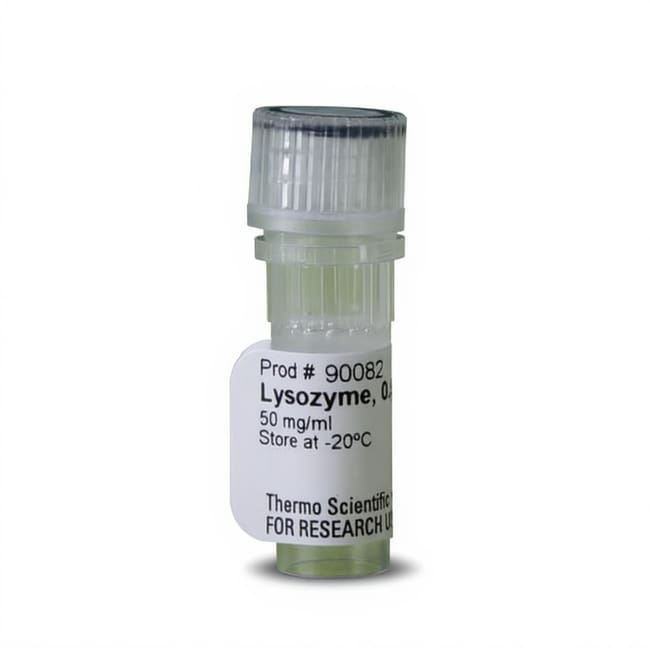
Thermo Scientific™ Lysozyme Solution (50 mg/mL)
Description
Thermo Scientific™ Lysozyme is an enzyme characterized by the ability to break down the bacterial cell wall to improve protein or nucleic acid extraction efficiency.
Additional Information and Online Ordering
Highlights:
- Bacterial cell wall lytic enzyme that improves inclusion body protein purification
- Compatible with Thermo Scientific Pierce Cell Lysis Reagents
- Available in two convenient formats: lyophilized powder for large volume applications (Part No. 89833) and convenient glycerol freezer stock (Part No. 90082)
Properties of lysozyme:
- Enzymatic function: Catalyzes the hydrolysis of 1,4-β-linkages between N-acetylmuramic acid and N-acetyl-D-glucosamine residues in peptidoglycans and between N-acetyl-D-glucosamine residues in chitodextrins
- Molecular weight: 14.388 kDa
- Extinction coefficient: ∽26.4 at 280nm
- Isoelectric point: pH 11.0
- Unit definition: 1 unit is that amount of enzyme needed to catalyze a decrease in absorbance at 450nm of 0.001/min at 25 degrees at pH 6.24 in a 1cm cuvette due to lysis using a ∼0.25mg/mL suspension of Micrococcus luteus.
Compatible with:
Thermo Scientific B-PER Bacterial Protein Extraction Reagent (Part No. 78248)
Specifications
Specifications
| Product Type | Cell Lysis Enzyme |
| Content And Storage | Store below -20°C |
| Form | Liquid |
| Reagent Type | Enzyme for Cell Lysis |
| Enzyme | Lysozyme (Muramidase) |
| Quantity | 0.5 mL |
Frequently Asked Questions (FAQs)
The Thermo Scientific BCA Protein Assay Kit (Cat. No. 23225, 23227) works very well to detect proteins extracted with B-PER Reagent. The Coomassie Plus Protein Assay (Cat. No. 23236) can be used with B-PER Reagent Protein extractions, however when using B-PER with PBS or B-PER II reagents, dilute the protein preparation two-to-four fold before assaying with Coomassie Plus or Prepare sample with Compat-Able Protein Assay Preparation Reagent Set (Cat. No. 23215). Finally, Thermo Scientific 660 nm Assay Kit (Cat. No. 22662) can also be used if protein extract is diluted two fold.
Add 1-2 µL of 50 mg/mL Lysozyme Solution (Cat. No. 90082) to 200 µL of the EasyPep lysis buffer provided in the kit and proceed with the sample prep. Add 200 µL of the prepared lysis solution to 5 X 10E8 bacterial cells (E. coli cells) (OD600 equal to 1, corresponding to 1 X 10E8 CFUs). Lyse by pipetting the sample repeatedly and centrifuge at 16,000 x g for 5 mins. Alternatively, E. coli cells can be lysed in lysis buffer using bead beating or sonication instead of lysozyme. After lysis, dilute samples to 1 mg/mL using lysis buffer, proceed with the EasyPep protocol for reduction, alkylation, digestion, and clean up as described in the product manual.
The B-PER Reagent solution contains a proprietary, mild, non-ionic detergent in 20 mM Tris-HCl, pH 7.5. It effectively disrupts cells and solubilizes native or recombinant proteins without denaturation. The reagent creates holes in the cell membrane that will leak out cytosolic proteins. The sample may become very viscous when the bacterial chromosome is released. We recommend adding DNAse I (Cat. No. 90083) to the reagent to reduce viscosity. For better lysis efficiency and if there are inclusion bodies, we recommend adding Lysozyme (Cat. No. 90082) to the reagent. Alternatively, you may purchase the B-PER Bacterial Protein Extraction Reagent with Enzymes Kit (Cat. No. 90078 or 90079) that includes the B-PER Bacterial Protein Extraction Reagent, DNase I, and Lysozyme.
For Research Use Only. Not for use in diagnostic procedures.