missing translation for 'onlineSavingsMsg'
Learn More

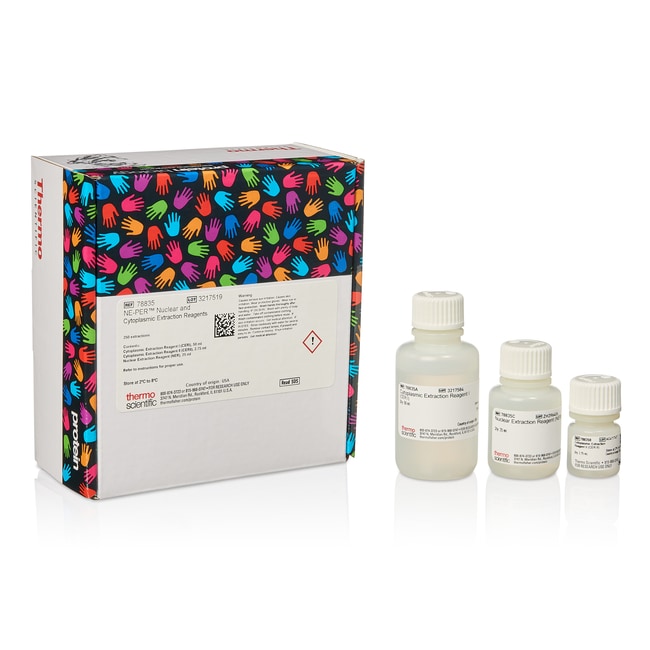
Thermo Scientific™ NE-PER™ Nuclear and Cytoplasmic Extraction Reagents

Catalog No. PI78835
Change view
Click to view available options
Quantity:
15 mL
75 mL
2 product options available for selection
Product selection table with 2 available options. Use arrow keys to navigate and Enter or Space to select.
Catalog No. Quantity
PI78835 75 mL
PI78833 15 mL
Use arrow keys to navigate between rows. Press Enter or Space to select a product option. 2 options available.
2 options
Catalog No. PI78835 Supplier Thermo Scientific™ Supplier No. 78835
Only null left

Efficiently lyse cells and extract separate cytoplasmic and nuclear protein fractions in less than two hours with this subcellular fractionation kit.

Thermo Scientific™ NE-PER Nuclear and Cytoplasmic Extraction Kit provides for efficient cell lysis and extraction of separate cytoplasmic and nuclear protein fractions in less than two hours.

The NE-PER Kit is a nuclear protein extraction method that involves simple, stepwise lysis of cells and centrifugal isolation of nuclear and cytoplasmic protein fractions. A benchtop microcentrifuge, tubes and pipettors are the only tools required. The NE-PER Reagents efficiently solubilize and separate cytoplasmic and nuclear proteins into fractions with minimal cross-contamination or interference from genomic DNA and mRNA. Once desalted or diluted, the isolated proteins can be used to perform immunoassays and protein interaction experiments, such as mobility shift assays (EMSA), co-immunoprecipitation (Co-IP) and pull-down assays.

Highlights:

  • Fast – obtain nuclear and cytoplasmic fractions in less than two hours
  • Proven – the NE-PER Kit is referenced in more than 950 distinct publications
  • Scalable – two kit sizes for producing extracts from cells and tissues
  • Convenient – simple instructions do not require ultracentrifugation over gradients
  • Compatible – use for downstream assays, including Western blotting, gel-shift assays, protein assays, reporter gene assays and enzyme activity assays

Includes:

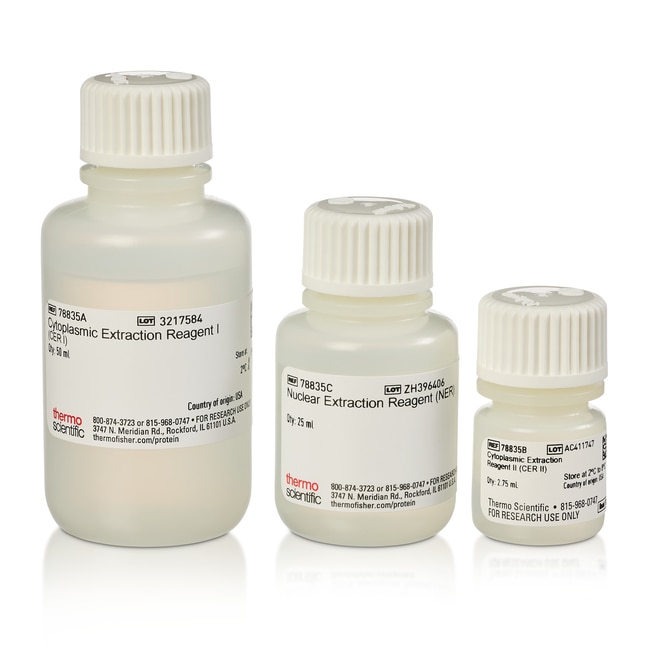
Two kit sizes, each containing three buffer and detergent solutions

Compatible with:

Thermo Scientific LightShift Chemiluminescent EMSA Kit (Mfr. No. 20148)

Storage Requirements:

Upon receipt store kit components at 4°C

Specifications

Product Type Nuclear and Cytoplasmic Extraction Reagent
Content And Storage Upon receipt store kit components at 4°C. Product is shipped at ambient temperature.
Shipping Condition Ambient
Form Liquid
Product Line NE-PER
Buffer Lysis Buffer
Reagent Type Cell Lysis Buffer, Detergent Solution, Subcellular Fractionation
Quantity 75 mL
How long does it take to complete the NE-PER Extraction reagents protocol?

Nuclear and cytoplasmic proteins can be isolated within 2 hours.

After protein extraction using the NE-PER Extraction reagents, where is the genomic DNA located?

After extracting the nuclear proteins using the NER Reagent, genomic DNA will be located in the pellet.

Are there any considerations when adding protease inhibitors to the CER I and NER Reagents?

EDTA-free Halt Protease and/or Phosphatase Inhibitor Cocktails (e.g., Cat. No. 78425) can be added to CER I and NER reagents. Most commercially available protease inhibitor cocktails are also compatible; however, avoid protease inhibitors that contain alcohols. Because the concentration of the CER I and NER Reagents are critical, do not dilute these reagents by more than 5% when adding protease inhibitors.

Have the NE-PER Reagents been tested with plant tissue or yeast cells?

No. Also, nuclear protein was not successfully isolated from yeast cells that were pre-lysed with Y-PER Yeast Protein Extraction Reagent.

Is the final soluble nuclear fraction dialyzable when using the NE-PER Extraction reagents?

Yes. The nuclear fraction can be dialyzed in a Slide-A-Lyzer MINI Dialysis Unit (Cat. No. 69550) against a buffer, such as PBS, that is compatible with the specific downstream application. A buffer exchange can also be performed using the Thermo Scientific Protein Desalting Spin Columns (Cat. No. 89849) or Zeba Desalt Spin Columns (Cat. No. 89882).

Can I use frozen cells or tissues with the NE-PER Extraction reagents?

Freezing and thawing will prematurely rupture cellular membranes and lead to high cross-contamination between the nuclear and cytoplasmic fractions.

Can I use the NE-PER Reagents for both adherent and suspension cells?

Yes. The kit was optimized for a packed-cell volume; therefore, adherent cells require harvesting, either by scraping or trypsinization, from the culture flask for maximum recovery.

Which tissues and cell types have been used with the NE-PER Reagents?

We have extracted soluble nuclear proteins from calf liver tissue and cultured epithelial, fibroid, kidney, liver and brain cells. Many references have cited the use of various other cells and tissues with the NE-PER Reagents.

How much protein can I expect to recover from the nuclear and cytoplasmic fraction when using the NE-PER Extraction reagents?

The total amount of protein recovered will vary with different sample types. Some examples are listed in the table below:

Cell/Tissue Type, Cytoplasmic Protein, Nuclear Protein
100 mg of liver tissue, 3 to 4 mg, 1 to 1.5 mg
10^6 HeLa cells, 300 to 400 µg, 40 to 60 µg
10^6 monocytes, N/A, 0.15 to 0.25 µg

How can I minimize cross-contamination of proteins between the nuclear and cytoplasmic fractions when using the NE-PER Extraction reagents?

Typically, cross-contamination between the nuclear and cytoplasmic fraction is 10% or less when using this kit. Careful pipetting and performing the incubation and centrifugation as indicated in the instructions will minimize cross-contamination. Performing an additional wash of the nuclear pellet with phosphate buffer before adding the NER Reagent will reduce carryover of the cytoplasmic proteins to the nuclear protein fraction.

How can I determine the separation efficiency between the cytoplasmic and nuclear fractions when using the NE-PER Extraction reagents?

Cross-contamination of the nuclear fraction by cytoplasmic proteins can be determined by probing for a protein known to reside only in the cytoplasm, such as a heat shock protein 90 (Hsp90), b-galactosidase or protein kinase C. Determine contamination of the cytoplasmic fraction by probing for Oct-1 or p53 nuclear proteins in the cytoplasmic fraction.

Which downstream applications can I perform after protein extraction using the NE-PER Extraction reagents?

The following applications were successfully used with protein extracted using the NE-PER Reagents: electrophoretic mobility shift assay (EMSA), Western blotting, reporter assays, isoelectric focusing (IEF) and immunoprecipitation.

How do the NE-PER Reagents fractionate cellular proteins?

The CER I Reagent induces swelling of the cell causing stress on the cellular membrane. The CER II reagent gently lyses the cell membrane allowing cytoplasmic proteins to be collected, while leaving the nucleus intact. The NER Reagent is then used to extract nuclear proteins from the pellet.

Can I use NE-PER Nuclear and Cytoplasmic Extraction Reagents (Cat. No. 78833, 78835) with FFPE samples?

We do not recommend using NE-PER Nuclear and Cytoplasmic Extraction Reagents (Cat. No. 78833, 78835) with FFPE samples. The extraction process with this product relies on the ability to separate nuclei from the rest of the cell/tissue components and then salt-extract proteins through the nuclear pores to get a ''nuclear protein fraction''. With fixed FFPE samples, this product would not be able to isolate nuclei and/or extract proteins. In addition, reversion of formalin crosslinks in FFPE samples does not guarantee that the integrity of the nuclear membrane and therefore, the compartmentalization of the proteins will be maintained.

Can I use NE-PER Nuclear and Cytoplasmic Extraction Reagents (Cat. No. 78833, 78835) for the extraction and fractionation of nucleic acids?

We have not performed any in-house testing for use of NE-PER Nuclear and Cytoplasmic Extraction Reagents (Cat. No. 78833, 78835) for the extraction and fractionation of nucleic acids. However, it is possible that it may work for this application. Please note that this product is not guaranteed to be RNase or DNase free so, you would need to use RNase inhibitors.

Which nuclear and cytoplasmic markers are suggested as positive and negative controls for NE-PER Nuclear and Cytoplasmic Extraction Reagents (Cat. No. 78833, 78835)?

Our R&D team has used p53, Ran, MCM2, MSH2, and/or TOPO II beta as markers for the nuclear fraction. On the other hand, GADPH, HSP90 or MEK1 can be used as markers for the cytoplasmic fraction. Bear in mind that protein expression might slightly vary between tissues and/or biological conditions. In addition, some common nuclear markers (DDX3, HDAC1 or H3) or cytoplasmic markers (GSK3 beta, HfkB P65) can also be found to some extent in the opposite fraction.

In what fraction are the cytoplasmatic proteins after using NE-PER Nuclear and Cytoplasmic Extraction Reagents?

This has not been tested.

What fraction should I expect lysosome and mitochondria proteins to show up in, when extractions are performed using NE-PER Nuclear and Cytoplasmic Extraction Reagents (Cat. No. 78835)?

Internal tests with Cox iV, a mitochondrial membrane protein, showed that almost all lysosome and mitochondrial proteins, extracted with NE-PER Nuclear and Cytoplasmic Extraction Reagents (Cat. 78835), were found in the cytosolic fraction, and minimal amount were found in the nuclear fraction when compared to other nuclear/cytoplasmic reagents. There are high density and low-density mitochondria, so we typically see some mitochondria marker proteins in both fractions, but the majority is in the cytoplasmic fraction.

What kits do you offer for cell fractionation?

We offer the following kits for cell fractionation:

Mem-PER Plus Membrane Protein Extraction Kit, Cat. No. 89842
NE-PER Nuclear and Cytoplasmic Extraction Reagents, Cat. No. 78835
Subcellular Protein Fractionation Kit for Cultured Cells, Cat. No. 78840
Subcellular Protein Fractionation Kit for Tissues, Cat. No. 87790
Mitochondrial Isolation Kit for Cultured Cells, Cat. No. 89874
Mitochondrial Isolation kit for Tissue, Cat. No. 89801
Lysosome Enrichment Kit for Tissues and Cultured Cells, Cat. No. 89839

Why is cell fractionation important?

Isolation of subcellular fractions and concentration of low-abundantce proteins allows for more efficient identification and study of the proteins of interest.


For Research Use Only. Not for use in diagnostic procedures.