Learn More
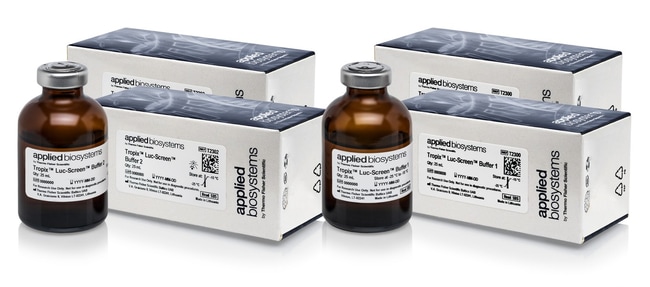
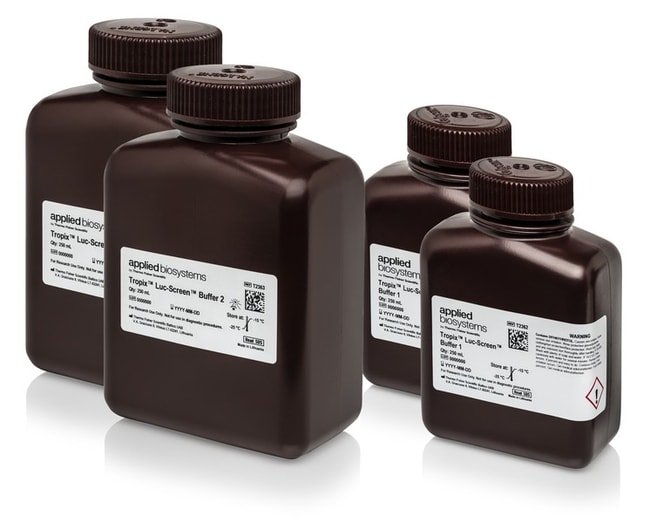
Invitrogen™ Luc-Screen™ Extended-Glow Luciferase Reporter Gene Assay System

Description
Includes
Two reaction buffers
Thermo Scientific Luc-Screen Extended-Glow Luciferase Reporter Gene Assay System with extended-glow light emission is designed for sensitive detection of firefly luciferase reporter enzyme in microplate cell cultures. A linear signal is obtained with the
The Luc-Screen™ assay system with extended-glow light emission is designed for sensitive detection of firefly luciferase reporter enzyme in microplate cell cultures. A linear signal is obtained with the Luc-Screen™ assay from 50 fg to 100 ng of pure enzyme in culture medium.
- Homogeneous assay format allows detection of firefly luciferase in the presence of normal culture media without removal of media and without an additional cell lysis step, providing the easiest and most streamlined assay procedure possible.
- The glow assay kinetics provides a 'window' during which measurements may be performed, facilitating HTS applications where assay automation is used.
- Wide dynamic range of firefly luciferase assay lets the user measure enzyme level accurately from femtogram to nanogram range.
- Assay sensitivity is 100- to 1,000-fold better than with either the isotopic/non-isotopic assays for chloramphenicol acetyl transferase (CAT) or the colorimetric/fluorescent assays for b-galactosidase, providing greater sensitivity than competing assay technologies.
- Highly sensitive assay with a wide dynamic range permits detection of high and low levels of reporter without performing numerous sample dilutions.
- Non-radioactive reporter gene assay kit eliminates radioisotopes.
- Assay can be completed in about one hour, providing fast assay turnaround.
Sensitive
Luciferase is an ideal reporter because of the high sensitivity of detection and the absence of endogenous luciferase activity in mammalian cells. The Luc-Screen™ assay conveniently couples in-well cell lysis in the presence of culture medium with a high sensitivity assay that exhibits extended-glow light emission kinetics. Light signal can be measured between 10 minutes and several hours after adding assay reagents, providing great flexibility in the time between reagent addition and measurement.
High Throughput
The Luc-Screen™ system is designed for maximum assay flexibility in a high throughput format and can be used in luminometers without automatic injectors. The Luc-Screen™ system is formulated to provide a convenient, easy-to-use luciferase assay that is optimized for use in high-throughput screening. The high sensitivity of the Luc-Screen™ assay is accompanied by a wide dynamic range.
For Research Use Only. Not for use in diagnostics procedures.
Specifications
Specifications
| Product Type | Luciferase Reporter Gene Assay System |
| Detection Method | Chemiluminescence |
| For Use With (Equipment) | Luminometer (Microplate) |
| Assay | Luciferase Assay |
| Content And Storage | This kit contains two reaction buffers. Store the product at -20°C. |
| Compatible Cells | Mammalian Cells |
| High-throughput Compatibility | High-throughput Compatible |
| Readout | End Point |
| Sample Type | Cell Cultures |
| Substrate | Luciferin |
| Show More |
Frequently Asked Questions (FAQs)
For Fetal Bovine Serum (FBS), there is no difference between 10% and 5% FBS. It is worthwhile to note that the type of serum does affect the luciferase assay. We tested the effect of 6 different types of sera (FBS, heat-inactivated FBS, dialyzed FBS, charcoal-treated FBS, donor adult bovine serum, and donor equine serum) on secreted luciferases, e.g. Gaussia, Gaussia-Dura, and Cypridina Luciferases. No noticeable difference was observed among different types of sera except for donor adult bovine serum. Unknown factors in donor adult bovine serum caused up to 35% inhibition in secreted luciferase activity. Therefore, we don’t recommend using donor adult bovine serum for Gaussia, Gaussia-Dura, and Cypridina Luciferases.
The problems with white plates are related to cross-talk blocking, surface reflectivity and tendency to phosphorescence. We do not recommend using white plates because they give much higher background even if adapted to darkness for 10 minutes. The white plastic does not block the light completely, and some portion of the signal will go through the plastic and will be seen when you measure adjacent wells. The typical situation is if you change from black to white plates, where the background is about doubled and the signal is increased about 10 times. Black plates are recommend for best signal to noise ratio even though the RLU values will be lower.
Gaussia, Gaussia-Dura, and Cypridina Luciferase are stable in the culture media for greater than 24 hours. Generally, after transfection of CMV driven constructs, we see ever increasing secreted signal between 24 and 72 hours.
The earliest detectable signal will depend on the strength of the promoter. In general, with a strong promoter (such as CMV), significant signal over background can be seen in as little as 20 minutes. However, with a weaker inducible promoter, significant signal over background may take 1-2 hours after induction.
We always recommend the luciferases to be read without filters for single luciferase assays. Use of filters reduces the amount of signal captured that may lead to decrease in sensitivity. Filters are required only for dual-spectral assays.
For Research Use Only. Not for use in diagnostic procedures.