Learn More
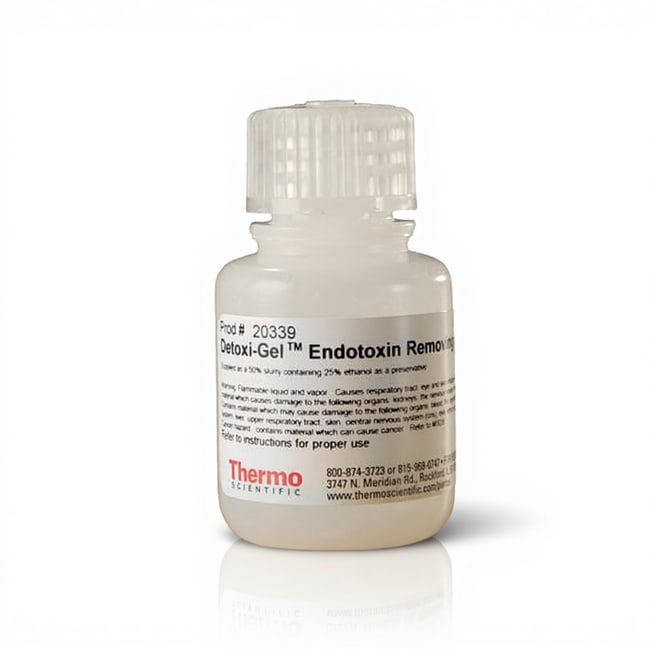


Thermo Scientific™ Detoxi-Gel™ Endotoxin Removing Gel
Description
Thermo Scientific™ Detoxi-Gel Endotoxin Removing Gel and Columns provide a quick method to remove endotoxins (lipopolysaccharides or LPS) from samples.
Highlights:
Affinity-based – uses immobilized polymixin B to remove endotoxins by binding to their lipid A domains
High capacity – 1mL of Detoxi-Gel Resin removes at least 9995 endotoxin units from a 5mL sample containing 10,000 EU of lipopolysaccharide (LPS)
Reusable – no loss in binding capacity even after 10 regenerations; requires activation and regeneration with 1% sodium deoxycholate (Part No. 89904)
Testing required – protein recovery is dependent upon protein type and concentration; empirical testing is required to validate the method for particular protein samples
Versatile – remove endotoxin from protein solutions, cell culture media and pharmacological components
Requires:
Sodium deoxycholate (Part No. 89904) for resin activation and regeneration.
Specifications
Specifications
| Capacity (Metric) | 4000 to 6000 EU Binding per mL Gel |
| Content And Storage | Store at 4°C. |
| Form | Liquid |
| Product Line | Detoxi-Gel |
| Quantity | 10 mL |
| Target | Endotoxin Removal |
| Type | Endotoxin Removing Gel |
| Stationary Phase | Polymixin B |
| Sufficient For | 1 mL of gel binds 4000-6000 EU |
| Format | Bottle |
| Show More |
Frequently Asked Questions (FAQs)
It is possible that the column may have been contaminated with endotoxin during storage and handling. Equilibrating the column with 1% sodium deoxycholate followed by pyrogen-free washing ensures that the column is free of endotoxin before the sample is added. The column must be regenerated following endotoxin removal from a sample to make sure the endotoxin that has bound to the column from the sample is washed off.
The Thermo Scientific 1 mL Detoxi-Gel Column has a void volume of 0.3-0.5 mL. This is the volume of solution that must be collected from the column before the sample will begin to come off the column.
1. Equilibrate the column with 5 column volumes of 1% sodium deoxycholate in pyrogen-free water, followed by 3 column volumes of pyrogen-free water or buffer of choice.
2. Apply sample, being sure not to exceed the binding capacity of the gel.
3. Collect sample by gravity flow by applying additional pyrogen-free water or buffer.
4. Regenerate the column with 5 column volumes of 1% sodium deoxycholate in pyrogen-free water, followed by 3 column volumes of pyrogen-free water.
Detoxi-Gel Support has the capacity to bind up to 2µg LPS/mL of gel. Because one endotoxin unit (EU) is approximately 0.1 ng/mL, the gel has the potential for binding up to 20,000 EU/mL of gel.
Detoxi-Gel Support consists of 6% cross-linked beaded agarose that has Polymixin B immobilized onto it. Polymixin B is an antibiotic that contains a cationic cyclopeptide with a fatty acid chain that can neutralize the biological activity of endotoxins by binding to the lipid A portion of the bacterial lipopolysacharide (LPS). After the endotoxin from a sample binds to the immobilized Polymixin B, the sample can be collected and the endotoxin can be eluted using 1% sodium deoxycholate.
For Research Use Only. Not for use in diagnostic procedures.