missing translation for 'onlineSavingsMsg'
Learn More
Learn More
Invitrogen™ Axl Monoclonal Antibody (DS7HAXL), Brilliant Violet™ 421, eBioscience™
Mouse Monoclonal Antibody
$590.92 - $1251.17
Specifications
| Antigen | Axl |
|---|---|
| Clone | DS7HAXL |
| Concentration | 5 μL/Test |
| Content And Storage | 4°C, store in dark, DO NOT FREEZE! |
| Applications | Flow Cytometry |
| Catalog Number | Mfr. No. | Quantity | Price | Quantity | |||||
|---|---|---|---|---|---|---|---|---|---|
| Catalog Number | Mfr. No. | Quantity | Price | Quantity | |||||
|
40-410-8741
|
Invitrogen™
404108741 |
25 Tests |
Each for $590.92
|
|
|||||
|
40-410-8742
|
Invitrogen™
404108742 |
100 Tests |
Each for $1,251.17
|
|
|||||
Description
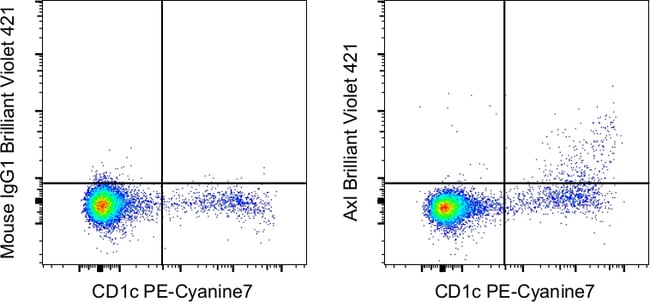
Description This DS7HAXL monoclonal antibody recognizes human Axl, a member of the TAM family of tyrosine kinase receptors that also includes MerTK and Tyro3. This DS7HAXL antibody will work in flow cytometry on both native and paraformaldehyde-fixed cells. It has also been shown to stain formalin-fixed, paraffin-embedded tissues for IHC analysis. Applications Tested This DS7HAXL antibody has been pre-diluted and tested by flow cytometric analysis of normal human peripheral blood cells. This may be used at 5 μL (0.125 μg) per test. A test is defined as the amount (μg) of antibody that will stain a cell sample in a final volume of 100 μL. Cell number should be determined empirically but can range from 10^5 to 10^8 cells/test. Blocking Buffers When using two or more Super Bright, Brilliant Violet™, Brilliant Ultra Violet™, or other polymer dye-conjugated antibodies in a staining panel, it is recommended to use Super Bright Complete Staining Buffer (Product # SB-4401) or Brilliant Stain Buffer (Product # 00-4409-75) to minimize any non-specific polymer interactions. Please refer to the datasheet for Super Bright Staining Buffer or Brilliant Stain Buffer for more information. Fixation Samples can be stored in IC Fixation Buffer (Product # 00-8222) (100 μL of cell sample + 100 μL of IC Fixation Buffer) or 1-step Fix/Lyse...
AXL is a chronic myelogenous leukemia-associated oncogene that is also associated with colon cancer and melanoma. The AXL protein is a receptor tyrosine kinase that transduces signals from the extracellular matrix into the cytoplasm by binding growth factors like vitamin K-dependent protein growth-arrest-specific gene 6, and is involved in the stimulation of cell proliferation. TAM receptors are also involved in phagocytosis of apoptotic cells. Mice lacking all three TAM receptors have several degenerative phenotypes linked to inefficient removal of apoptotic cells and membranes (e.g., in the retina and the male reproductive tract) and develop a severe autoimmune phenotype akin to systemic lupus erythematosus, including the production of broad spectrum auto-antibodies. In addition, Axl may function as a putative entry receptor for filoviruses. Axl is also used to identify a specific subpopulation of human blood dendritic cells, also referred to as Siglec 6+/Axl+ dendritic cells. Cellular expression of Axl can be upregulated by TLR ligands, such as LPS or poly I:C. Soluble Axl is generated by proteolytic cleavage of the membrane form. Increased plasma levels may be indicative of inflammation and cancer.Specifications
| Axl | |
| 5 μL/Test | |
| Flow Cytometry | |
| Brilliant Violet 421 | |
| Mouse | |
| RUO | |
| PBS with BSA and 0.09% sodium azide; pH 7.2 | |
| P30530 | |
| 558 | |
| Primary | |
| Affinity chromatography |
| DS7HAXL | |
| 4°C, store in dark, DO NOT FREEZE! | |
| Monoclonal | |
| Liquid | |
| IgG1 κ | |
| Human | |
| AXL | |
| Adhesion-related kinase; AI323647; ARK; AXL; AXL oncogene; AXL receptor tyrosine kinase; AXL transforming sequence/gene; AZF1; JTK11; oncogene AXL; sAXL; soluble AXL; Tyro7; Tyrosine-protein kinase receptor UFO; Ufo; ufo oncogene homolog | |
| AXL | |
| Antibody |