Learn More
Invitrogen™ Axl Monoclonal Antibody (DS7HAXL), Brilliant Violet™ 421, eBioscience™

Description
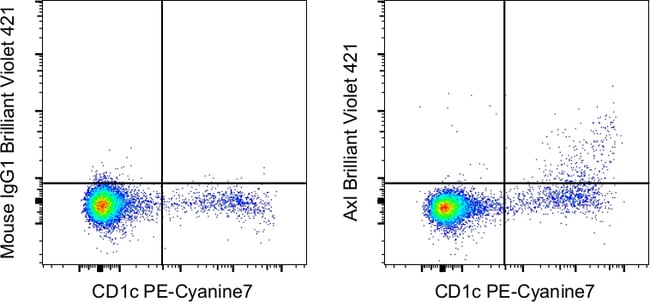
Description This DS7HAXL monoclonal antibody recognizes human Axl, a member of the TAM family of tyrosine kinase receptors that also includes MerTK and Tyro3. This DS7HAXL antibody will work in flow cytometry on both native and paraformaldehyde-fixed cells. It has also been shown to stain formalin-fixed, paraffin-embedded tissues for IHC analysis. Applications Tested This DS7HAXL antibody has been pre-diluted and tested by flow cytometric analysis of normal human peripheral blood cells. This may be used at 5 μL (0.125 μg) per test. A test is defined as the amount (μg) of antibody that will stain a cell sample in a final volume of 100 μL. Cell number should be determined empirically but can range from 10^5 to 10^8 cells/test. Blocking Buffers When using two or more Super Bright, Brilliant Violet™, Brilliant Ultra Violet™, or other polymer dye-conjugated antibodies in a staining panel, it is recommended to use Super Bright Complete Staining Buffer (Product # SB-4401) or Brilliant Stain Buffer (Product # 00-4409-75) to minimize any non-specific polymer interactions. Please refer to the datasheet for Super Bright Staining Buffer or Brilliant Stain Buffer for more information. Fixation Samples can be stored in IC Fixation Buffer (Product # 00-8222) (100 μL of cell sample + 100 μL of IC Fixation Buffer) or 1-step Fix/Lyse Solution (Product # 00-5333) for up to 3 days in the dark at 4°C with...
Specifications
Specifications
| Antigen | Axl |
| Applications | Flow Cytometry |
| Classification | Monoclonal |
| Clone | DS7HAXL |
| Concentration | 5 μL/Test |
| Conjugate | Brilliant Violet 421 |
| Formulation | PBS with BSA and 0.09% sodium azide; pH 7.2 |
| Gene | AXL |
| Gene Accession No. | P30530 |
| Gene Alias | Adhesion-related kinase; AI323647; ARK; AXL; AXL oncogene; AXL receptor tyrosine kinase; AXL transforming sequence/gene; AZF1; JTK11; oncogene AXL; sAXL; soluble AXL; Tyro7; Tyrosine-protein kinase receptor UFO; Ufo; ufo oncogene homolog |
| Show More |