Learn More




Applied Biosystems™ Path-ID™ Multiplex One-Step Kit

Description
Includes
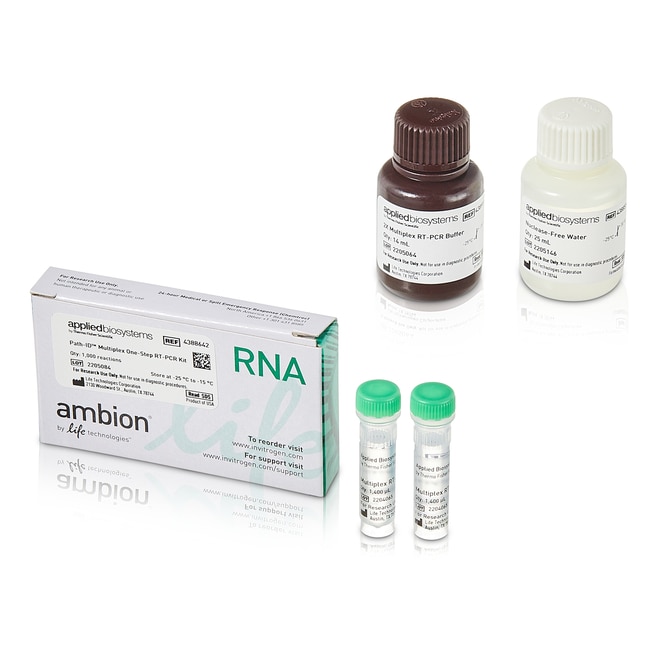
1.375mL of 2X Multiplex RT-PCR Buffer, 280μL of 10X Multiplex Enzyme Mix including AmpliTaq Gold and ArrayScript, 1.75mL of Nuclease-free water
It is optimized for the amplification of up to four targets simultaneously using your RNA samples and TaqMan™ primer/probe sets. Reactions are run using a single-tube, one-step procedure to reverse-transcribe the RNA and amplify your targets. The kit contains a Multiplex Enzyme Mix with ArrayScript™ reverse transcriptase and AmpliTaq Gold™ DNA Polymerase, and a buffer mix.
Multiplex One-Step Kit is optimized for amplification of up to four targets simultaneously using your RNA samples and TaqMan™ primer/probe sets. Reactions are run using a single-tube, one-step procedure to reverse-transcribe the RNA and amplify your targets. Kit contains a Multiplex Enzyme Mix with Arrayscript™ reverse transcriptase and AmpliTaq Gold™ DNA Polymerase, and a buffer mix.
Applications:
One-Step qRT-PCR, PCR & Real-Time PCR, Real Time PCR (qPCR)
Order Info
Built-In Hot Start. Guaranteed minimum shelf life is 60 days.
Specifications
Specifications
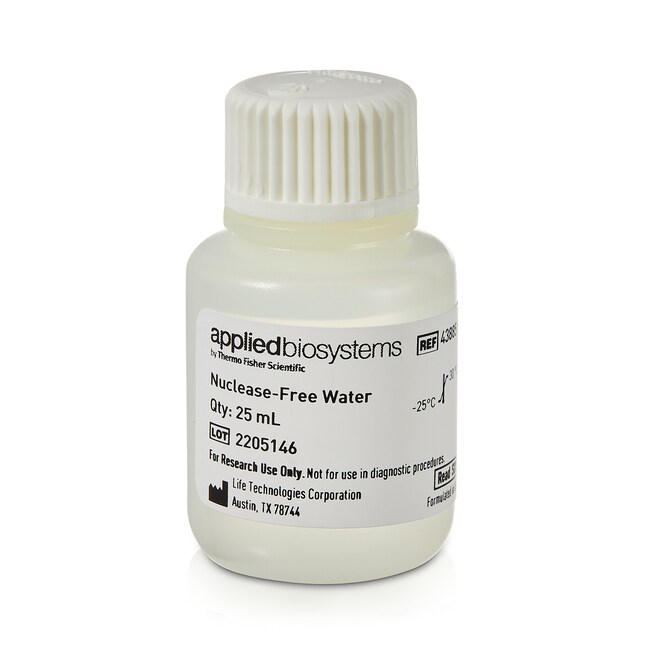
| Content And Storage | • 14 mL of 2X Multiplex RT-PCR Buffer • 2 x 1.4 mL of 10X Multiplex Enzyme Mix including AmpliTaq Gold and ArrayScript • 25 mL of Nuclease-free water • Store the kit at -20C; the Nuclease-free water may be stored at -20C, 4C, or room temperature Guaranteed minimum shelf life is 60 days (exact expiry date printed on product and CofA). |
| Detection Method | Primer-probe |
| Form | Liquid |
| Format | Tube(s) |
| PCR Method | 1-step RT-qPCR, Multiplex qPCR |
| Polymerase | AmpliTaq Gold DNA Polymerase |
| Reaction Speed | Standard |
| For Use With (Equipment) | 7000 System, 7300 System, 7500 Fast System, 7500 System, 7700 System, 7900HT System, AB 7900 HT 384-Well System, StepOne™, Standard Mode, StepOnePlus™, Standard Mode |
| Passive Reference Dye | ROX (Pre-mixed) |
| Product Line | Path-ID |
| Show More |
Frequently Asked Questions (FAQs)
If you are targeting a low-abundance gene, you may have trouble getting Ct values in a good, reliable range (Ct > 32). To increase the sensitivity of the assay, you may want to consider the following:
- Increase the amount of RNA input into your reverse transcription reaction, if possible
- Increase the amount of cDNA in your qPCR reaction (20% by volume max)
- Try a different reverse transcription kit, such as our SuperScript VILO Master Mix, for the highest cDNA yield possible
- Consider trying a one-step or Cells-to-CT type workflow (depending on your sample type)
Most times your instrument software can automatically set a proper baseline for your data. Check out our short video, Understanding Baselines, for more information on how to set them (https://www.youtube.com/watch?feature=player_embedded&v=5BjFAJHW-bE).
In most cases your instrument software can automatically set a proper threshold for your data. Check out our short video, Understanding Thresholds, for more information on how to set them (https://www.youtube.com/watch?feature=player_embedded&v=H_xsuRQIM9M).
There could be several reasons for no amplification from an assay or primer set. Please see these examples and suggested solutions in our Real-Time Troubleshooting Tool (https://www.thermofisher.com/us/en/home/life-science/pcr/real-time-pcr/qpcr-education/real-time-pcr-troubleshooting-tool/gene-expression-quantitation-troubleshooting/no-amplification.html) for more details.
There could be several reasons for amplification in a NTC well. Please see these examples and suggested solutions in our Real-Time Troubleshooting Tool (https://www.thermofisher.com/us/en/home/life-science/pcr/real-time-pcr/qpcr-education/real-time-pcr-troubleshooting-tool/gene-expression-quantitation-troubleshooting/amplification-no-template-control.html) for more details.
For Research Use Only. Not for use in diagnostic procedures.