Learn More
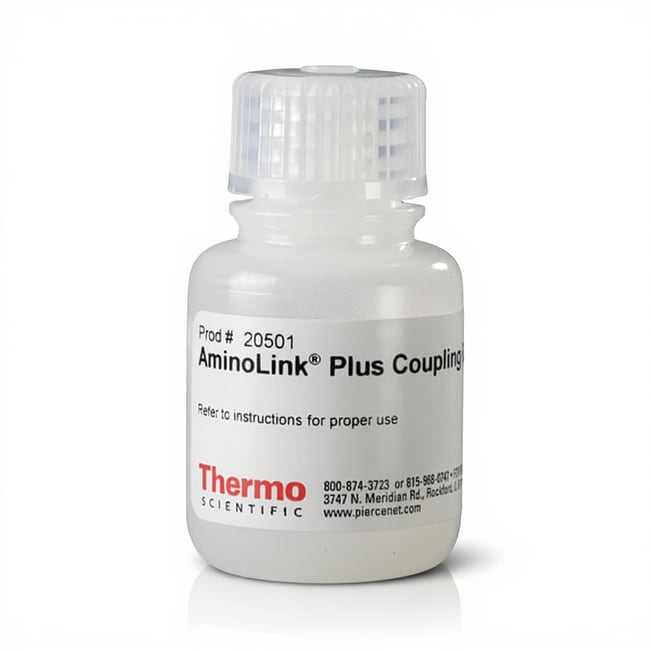


Thermo Scientific™ AminoLink™ Plus Coupling Resin
Description
Thermo Scientific™ AminoLink Plus Coupling Resin and Kits use aldehyde-activated agarose beads for high-yield covalent coupling of antibodies (proteins) via primary amines for preparation of affinity purification columns.
The AminoLink Plus Coupling Reaction involves spontaneous formation of Schiff base bonds between aldehydes (on the support) and amines (on the ligand) and their subsequent stabilization by incubation with a mild reductant (sodium cyanoborohydride). The entire coupling reaction, called reductive amination, occurs in 4 to 6 hours in simple non-amine buffers such as PBS. Coupling efficiency with antibodies and typical proteins is generally greater than 85%, resulting in 1 to 20mg of immobilized protein per milliliter of agarose beads.
Highlights:
AminoLink Plus Coupling Resin–aldehyde-activated crosslinked 4% beaded agarose
Ideal for antibodies and other proteins– immobilize molecules via primary amines (-NH2)
Flexible coupling conditions– efficient ( >85%) coupling over a wide range of pH (4-10) and buffer conditions (PBS or other non-amine buffer with or without organic solvent); regular (PBS, pH 7.2) and enhanced (borate, pH 10) coupling protocols provided
Stable, permanent immobilization – coupling reaction results in stable, leak-resistant secondary amine bond between resin and ligand
Better than immobilization to CNBr-activated agarose – bond is more stable and uncharged, resulting in less nonspecific binding in affinity purification procedures
Versatile and reusable – prepared affinity resin is adaptable to column and batch affinity techniques and the resin is reusable for typical applications based on protein binding interactions
Convenient kits and product sizes – choose 1- or 5-column kit containing complete sets of buffers, reagents and versatile spin/drip columns, or select bulk resin; bulk quantities available for manufacturing applications
Includes:
Kits contain AminoLink Plus Columns, neutral and enhanced coupling buffers (Part No. 44894 only), quenching buffer, wash solution, sodium cyanoborohydride solution, and column accessories
Specifications
Specifications
| Formulation | Aldehyde-activated 4% beaded agarose, slurried in water with sodium azide |
| Content And Storage | Store at 4°C. |
| Form | Liquid |
| Product Line | AminoLink |
| Quantity | 10 mL |
| Target | Antibody, Proteins through Primary Amine |
| Type | Resin |
| Stationary Phase | Aldehyde |
| Format | Bottle |
| Column Type | Affinity, Agarose Resin |
Frequently Asked Questions (FAQs)
AminoLink Coupling Resin can bind approximately 10 mg of IgG/mL of resin bed, while AminoLink Plus Resin can bind up to 15-20 mg of IgG/mL of resin bed. The upper limit for binding peptides is approximately 1 mg/mL of resin for both support types.
The AminoLink Plus Resin uses a type of agarose that has better flow properties, which may shorten the time needed for drip-column methods. It is also activated at a higher level, allowing greater ligand to be immobilized.
Coupling reactions with AminoLink Resins are compatible with 3-4 M fresh urea or guanidine. (However, old solutions of urea may contain ammonia, which will interfere with ligand immobilization.) Alternatively, dissolve the peptide in 100% DMSO. Add the peptide in DMSO to coupling buffer so that the DMSO does not exceed 20% of the final solution.
Columns can be reused at least 10 times without loss of activity.
The immobilizatoin reaction takes six hours; the entire procedure may require seven to eight hours. This time can be decreased if the high pH protocol for AminoLink Plus Resin is used.
For Research Use Only. Not for use in diagnostic procedures.