Learn More
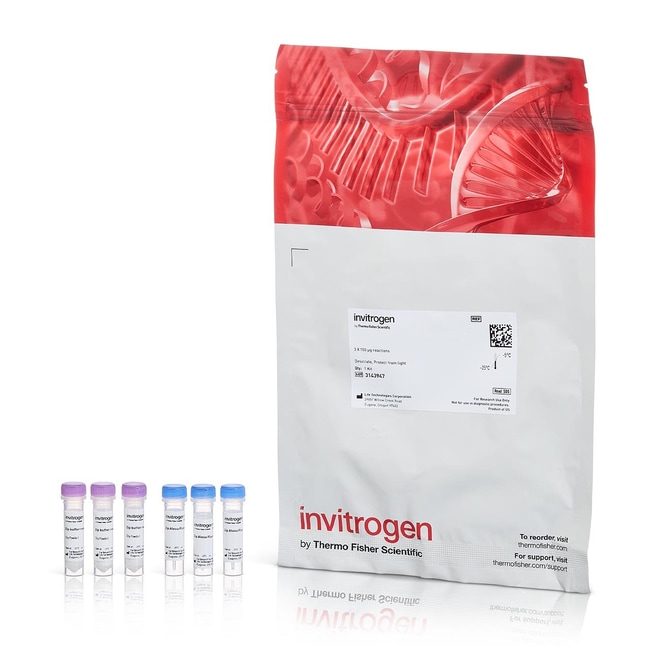
Invitrogen™ Zip Alexa Fluor™ Rapid Antibody Labeling Kits

Description
Invitrogen Zip Alexa Fluor Rapid Antibody Labeling kits allow you to efficiently and quickly label your precious antibody with Alexa Flour dyes to create an antibody conjugate that is ready to use within 15 minutes with 100% recovery. Each kit contains everything needed for three separate labeling reactions of 100 μg of antibody. Simply add 1 mL water to component A containing Zip buffer, add 100 μg of antibody, incubate for 15 minutes, and your antibody is ready to use. Conjugates are ideal for multiple applications, including flow cytometry, fluorescent microscopy, immunohistochemistry (IHC), primary detection, ELISAs, immunocytochemistry (ICC), and indirect FISH.
Create ready-to-use antibody conjugate in just 15 minutes with our Invitrogen Zip Alexa Fluor Rapid Antibody Labeling kits. These kits enable you to efficiently label your precious antibody with various Alexa Flour dyes.
Important features of Zip Alexa Fluor Rapid Antibody Labeling kits:
- Speed—antibody conjugates ready to use in 15 min
- Efficiency—100% antibody recovery
- Versatility—kits are useful for a wide range of applications
- Easy-to-use—no chemistry or conjugation experience needed
- Flexibility—choose from Alexa 488, 555, and 647
Each kit contains everything you need to perform three separate labeling reactions of 100 μg of antibody. Conjugates are ideal for multiple applications, including flow cytometry, fluorescent microscopy, immunohistochemistry (IHC), primary detection, ELISA, immunocytochemistry (ICC), and indirect FISH.
Benefits of using Zip Alexa Fluor Rapid Antibody Labeling kits:
Specificity and versatility
A primary antibody that is directly labeled with a fluorophore often produces lower background fluorescence and less nonspecific binding. Multiple primary antibodies of the same isotype or derived from the same species can be used in the same experiment if they are directly labeled with compatible fluorophores.
Robustness
Compared to traditional dyes, Alexa Fluor dyes are brighter, more photostable, and more pH resistant between pH 4 and 10. When using Alexa Fluor dyes, higher degrees of labeling can usually be achieved without intramolecular quenching.
Customization is possible
Can't find what you're looking for in our stocked list? We can prepare a custom antibody conjugate for you. Our custom conjugation service is efficient and confidential, and we stand by the quality of our work. We are ISO 13485:2000 certified.
Specifications
Specifications
| Product Type | Labeling Kit |
| Quantity | 3 Labelings |
| Content And Storage | Reactive fluorescent label (3 vials), sodium bicarbonate (3 vials). Store desiccated and protected from light in the freezer (-5°C to +30°C). |
| Excitation/Emission | 650/665 nm |
| Labeling Scale | 100 μg |
| Product Line | Alexa Fluor |
| Chemical Reactivity | Amine |
| Label or Dye | Alexa Fluor 647 |
| Color | Far-Red |
| Labeling Target | IgG |
| Show More |
Frequently Asked Questions (FAQs)
No, it is intended for immediate use. If you wish to store your labeled antibody after the reaction, it should undergo a post-reaction clean-up using either size exclusion resin (such as Bio-Rad BioGel P-30) or Dye Removal Columns (Cat No. 22858).
This is because we have optimized the amount of dye to label 100 µg of antibody per reaction and after the incubation time of 15 mins, most of the reactive dye is either bound or unreactive due to spontaneous hydrolysis, leaving little or no reactive dye to label your sample.
Yes, the BSA and any component with a primary amine (such as the Tris buffer) would react with the amine-reactive Alexa Fluor dyes used in these labeling kits, resulting in less optimal labeling of the antibody. For small volume purification of the antibody, you may use either Nab Protein A/G Spin Kit, 0.2 mL (Cat No. 89950), Protein A/G Magnetic Agarose Beads (Cat No. 78609), or Melon Gel IgG Spin Purification Kit (Cat No. 45206).
The 1 mg/mL concentration of the antibody (100 µg of antibody in a 100 µL volume) allows for optimal reaction kinetics. A more dilute solution of antibody would exhibit suboptimal labeling due to a greater amount of reactive dye lost to spontaneous hydrolysis; the reactive group on the dyes is labile in aqueous solutions.
Each kit contains 3 vials of solid sodium bicarbonate (Zip buffer reagent, Component A), 3 vials of the Alexa Fluor reactive dye (Component B), and a Quick Reference Card. Sufficient reagents are provided to label 100 µg of antibody per reaction (100 µL of a 1 mg/mL antibody solution), 3 reactions per kit.