missing translation for 'onlineSavingsMsg'
Learn More
Learn More
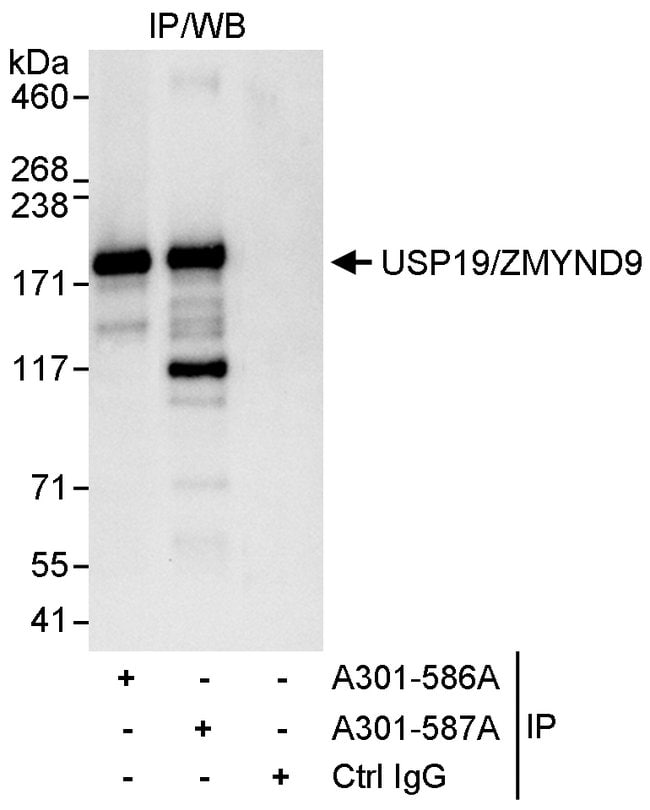
USP19/ZMYND9 Rabbit anti-Human, Polyclonal, Bethyl Laboratories

Description
The recommended shelf life for this product is 1 year from date of receipt.
Modification of target proteins by ubiquitin participates in a wide array of biological functions. Proteins destined for degradation or processing via the 26 S proteasome are coupled to multiple copies of ubiquitin. However, attachment of ubiquitin or ubiquitin-related molecules may also result in changes in subcellular distribution or modification of protein activity. An additional level of ubiquitin regulation, deubiquitination, is catalyzed by proteases called deubiquitinating enzymes, which fall into four distinct families. Ubiquitin C-terminal hydrolases, ubiquitin-specific processing proteases (USPs), 1 OTU-domain ubiquitin-aldehyde-binding proteins, and Jab1/Pad1/MPN-domain-containing metallo-enzymes. Among these four families, USPs represent the most widespread and represented deubiquitinating enzymes across evolution. USPs tend to release ubiquitin from a conjugated protein. They display similar catalytic domains containing conserved Cys and His boxes but divergent N-terminal and occasionally C-terminal extensions, which are thought to function in substrate recognition, subcellular localization, and protein-protein interactions.
Specifications
Specifications
| Antigen | USP19/ZMYND9 |
| Applications | Immunoprecipitation |
| Classification | Polyclonal |
| Concentration | 1 mg/ml |
| Conjugate | Unconjugated |
| Formulation | phosphate, tris citrate with 0.09% sodium azide; pH 7-8 |
| Gene | USP19 |
| Gene Accession No. | O94966 |
| Gene Alias | deubiquitinating enzyme 19, KIAA0891, ubiquitin specific protease 19, ubiquitin thioesterase 19, ubiquitin thiolesterase 19, ubiquitin-specific-processing protease 19, zinc finger MYND domain-containing protein 9, ZMYND9 |
| Gene Symbols | USP19 |
| Show More |