Learn More
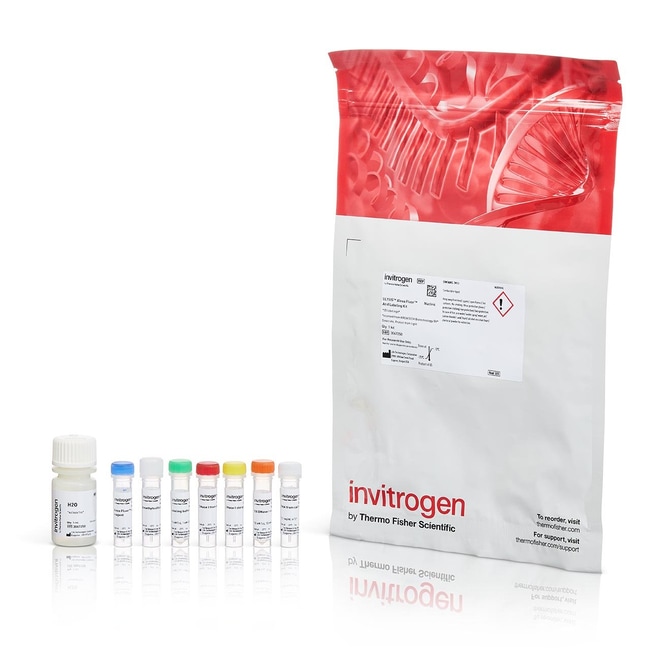
Invitrogen™ ULYSIS™ Alexa Fluor™ Nucleic Acid Labeling Kit

Description
ULYSIS nucleic acid labeling kits provide a unique method for attaching a fluorescent dye to nucleic acids. The labeling reagent in the kit reacts with the N7 of guanine to form a stable coordination complex, and the reaction is simple and fast - just heat denature DNA (5 minutes), add the label (react for 15 minutes), then purify.
Features include:
- Labeling reaction complete in as little as 15 minutes
- Available in several Alexa Fluor dye colors
- Non-enzymatic labeling—avoids the potential biases and limitations associated with enzymatic labeling methods
- Flexibility—compatible with a wide range of experimental conditions and protocols
- High sensitivity—provides strong fluorescence signals, enabling detection of low-abundance targets
Reliable labeling with the Universal Linkage System
This series of ULYSIS kits was developed to enable rapid and simple coupling of Alexa Fluor dyes to purine bases in nucleic acid polymers. The method, the Universal Linkage System (ULS), makes use of a platinum dye complex that forms a stable adduct with the N7 position of guanine and, to a lesser extent, adenine bases in DNA, RNA, PNA, and oligonucleotides. The result is a reliable nonenzymatic method for nucleic acid labeling.
Labeling is fast and easy
The labeling reaction typically takes only 15 minutes, and separation of the labeled nucleic acids from the unreacted ULS complex can be accomplished with a simple spin-column procedure. DNA longer than ∼1,000 base pairs require a 10-minute DNase digestion before labeling, which both optimizes labeling and fragments the probe for efficient hybridization.
Specifications
Specifications
| Content And Storage | Store in freezer (-5 to -30°C) and protect from light. Needed but not included: gel filtration-based spin columns for purification of the labeled DNA from excess labeling reagent |
| Color | Far-red |
| Detection Method | Fluorescence |
| Format | Kit |
| Label or Dye | Alexa Fluor 647 |
| Final Product Type | Probes (Labeled RNA), Probes (Labeled DNA), Oligos (Labeled) |
| Sample Type | DNA/RNA |
| Labeling Target | DNA (General), Oligos, RNA (General) |
| Excitation/Emission | 650/670 nm |
| For Use With (Application) | Dot blot, Northern blot, Southern blot, RNA in situ hybridization, DNA in situ hybridization, Multicolor fluorescence in situ hybridization (mFISH), Comparative genome hybridization (CGH), Microarray analysis |
| Show More |
Frequently Asked Questions (FAQs)
Yes, there are numerous examples of ULYSIS labeled probes that have been used in microarray analysis. Here are a few publications for your reference:
- Babak T, Zhang W, Marros Q et al. (2004) Probing microRNAs with microarrays: tissue specificity and functional inference. RNA 10(11):1813-1819.
- Hiley SL, Jackman J, Babak T et al. (2005) Detection and discovery of RNA modifications using microarrays. Nucleic Acids Res 33(1):e2.
- Torchet C, Badis G, Devaux F et al. (2005) The complete set of H/ACA snoRNAs that guide rRNA pseudouridylations in Saccharomyces cerevisiae. RNA 11(6):928-938.
Long-term storage for the ULYSIS labeled probes can be done in just about any kind of buffer, TE, formamide, hybridization buffer, or ethanol. We suggest using your normal storage conditions as long as you protect the probes from light. ULYSIS conjugates are very stable. Avoid phenol.
A preliminary protocol modifies our DNA-labeling protocol: Do not nuclease-treat the RNA, but label it directly by incubating for 10 minutes at 90°C or 15 minutes at 85°C. Add 2 µg of glycogen for every 1 µg of RNA and purify by ethanol precipitation. Refer to these publications:
- Babak T, Zhang W, Marros Q et al. (2004) Probing microRNAs with microarrays: tissue specificity and functional inference. RNA 10(11):1813-1819.
- Hiley SL, Jackman J, Babak T et al. (2005) Detection and discovery of RNA modifications using microarrays. Nucleic Acids Res 33(1):e2.
- Torchet C, Badis G, Devaux F et al. (2005) The complete set of H/ACA snoRNAs that guide rRNA pseudouridylations in Saccharomyces cerevisiae. RNA 11(6):928-938.
It might be possible to label larger probes with the ULYSIS Nucleic Acid Labeling Kits, but the dye will likely need to be diluted to avoid (or at least reduce) problems with aggregation. Refer to this publication: Coelho-Castelo AA, Santos Junior RR, Bonato VL et al. (2003) B-lymphocytes in bone marrow or lymph nodes can take up plasmid DNA after intramuscular delivery. Hum Gene Ther 14(13):1279-1285.
An oligonucleotide labeled with a ULYSIS Nucleic Acid Labeling Kit should survive 100°C for 5 minutes, and storage at 68°C overnight should also not cause any dissociation of the complex.
For Research Use Only. Not for use in diagnostic procedures.