Learn More

Invitrogen™ Ubiquitin Monoclonal Antibody (eBioP4D1 (P4D1)), eBioscience™, Invitrogen™

Description
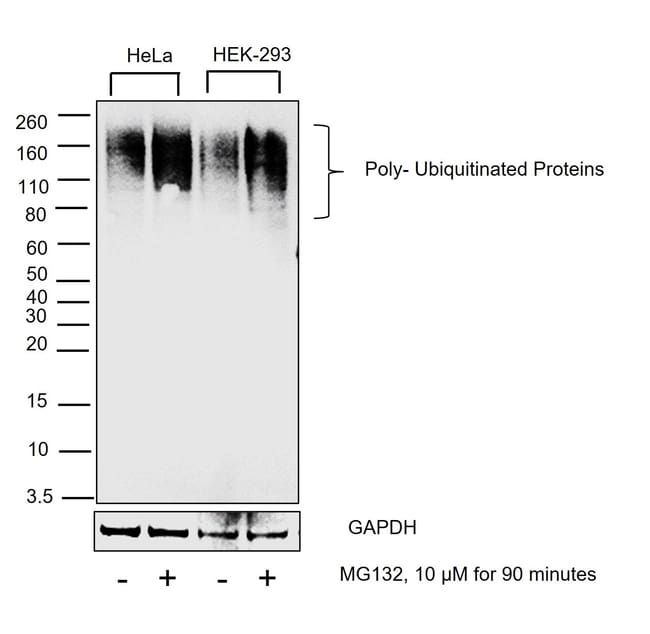
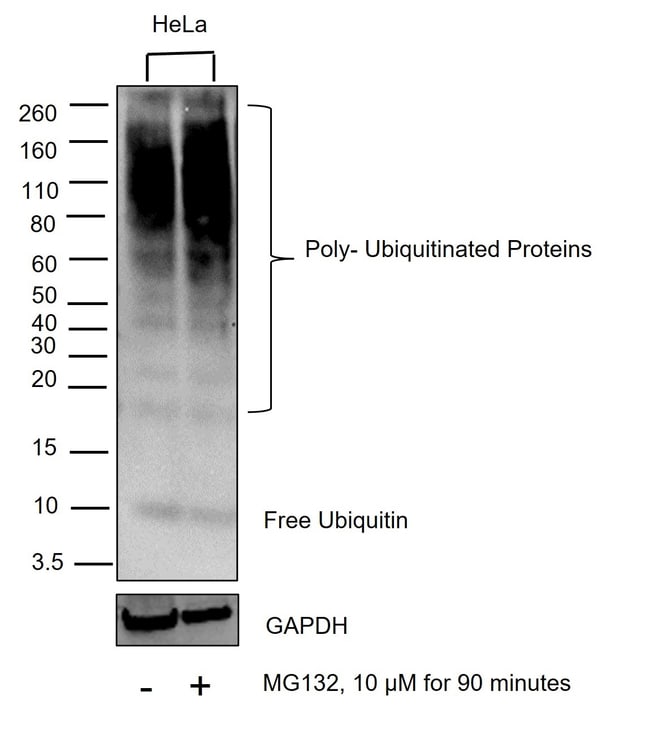
Description: The monoclonal antibody eBioP4D1 (p4D1) recognizes ubiquitin, a small 8Ka protein. Ubiquitin units are linked to proteins via a ubiquitination process, thereby signaling the protein for degradation by the 26S proteosome. The process of ubiquitination plays a role in differentiation, cell cycle progression, apoptosis and disease progression. For example, neuronal inclusions called Lewis bodies from Parkinson patients are rich in ubiquitin. Applications Reported: This eBioP4D1 (P4D1) antibody has been reported for use in immunoprecipitation, immunoblotting (WB), and immunohistochemical staining. Applications Tested: This eBioP4D1 (P4D1) antibody has been tested by immunblotting of treated cell lines. This can be used at less than or equal to 2 μg/mL. It is recommended that the antibody be carefully titrated for optimal performance in the assay of interest. Purity: Greater than 90%, as determined by SDS-PAGE. Aggregation: Less than 10%, as determined by HPLC. Filtration: 0.2 μm post-manufacturing filtered.
Specifications
Specifications
| Antigen | Ubiquitin |
| Applications | Immunohistochemistry, Immunoprecipitation, Western Blot |
| Classification | Monoclonal |
| Clone | eBioP4D1 (P4D1) |
| Concentration | 0.5 mg/mL |
| Conjugate | Unconjugated |
| Formulation | PBS with 0.09% sodium azide; pH 7.2 |
| Gene | UBB |
| Gene Accession No. | P0CG47, P0CG48, P0CG49, P0CG50, P0CG51, P24051, P62979, P62982, P62983, P62984, P62986, P62987, Q63429, Q6ZWY3, Q71UM5 |
| Gene Alias | 0610006J14Rik; 1810034D23Rik; 2700054O04Rik; 40S ribosomal protein S27a; 40S ribosomal protein S27-like; 40S ribosomal protein S27-like protein; AI194771; AL033289; CEP80; CG5271; CG5271-PA; Chap1; Dmel\CG5271; Dmel_CG5271; Dub80; epididymis luminal protein 112; epididymis secretory protein Li 50; HEL112; HEL-S-50; hm:zeh0386; HMG20; hPLIC-2; HRIHFB2157; HUBCEP52; ik:tdsubc_1f2; l(2)04820; l(2)31Ei; LOC100912032; LOC101747587; male female sterile 31; mfs(2)31; mfs(2)48; mfs48; OTTHUMP00000200786; OTTHUMP00000201692; PLIC-2; polyubiquitin; polyubiquitin B; polyubiquitin C; poly-ubiquitin precursor; polyubiquitin-B; Polyubiquitin-C; polyubiquitin-C-like; RE44350p; ribosomal protein S27; ribosomal protein S27 like; ribosomal protein S27A; ribosomal protein S27a L homeolog; ribosomal protein S27a S homeolog; ribosomal protein S27-like; ribosomal protein S27-like protein; RPL40; RpS27; Rps27a; rps27a.L; rps27a.S; RpS27A-PA; RPS27L; S27A; similar to polyubiquitin; similar to ubiquitin-S27a fusion protein; Small ribosomal subunit protein eS27-like; Small ribosomal subunit protein eS31; tdsubc_1f2; TI-225; UB3-D; Uba52; UBA80; UBB; Ubb2; UBC; UBCEP1; UBCEP80; Ubi-f80; Ubi-m; Ubiq; Ubiquilin 2; ubiquitin; ubiquitin (34 AA) (1 is 2nd base in codon); ubiquitin and ribosomal protein S27a; ubiquitin B; ubiquitin C; ubiquitin carboxyl extension protein 80; ubiquitin copy 4; ubiquitin fusion 80; ubiquitin polyprotein (heat shock related); ubiquitin/ribosomal protein; ubiquitin-40S ribosomal protein S27a; ubiquitin-40S ribosomal protein S27a-like; ubiquitin-CEP80; ubiquitin-hybrid protein precursor; Ubiquitin-monomeric; Ubiquitin-related; Ubiquitin-related 1; Ubiquitin-related 2; ubiquitin-S27a fusion protein; Unknown (protein for MGC:127652); unnamed protein product; XELAEV_18028796mg; xx:tdsubc_1f2; zgc:66168; zgc:66168 protein |
| Show More |