missing translation for 'onlineSavingsMsg'
Learn More
Learn More
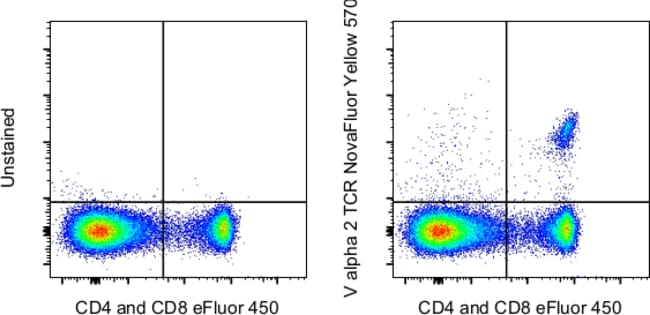
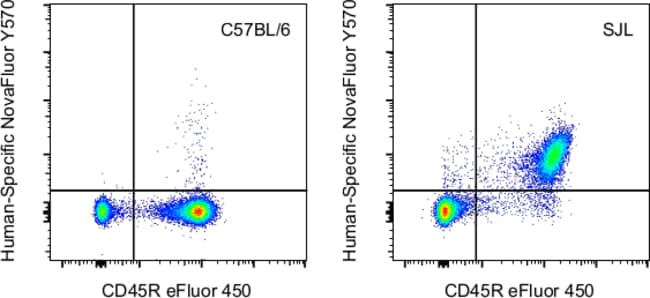

Invitrogen™ TCR V alpha 2 Monoclonal Antibody (B20.1), NovaFluor™ Yellow 570, eBioscience™, Invitrogen™
Description
The ability of T cell receptors (TCR) to discriminate foreign from self-peptides presented by major histocompatibility complex (MHC) class II molecules is essential for an effective adaptive immune response. TCR recognition of self-peptides has been linked to autoimmune disease. Mutant self-peptides have been associated with tumors. Engagement of TCRs by a family of bacterial toxins know as superantigens has been responsible for toxic shock syndrome. Autoantibodies to V beta segments of T cell receptors have been isolated from patients with rheumatoid arthritis (RA) and systemic lupus erythematosus (SLE). The autoantibodies block TH1-mediated inflammatory autodestructive reactions and are believed to be a method by which the immune system compensates for disease. Most human T cells express the TCR alpha-beta and either CD4 or CD8 molecule (single positive, SP). A small number of T cells lack both CD4 and CD8 (double negative, DN). Increased percentages of alpha-beta DN T cells have been identified in some autoimmune and immunodeficiency disorders. Gamma-delta T cells are primarily found within the epithelium. They show less TCR diversity and recognize antigens differently than alpha-beta T cells. Subsets of gamma-delta T cells have shown antitumor and immunoregulatory activity.
Specifications
Specifications
| Antigen | TCR V alpha 2 |
| Applications | Flow Cytometry |
| Classification | Monoclonal |
| Clone | B20.1 |
| Concentration | 0.1 mg/mL |
| Conjugate | NovaFluor Yellow 570 |
| Formulation | PBS with 0.09% sodium azide; pH 7.2 |
| Gene Alias | TCRVA; TCRVA2; V alpha 2; V alpha-2 TCR; Va 2; Va2; Valpha 2; Valpha2 |
| Host Species | Rat |
| Purification Method | Affinity chromatography |
| Show More |