Learn More
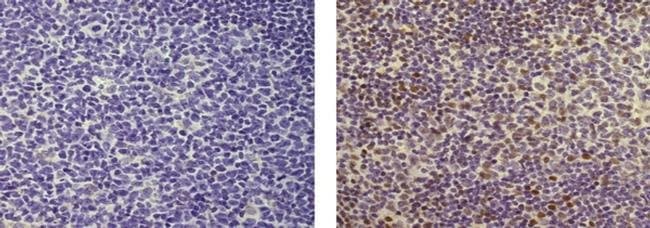
Invitrogen™ SPI-B Monoclonal Antibody (235D), eBioscience™, Invitrogen™


Description
Description: The 235D monoclonal antibody recognizes human SPI-B. SPI-B is a member of the ETS transcription factor family which is comprised of DNA binding proteins that function in lymphoid development and activity. SPI-B binds the PU box, a purine-rich DNA sequence (5'-GAGGAA-3'). SPI-B is expressed in mature B cells, immature T cells, plasmacytoid dendritic cells, and microfold cells (M cells) of the intestine. In human tonsil tissue, high levels of SPI-B are expressed in plasmacytoid dendritic cells, while lower levels of expression are found in germinal center B cells. Applications Reported: This 235D antibody has been reported for use in western blotting, immunohistochemical staining of formalin-fixed paraffin embedded tissue sections, microscopy, immunohistochemical staining, and immunocytochemistry. Applications Tested: This 235D antibody has been tested by immunohistochemistry on formalin-fixed paraffin embedded human tissue using low pH antigen retrieval and can be used at less than or equal to 5 μg/mL. It is recommended that the antibody be carefully titrated for optimal performance in the assay of interest. Purity: Greater than 90%, as determined by SDS-PAGE. Aggregation: Less than 10%, as determined by HPLC. Filtration: 0.2 μm post-manufacturing filtered.
Specifications
Specifications
| Antigen | SPI-B |
| Applications | Immunohistochemistry (Paraffin), Western Blot, Immunocytochemistry |
| Classification | Monoclonal |
| Clone | 235D |
| Concentration | 0.5 mg/mL |
| Conjugate | Unconjugated |
| Formulation | PBS with 0.09% sodium azide; pH 7.2 |
| Gene | SPIB |
| Gene Accession No. | Q01892 |
| Gene Alias | B42b-like; Ets transcription factor Spi-B; Spi-1/PU.1 related; Spib; SPI-B; Spi-B transcription factor; Spi-B transcription factor (Spi-1/PU.1 related); Transcription factor Spi-B |
| Show More |