missing translation for 'onlineSavingsMsg'
Learn More
Learn More
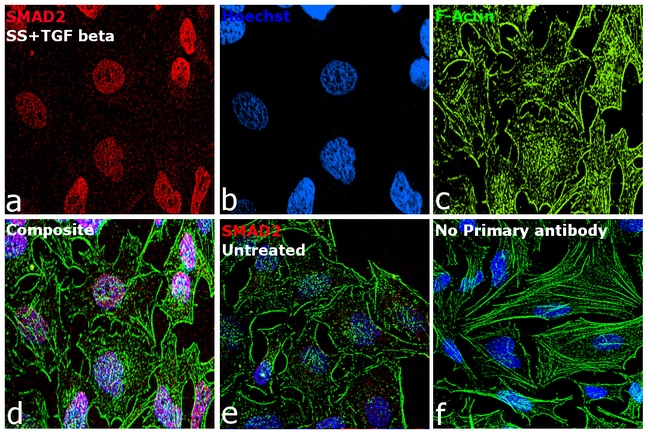
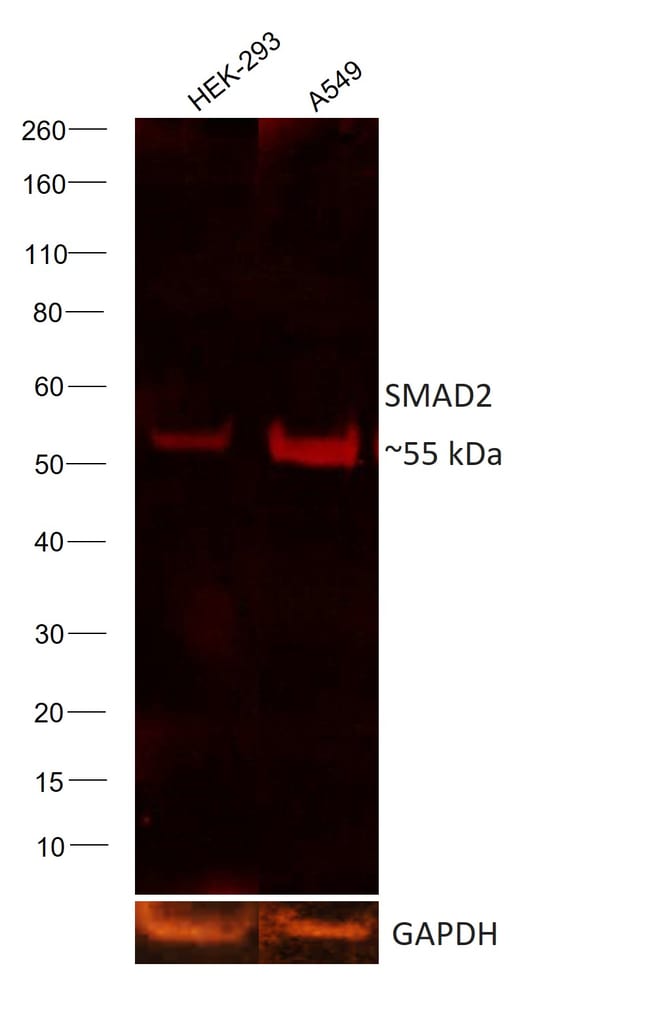
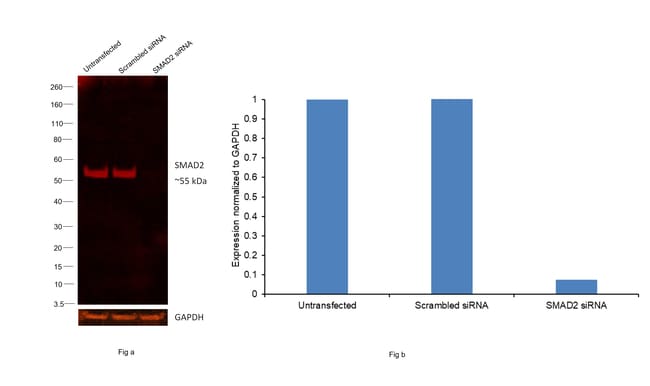
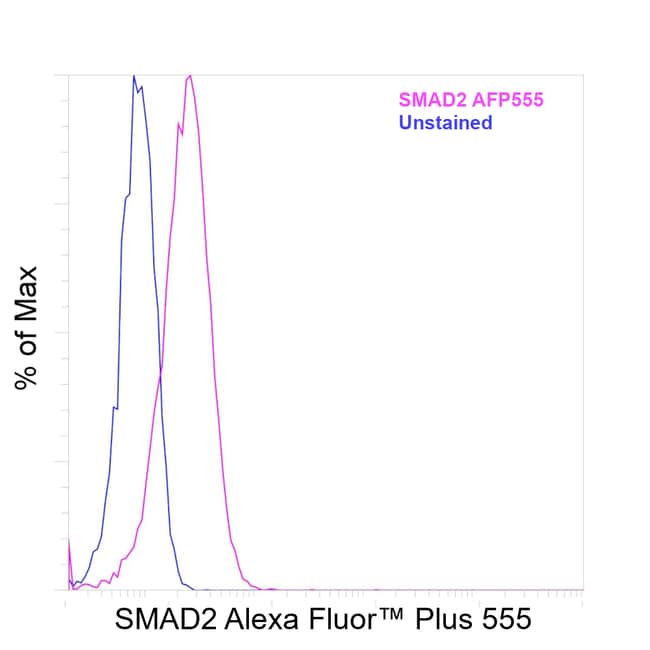
Invitrogen™ SMAD2 Recombinant Rabbit Monoclonal Antibody (31H15L4), Alexa Fluor™ Plus 555
Rabbit Recombinant Monoclonal Antibody
$623.94 - $987.06
Specifications
| Antigen | SMAD2 |
|---|---|
| Clone | 31H15L4 |
| Concentration | 1 mg/mL |
| Content And Storage | 4°C, store in dark, DO NOT FREEZE! |
| Applications | Flow Cytometry, Western Blot, Immunocytochemistry |
| Catalog Number | Mfr. No. | Quantity | Price | Quantity | |||||
|---|---|---|---|---|---|---|---|---|---|
| Catalog Number | Mfr. No. | Quantity | Price | Quantity | |||||
|
700048RP555
|
Invitrogen™
700048RP555 |
50 μL |
Each for $987.06
|
|
|||||
|
5000102347
|
Invitrogen™
700048RP555XS |
20 μL |
Each for $623.94
|
|
|||||
Description
Alexa Fluor™ Plus recombinant antibodies are conjugated using new, proprietary dye chemistry so you can generate stunning data. Alexa Fluor™ Plus antibodies represent an advancement in fluorescent conjugate technology. Alexa Fluor™ Plus antibodies provide brighter signal compared to leading Alexa Fluor™ antibodies, providing you with better signal-to-noise for your critical experiments. These antibodies show better specificity and lot-to-lot consistency as these are recombinant antibodies, generated by cloning specific genes for the desired antibodies into an expression vector and expressed in vitro. Using conjugate solutions: Centrifuge the protein conjugate solution briefly in a microcentrifuge before use; add only the supernatant to the experiment. This step will help eliminate any protein aggregates that may have formed during storage, thereby reducing nonspecific background staining. It is recommended that the antibody be carefully titrated for optimal performance in the assay of interest. Excitation: 553 nm; Emission: 568 nm; Laser: Yellow Laser Filtration: 0.2 μm post-manufacturing filtered.
SMAD2 (MADH2, MAD2) regulates multiple cellular processes, such as cell proliferation, apoptosis, and differentiation. SMAD2 interacts with the TGF-beta receptors through its interaction with the SMAD anchor for receptor activation into the nucleus is a central event in TGF beta signaling. Phosphorylation of threonine 8 in the calmodulin-binding region of the MH1 domain by extracellular signal regulated kinase 1 (ERK1) enhances SMAD2 transcriptional activity, which is negatively regulated by calmodulin. In response to the TGF-beta signal, SMAD2 is phosphorylated by the TGF-beta receptors. The phosphorylation induces the dissociation of this protein with SARA and the association with the family member SMAD4. The association with SMAD4 is important for the translocation of this protein into the nucleus, where it binds to target promoters and forms a transcription repressor complex with other cofactors. SMAD2 can also be phosphorylated by activin type 1 receptor kinase, and mediates the signal from the activin. Alternatively spliced transcript variants encoding the SMAD2 protein have been observed.Specifications
| SMAD2 | |
| 1 mg/mL | |
| Flow Cytometry, Western Blot, Immunocytochemistry | |
| Alexa Fluor Plus 555 | |
| Rabbit | |
| RUO | |
| Proprietary buffer with 0.008% Bromonitrodioxane, 0.008% Methylisothiazolone; pH 6.3-7.3 | |
| Q15796 | |
| 4087 | |
| Primary | |
| Protein A/G |
| 31H15L4 | |
| 4°C, store in dark, DO NOT FREEZE! | |
| Recombinant Monoclonal | |
| Liquid | |
| IgG | |
| Human | |
| SMAD2 | |
| 7120426M23Rik; EGK_09664; hMAD-2; hSMAD2; JV18; JV18-1; MAD; MAD homolog 2; Mad protein homolog; Madh2; Madr2; Mad-related protein 2; MGC22139; MGC34440; mMad2; mother against DPP homolog 2; mothers against decapentaplegic homolog 2; Mothers against decapentaplegic-like protein 2; mothers against DPP homolog 2; pSMAD2; Sma- and Mad-related protein 2; SMAD; SMAD 2; SMAD family member 2; SMAD, mothers against DPP homolog 2; Smad2; Smad-2; Smad2Deltaexon3 | |
| SMAD2 | |
| Antibody |