Learn More
Invitrogen™ SCF Polyclonal Antibody, PeproTech®, Invitrogen™

Description
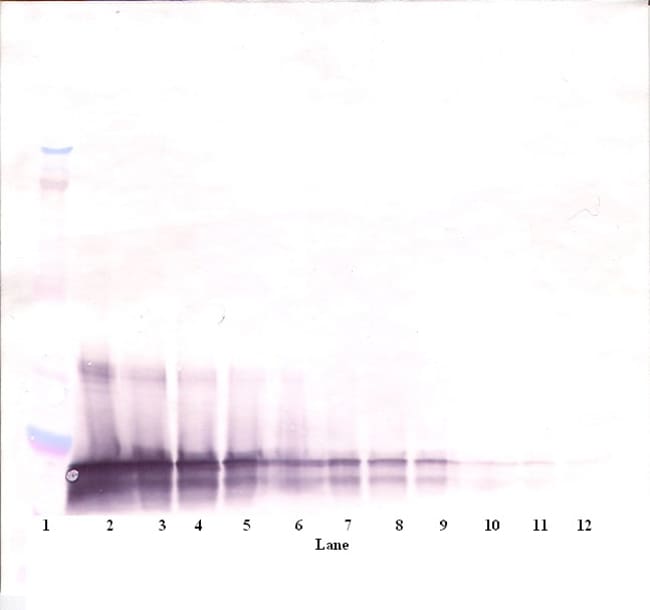
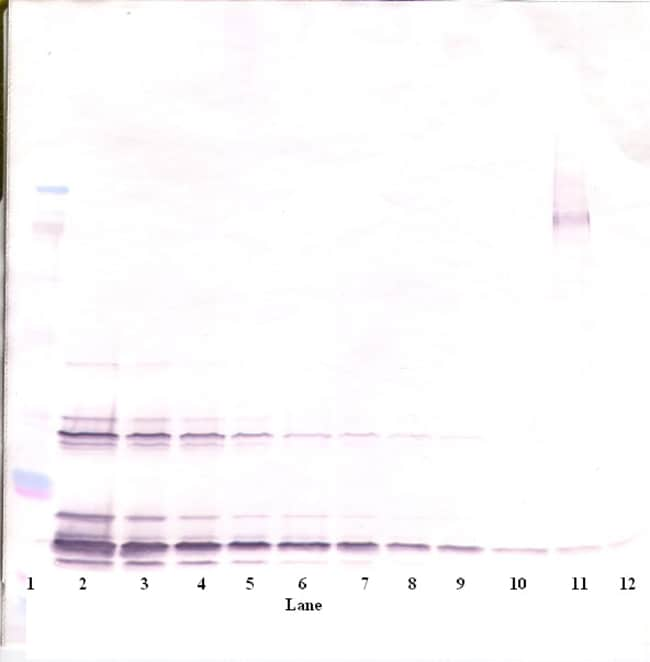
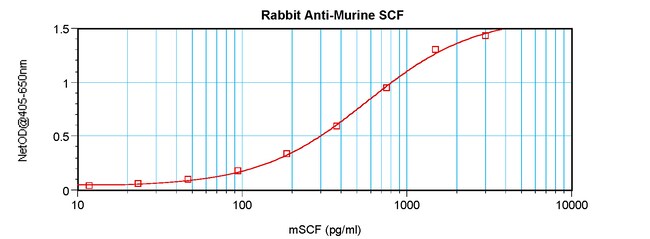
AA Sequence of recombinant protein: MKEICGNPVT DNVKDITKLV ANLPNDYMIT LNYVAGMDVL PSHCWLRDMV IQLSLSLTTL LDKFSNISEG LSNYSIIDKL GKIVDDLVLC MEENAPKNIK ESPKRPETRS FTPEEFFSIF NRSIDAFKDF MVASDTSDCV LSSTLGPEKD SRVSVTKPFM LPPVA. Preparation: Produced from sera of rabbits immunized with highly pure Recombinant Murine SCF. Anti-Murine SCF-specific antibody was purified by affinity chromatography employing an immobilized Murine SCF matrix. Sandwich ELISA: To detect Murine SCF by sandwich ELISA (using 100 μL/well antibody solution) a concentration of 0.5-2.0 μg/mL of this antibody is required. This antigen affinity purified antibody, in conjunction with PeproTech Biotinylated Anti-Murine SCF (500-P71Bt) as a detection antibody, allows the detection of at least 0.2-0.4 ng/well of Recombinant Murine SCF. Western Blot: To detect Murine SCF by Western Blot analysis this antibody can be used at a concentration of 0.1-0.2 μg/mL. Used in conjunction with compatible secondary reagents the detection limit for Recombinant Murine SCF is 1.5-3.0 ng/lane, under either reducing or non-reducing conditions.
Specifications
Specifications
| Antigen | SCF |
| Applications | ELISA, Western Blot |
| Classification | Polyclonal |
| Concentration | 0.1-1.0 mg/mL |
| Conjugate | Unconjugated |
| Formulation | PBS with no preservative |
| Gene | Kitl |
| Gene Accession No. | P20826 |
| Gene Alias | 710-712; blz; c-Kit ligand; Clo; cloud gray; Con; contrasted; CSF; DCUA; DFNA69; DKFZp686F2250; familial progressive hyperpigmentation 2; FPH2; FPHH; Gb; grizzle-belly; hematopoietic growth factor KL; H-SCF; Kit ligand; Kitl; Kitlg; kit-ligand; KL-1; Mast cell growth factor; MGF; M-SCF; Processed kit ligand; SCF; SF; SHEP7; sKITLG; Sl; SLF; Soluble KIT ligand; Steel factor; steel factor/kit ligand; stem cell factor; stem cell factor KL-1; stem cell factor, CSF |
| Gene Symbols | Kitl |
| Show More |