missing translation for 'onlineSavingsMsg'
Learn More
Learn More
Invitrogen™ SAP102 Polyclonal Antibody

Description
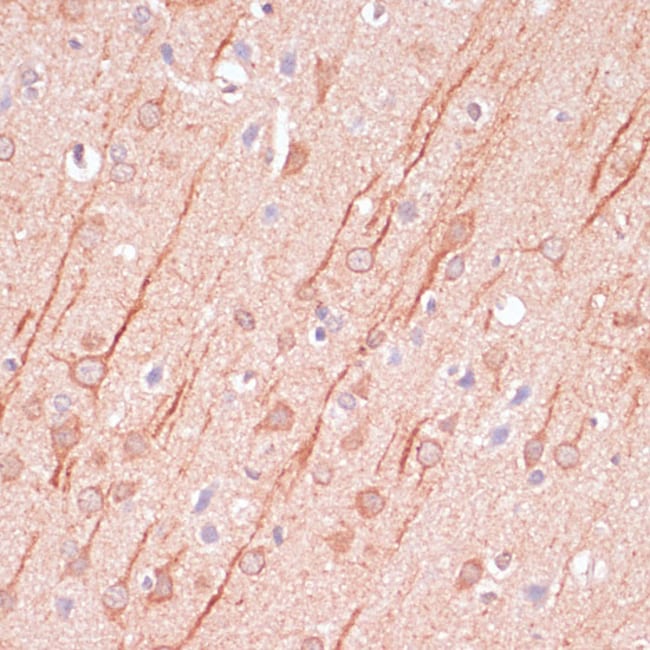
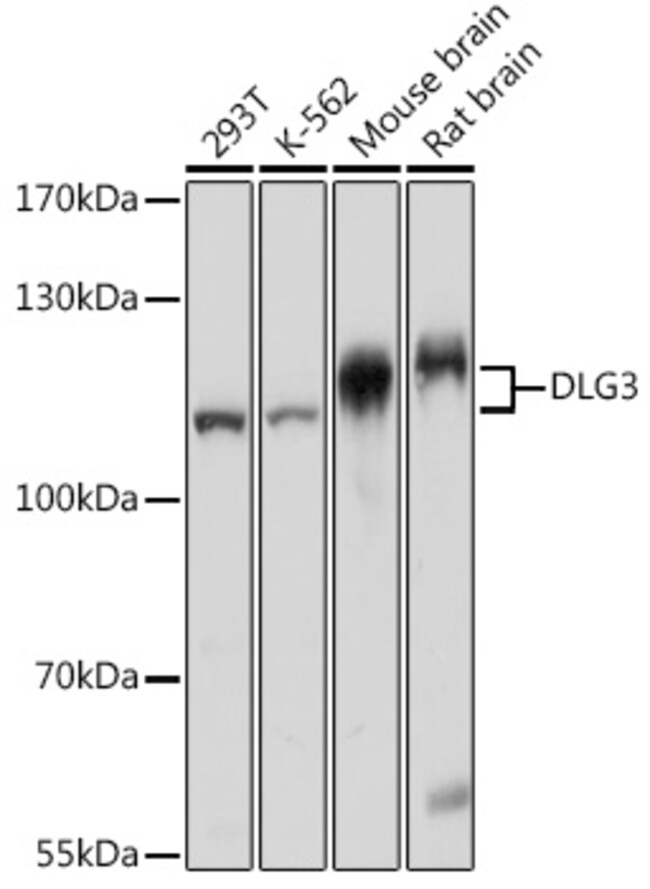
Positive test controls include: 293T, K-562, Mouse brain, Rat brain. Immunogen sequence: QYRPEEYSRF ESKIHDLREQ MMNSSMSSGS GSLRTSEKRS LYVRALFDYD RTRDSCLPSQ GLSFSYGDIL HVINASDDEW WQARLVTPHG ESEQIGVIPS KKRVEKKERA RLKTVKFHAR TGMIESNRDF PGLSDDYYGA KNLKGQEDAI LSYEPVTRQE IHYARPVIIL GPMKDRVNDD LISEFPHKFG SCVPHTTRPR RDNEVDGQDY HFVVSREQME KDIQDNKFIE AGQFNDNLYG TSIQSVRAVA ERGKHCILDV SGNAIKRLQQ AQLYPIAIFI KPKSIEALME MNRRQTYEQA NKIYDKAMKL EQEFGEYFTA IVQGDSLEEI YNKIKQIIED QSGHYIWVPS PEKL.
Synapse-Associated Protein 102 (SAP102) is one of a family of plasma membrane-associated proteins found in synaptic junctions. Like other members of the family, SAP102 has three approximately 90 amino acid repeats called PDZ domains followed by an SH3 domain and a yeast guanylate kinase homology (GuK) domain. It is hypothesized that PDZ-domain interactions play a role in receptor and channel clustering which contributes to neuronal plasticity. SAP102 is believed to participate in the clustering of certain proteins, including NMDA receptors, shaker-type potassium channels at the synaptic membrane in CNS neurons. NMDA receptors and Shaker-type potassium channels both share C-terminal sequence homology consisting of a threonine/serine-X-valine-COOH (T/SXV) motif. Other neuronal proteins that share this motif (beta 1 adrenergic receptor, some serotonin receptors, some sodium channel subunits, and additional potassium channel subunits) may interact with SAP102 by binding to its PDZ domains. Neuronal nitric oxide synthase (nNOS), which lacks the T/SXV motif but which has its own PDZ domain, has been shown to associate with SAP102 in vitro through a pseudo-homotypic PDZ-PDZ interaction.
Specifications
Specifications
| Antigen | SAP102 |
| Applications | ELISA, Immunohistochemistry (Paraffin), Western Blot |
| Classification | Polyclonal |
| Concentration | 1.44 mg/mL |
| Conjugate | Unconjugated |
| Formulation | PBS with 50% glycerol and 0.01% thimerosal; pH 7.3 |
| Gene | DLG3 |
| Gene Accession No. | P70175, Q62936, Q92796 |
| Gene Alias | discs large homolog 3; discs large MAGUK scaffold protein 3; discs, large homolog 3; discs, large homolog 3 (Drosophila); disks large homolog 3; DLG3; Dlgh3; KIAA1232; mKIAA1232; MRX; MRX90; NEDLG; Neuroendocrine-DLG; PPP1R82; protein phosphatase 1, regulatory subunit 82; PSD-95/SAP90-related protein 1; SAP102; SAP-102; synapse-associated protein 102; XLMR |
| Gene Symbols | DLG3 |
| Show More |