Learn More
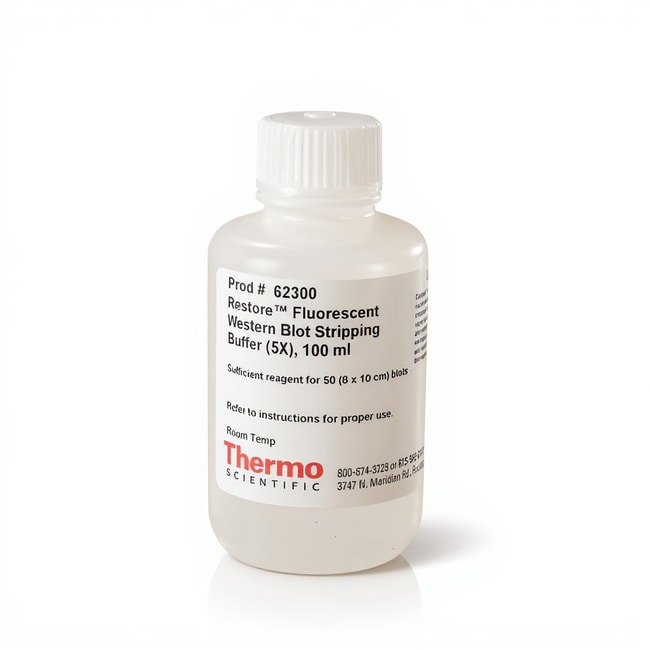
Thermo Scientific™ Restore™ Fluorescent Western Blot Stripping Buffer
Description
Thermo Scientific™ Restore Fluorescent Western Blot Stripping Buffer is a gentle and highly effective reagent for quickly removing primary and near-infrared (IR) dye-labeled secondary antibodies from Western blots.
Highlights:
Fast – strip blots in only 15 minutes at room temperature
Saves time – no need to run new gels and prepare a new blot
Conserve samples – reprobe the same PVDF membrane for multiple targets
Economical – less expensive than other commercially available stripping buffers
Efficient – effectively strips blots the first time
Specifications
Specifications
| Form | Liquid |
| Product Line | Restore |
| Quantity | 4 x 100 mL |
| Content And Storage | Upon receipt store at room temperature. |
Frequently Asked Questions (FAQs)
No. Although the fluorescent antibodies, like other antibodies, can be stripped with Restore Buffers, stripped membranes typically produce unacceptable background for subsequent fluorescent detection methods. We recommend Restore Fluorescent Western Blot Stripping Buffer, Cat. No. 62299 (20 mL) and Cat. No. 62300 (100 mL).
Note: Restore Fluorescent Western Blot Stripping Buffer is for use with low-fluorescence PVDF membrane (Cat. No. 22860) only.
For nitrocellulose or PVDF membrane following Western blot detection using a chemiluminescent or fluorescent substrate system: Following transfer, air dry the membrane and place in an envelope, preferably on top of a supported surface to keep the membrane flat. The blot can be stored indefinitely at -80 degrees C. When ready to reprobe, prewet the PVDF blot with alcohol for a few seconds, followed by a few rinses with pure water to reduce the alcohol concentration. Then proceed as normal with blocking step.
FOR STRIPPING/REPROBING OF MEMBRANES:
Harsh protocol (see NOTE below for modifications)
1) Submerge the membrane in stripping buffer (100 mM BME, 2% SDS, 62.5 mM Tris-HCl, pH 6.7) and incubate at 50 degrees C for 30 min with occasional agitation. If more stringent conditions necessary, incubate at 70 degrees C.
2) Wash 2 x 10 min in TBS-T/PBS-T at room temperature.
3) Block the membrane by immersing in 5% blocking reagent TBS-T or PBS-T for 1 hr at room temperature.
4) Immunodetection
NOTE: Often you don't need such harsh conditions to remove antibodies from their proteins. The stringency of one or several of the variables can be decreased: lower the temperature, decrease the time, less BME, less SDS, etc. An especially mild but still often effective stripping protocol is lower pH incubation. Example: pH 2.0 Tris 50-100 mM, 30-60 min incubation (you may do two incubations if you wish). Then rinse and block as usual. If you do not wish to re-use the membrane immediately after stripping, you can store the membrane in plastic wrap (wet, you do not want it to dry out). Another simple, mild stripping buffer is 0.1 M glycine•HCl (pH 2.5-3.0), incubation 30 min to 2 hrs room temperature or 37 degrees C, depending on the antibody.
For Research Use Only. Not for use in diagnostic procedures.