Learn More

Invitrogen™ Rat RAGE (AGER) ELISA Kit

Description
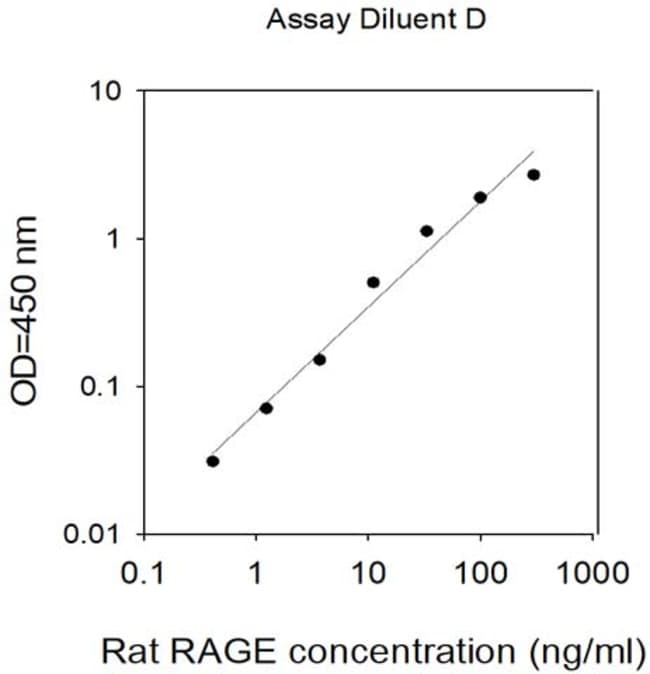
The Rat RAGE (AGER) ELISA quantitates Rt RAGE in rat serum, plasma, or cell culture medium. The assay will exclusively recognize both natural and recombinant Rt RAGE. Principle of the method The Rat RAGE solid-phase sandwich ELISA (enzyme-linked immunosorbent assay) is designed to measure the amount of the target bound between a matched antibody pair. A target-specific antibody has been pre-coated in the wells of the supplied microplate. Samples, standards, or controls are then added into these wells and bind to the immobilized (capture) antibody. The sandwich is formed by the addition of the second (detector) antibody, a substrate solution is added that reacts with the enzyme-antibody-target complex to produce measurable signal. The intensity of this signal is directly proportional to the concentration of target present in the original specimen. Rigorous validation Each manufactured lot of this ELISA kit is quality tested for criteria such as sensitivity, specificity, precision, and lot-to-lot consistency. See manual for more information on validation.
Specifications
Specifications
| Accession Number | Q63495 |
| Assay Range | 0.3-300 ng/mL |
| Assay Sensitivity | 300 pg/mL |
| Calibration Range | 300 pg/mL to 300 ng/ml |
| Content And Storage | Pre-coated 96-well plate, standard, detector antibody, streptavidin-HRP, diluents, wash buffer, chromogen, stop solution, and plate covers. May be stored at 2–8°C for up to 6 months from the date of shipment. |
| Assay | Solid-phase sandwich ELISA |
| Conjugate | HRP |
| Immunoassay Kit Format | Sandwich ELISA Kit |
| Product Type | ELISA |
| Protein Family | Other Proteins |
| Show More |
Frequently Asked Questions (FAQs)
All ELISA kits are provided in the sandwich ELISA format with capture antibody already coated onto a 96 well plate. Typical detection uses a biotinylated detection antibody followed by Streptavidin-HRP and HRP substrate. Most kits are available as single 96-well plate kits, some are available as 2- and 5-plate kits. Kits typically contain:
96 Well Strip Plate coated with capture antibody
Standard protein
Wash buffer, 10x
ELISA buffer/Diluent, 10x
Detection antibody (in most kits, biotinylated)
HRP Reagent (either secondary antibody or streptavidin conjugated to HRP)(100x)
Substrate (usually TMB)
Stop solution
Adhesive plate covers
Running internal controls along with the blanks and the standard curve is an excellent way to monitor the performance of any ELISA kit. Internal controls are samples containing known amounts of the analyte being measured with the kit. A key attribute of internal controls, and what differentiates them from the samples of the standard curve, is that they duplicate the composition of your actual samples as closely as possible. This is important because your samples may contain components that affect detection of the analyte differently than does the Standard Diluent provided in the kit. In other words, internal controls allow you to determine if assaying the same amount of analyte in the Standard Diluent (the standard curve) and in the sample matrix (internal controls) gives the same results. It's also important to remember that internal controls give you confidence in the accuracy of your results. Internal controls help ensure that the assay is performing consistently from assay to assay, every time you run it.
One source of internal controls is naturally occurring samples (such as serum or plasma) containing known amounts of the analyte you want to measure. Such positive control samples can be run as-is, or they can be diluted to various known concentrations, preferably with a naturally occurring negative sample of the same type. It's a good idea to run at least 2 internal controls, if you can. One usually has an analyte concentration between the lowest point on the standard curve and the curve's midpoint, while the other has a concentration between the midpoint and the highest concentration. Some researchers also run an internal control that falls close to the midpoint of the curve.
If you don't have access to naturally occurring controls, you can prepare them yourself. Let's say that you will be measuring interleukin-6 (IL-6) in human serum samples with an ELISA kit, Cat. No. KHC0061. First you will need to obtain some pooled normal human sera, which will be used as the sample matrix for your internal controls. Preferably, the IL-6 content of this serum should be negligible (but known) or too low to measure. Next you should add known amounts of human IL-6 to this serum to create the internal controls, using the human IL-6 standard provided in the kit. After you prepare the standard curve as described in the product manual, add some of the leftover concentrated IL-6 standard to the serum matrix. As described above, you can prepare controls with high and low IL-6 levels, or high, medium, and low, if you have enough wells in your ELISA plate.
Even if your sample type is not serum and you're not measuring IL-6, follow the general procedure outlined above to prepare your internal controls with your protein and sample matrix of interest. A valuable resource describing Spike and Recovery and Linearity of Dilution assays can be found here (http://tools.thermofisher.com/content/sfs/brochures/TR0058-Spike-and-Recovery.pdf). If you need more help, please contact Technical Support at techsupport@thermofisher.com.
Our ELISA kits can be categorized into several different groups (see Table 2, Page 35 of the Protein Analysis Handbook - http://www.thermofisher.com/us/en/home/global/forms/protein-handbook-registration.html), based on a number of factors: target protein class, sensitivity, readout method, or ability to detect specific phosphorylation states of the target protein.
Standard colorimetric ELISA kits use a standard colorimetric readout and allow excellent sensitivity and detection range. Typical sensitivity is less than 10 pg/mL and standard curve range is around 10-250 pg/mL, although there are some kits with wider ranges.
Ultrasensitive ELISA kits use a standard colorimetric readout but enable detection and analysis of proteins to levels as low as 0.5 pg/mL. With measurement range of 0.5-20 pg/mL, these kits are especially useful with highly diluted samples.
Chemi ELISA kits use chemiluminescence detection for high sensitivity (less than 1 pg/mL) and are highly flexible with a wide measurement range from 0.5 to 2000 pg/mL.
Phospho ELISA kits enable the specific detection of phosphorylation of key signaling proteins with high specificity, and are often used to supplement western blot results and provide quantitative data.
We offer full ELISA kits, Reagent Sets and Antibody Pairs. ELISA kits are complete, ready-to-use kits with pre-coated plates, all buffers, capture, and detection antibodies included. Most kits are single plate format, but some are available in 2- or 5-plate formats. Reagent Sets are for researchers who need the core kit components but prefer to make their own buffers and coat their own plates. Antibody Pairs are matched pairs of detection and capture antibodies for researchers who need to process large numbers of samples.