Learn More
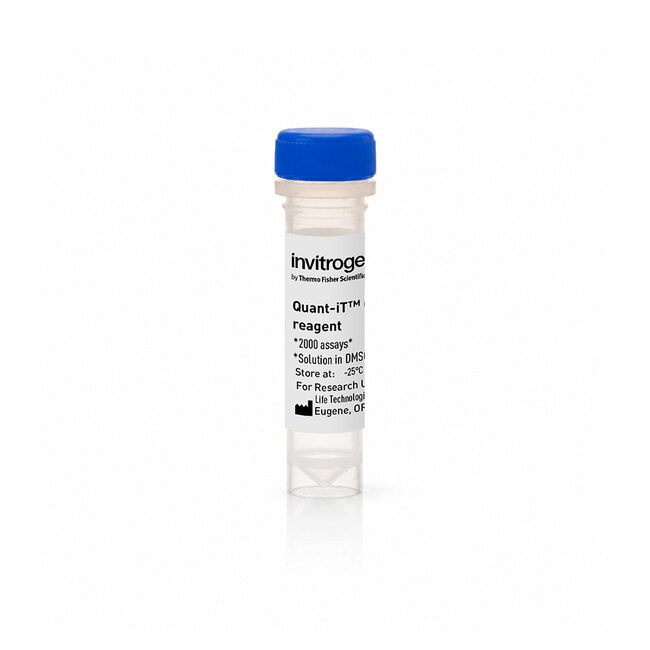

Invitrogen™ Quant-iT™ OliGreen™ ssDNA Assay Kit and Quant-iT OliGreen ssDNA Reagent

Description
Quantify ssDNA with ease using the Quant-iT OliGreen ssDNA Assay kit and reagent. This assay kit and reagent enable sensitive quantitation of single-stranded DNA without the need for a highly concentrated sample. As little as 100 pg/mL can be quantitated using the assay kit or Quant-iT OliGreen ssDNA Reagent.
In addition to the dye, the OliGreen ssDNA Assay Kit includes buffer and an oligonucleotide standard. The OliGreen reagent is also available as the stand-alone Quant-iT OliGreen ssDNA Reagent.
Order Info
Shipping Condition: Room temperature
Specifications
Specifications
| Detection Method | Fluorescence |
| Excitation/Emission | 500/525 |
| For Use With (Equipment) | Microplate Reader |
| No. of Reactions | 200 assays (2 mL assay volume) |
| Quantitation Range | 200 pg to 2 μg |
| Product Line | OLIGREEN, Quant-iT |
| Product Type | Quant-iT OliGreen ssDNA Rgnt |
| Quantity | 1 mL |
| Shipping Condition | Room Temperature |
Frequently Asked Questions (FAQs)
Negative fluorescence is a physical impossibility. It is an artifact from software autocorrecting for background signal. This means your reader is picking up and subtracting out background light at the cost of your data. Make sure to do a buffer-only control and assess the type of signal. You may need to switch to a different plate.
Yes, the manual has directions for this application. You will use the 0 ng/µL lambda dsDNA HS standard to generate Standard #1. You will prepare a dilution of the 10 ng/µL lambda dsDNA HS standard to generate Standard #2. You then prepare the samples and compare them to this 2-point standard curve. The Quant-iT dsDNA BR Kit can be used in a similar manner.
The buffer included in the kit should assure the proper pH range, even if your DNA is at a pH outside of this range, since at least a 10-fold excess of kit buffer over sample is used in the assay.
PicoGreen dye and other fluorescence-based quantification reagents are not recommended for quantifying dye-conjugated nucleic acids. The attached dye molecules can interfere with either binding and/or fluorescence output of the quantification reagents.
Strands that are roughly in the 20-mer range or shorter show a lower level of signal. For dsDNA samples that are composed of mostly short strands, the reagent may still be used, but one should use a dsDNA standard that is of comparable length as the sample.