Learn More
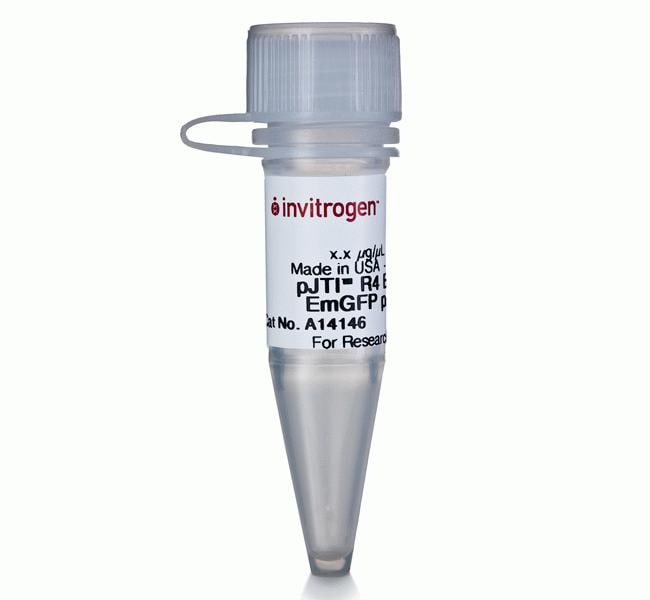
pJTI™ R4 Exp CMV EmGFP pA Vector

Description
Ensure the Success of Your Jump-In™ Retargeting Reactions
Successful retargeting of Jump-In™ parental cell lines like the the Jump-In™ GripTite™ HEK293 kit (A14150) is dependent on a variety of factors such as:
Transfection efficiency
We strongly recommend including a retargeting reaction with the pJTI™ R4 Exp CMV EmGFP pA vector in your Jump-In™ experiment along with negative controls (no plasmid DNA, no integrase vector) so you can easily visualize the results and optimize the retargeting conditions.
For Research Use Only. Not intended for any animal or human therapeutic or diagnostic use.
Specifications
Specifications
| Constitutive or Inducible System | Constitutive |
| Delivery Type | Transfection |
| Format | Liquid |
| Promoter | CMV |
| Product Type | Mammalian Expression Vector |
| Selection Agent (Eukaryotic) | None |
| Content And Storage | Immediately upon receipt, store vector at -20°C |
| Shipping Condition | Dry Ice |
| Protein Tag | Untagged |
| Cloning Method | Gateway |
| Show More |
Frequently Asked Questions (FAQs)
We offer pJTI R4 Exp CMV EmGFP pA Vector, Cat. No. A14146, which you can use to monitor your transfection and expression.
Use irreversible integration (Jump-In system) if the transgene should be sustained in the mammalian genome for a long time. Use reversible integration such as Flp-In system if the transgene needs to be replaced with another gene of interest after a short period of time.
The second step in targeted integration is the retargeting event mediated by the R4 integrase where the genetic elements of interest are site-specifically transferred from the retargeting expression construct (created using the MultiSite Gateway Pro module) onto the genome of the platform line. This integration event also positions the EF1alpha promoter upstream of the blasticidin, neomycin, or eosin resistance gene (i.e., "promoterless" selection marker), thus allowing the selection of transformants that are successfully "retargeted" using the appropriate selection agent. Although you select from successfully retargeted clones using the blasticidin, Geneticin, or Zeocin antibiotic, you may also perform a nested PCR to amplify the region from the EF1alpha promoter to the appropriate resistance gene. You can amplify the hygromycin resistance gene as a positive control. Similar to the platform line creation, you may also perform a Southern blot analysis with a probe designed for your gene of interest.
A platform cell line is created when the R4 attP retargeting sequences are site-specifically inserted into the mammalian genome via PhiC31 Int-mediated recombination. In addition to the R4 retargeting sequences, this integration event introduces the hygromycin resistance gene under the control of the HSV TK promoter and the promoterless Bsd, Neo, or Zeo resistance marker, depending on the platform vector used (i.e., pJTI/Bsd, pJTI/Neo, or pJTI/Zeo). Although you select for transformants carrying the R4 retargeting sequences by their resistance to hygromycin, you may perform PCR analysis to check the integrity of the R4 attP retargeting sequences. For this, we recommend amplifying the region from the R4 attP sequence to the appropriate resistance marker (depending on the platform line used) using the genomic DNA from the platform line. A nested PCR is recommended to reduce the high background you may observe with only primary PCR. Alternatively, you may create a labeled DNA probe by PCR amplifying an approximately 1.5 kb region covering the retargeting sequences, and then perform a Southern blot analysis. The Southern blot will also act as an additional check to verify that only a single copy of the retargeting sequence is integrated into the genome.
The amount of DNA to be used to obtain single copies should be determined by control experiments done in the absence of integrase. The same amount of DNA that yields less than 5 colonies in the absence of integrase should be used in the presence of integrase. Typically, the integrase expression plasmid makes up most of the amount of DNA used for transfection.
For Research Use Only. Not for use in diagnostic procedures.