Learn More
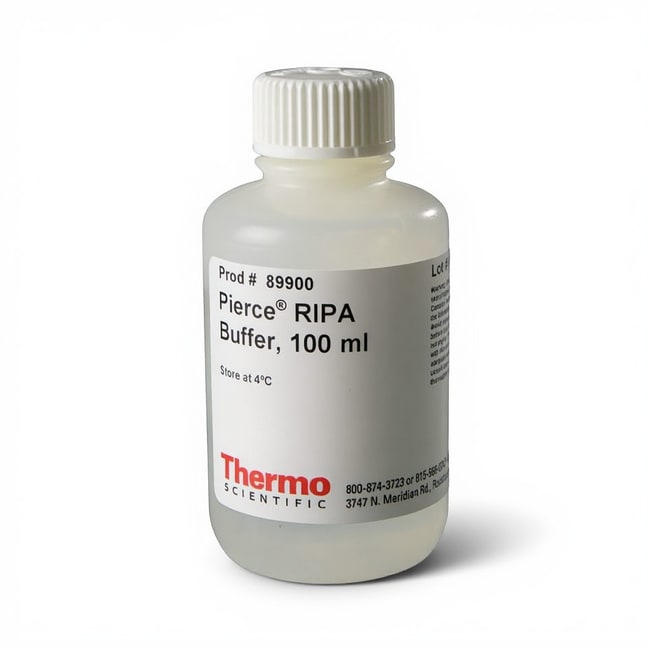


Thermo Scientific™ RIPA Lysis and Extraction Buffer
Description
Thermo Scientific RIPA Lysis and Extraction Buffer is a high-quality, ready-to-use and fully disclosed formulation of a popular cell lysis reagent for cultured mammalian cells.
Features of RIPA Buffer:
- Convenient—ready-to-use solution; no need to assemble and prepared components yourself
- Flexible—compatible with many applications, including reporter assays, protein assays, immunoassays and protein purification
- Versatile—enables extraction of cytoplasmic, membrane and nuclear proteins
- Disclosed formulation—contains no proprietary components, providing users with complete control and knowledge of possible compatibility issues
This RIPA buffer effectively lyses and extracts protein from cultured mammalian cells, including plated cells and pelleted suspension cells. The popular reagent enables the extraction of membrane, nuclear and cytoplasmic proteins and is compatible with many applications, including reporter assays, the Thermo Scientific BCA Protein Assay (Cat. No. 23225), immunoassays and protein purification. Inhibitors such as Thermo Scientific Halt Protease Inhibitor Cocktail (Cat. No. 78420) and Halt Phosphatase Inhibitor Cocktail (Cat. No. 78420) are also compatible with this RIPA buffer formulation and can be added before use to prevent proteolysis and maintain protein phosphorylation.
RIPA buffer derives its name from the original application for which it was developed: the radio-immunoprecipitation assay. While this isotopic assay method is rarely performed in laboratories today, the acronym for this lysis buffer formulation has endured in common use. RIPA cell lysis reagent is highly effective for protein extraction from a variety of cell types because it contains three non-ionic and ionic detergents. One disadvantage of this detergent formulation is its relative incompatibility with certain downstream applications compared to other lysis reagents.
Related Products
- Pierce™ IP Lysis Buffer (Cat. No. 87787)
- M-PER™ Mammalian Protein Extraction Reagent (Cat. No. 78501)
Specifications
Specifications
| Quantity | 100 mL |
| Format | Liquid |
| Product Type | Extraction Buffer |
| Volume (Metric) | 100 mL |
| Content And Storage | Upon receipt store at 4°C. |
Frequently Asked Questions (FAQs)
RIPA Lysis and Extraction Buffer (Cat. No. 89900, 89901) does not contain protease or phosphatase inhibitors. If desired, you may add protease and/or phosphatase inhibitors, such as Halt Protease Inhibitor Cocktail (Cat. No. 78410) and Halt Phosphatase Inhibitor Cocktail (Cat. No. 78420) to the RIPA Lysis and Extraction Buffer to prevent proteolysis and maintain phosphorylation status of proteins. We recommend adding protease and phosphatase inhibitors immediately before use.
RIPA buffer produces a particularly strong absorbance signal at the 280 nm wavelength. As a result, it will either over estimate or under estimate protein concentrations and interfere with the protein purity ratio.
Protein samples in RIPA buffer should be quantified via the Pierce Protein 660 or BCA colorimetric assays using a full spectrum NanoDrop model.
Low phosphorylation is usually due to phosphatase activity. We recommend adding a Halt Phosphatase Inhibitor Cocktail to the buffer before use.
Alternatively, the protein is not phosphorylated or phosphorylated at a low level.
Proteolysis indicates that no protease inhibitors were added. We recommend adding a Halt Protease Inhibitor Cocktail to the RIPA Lysis and Extraction Buffer before use.
For Research Use Only. Not for use in diagnostic procedures.