Learn More
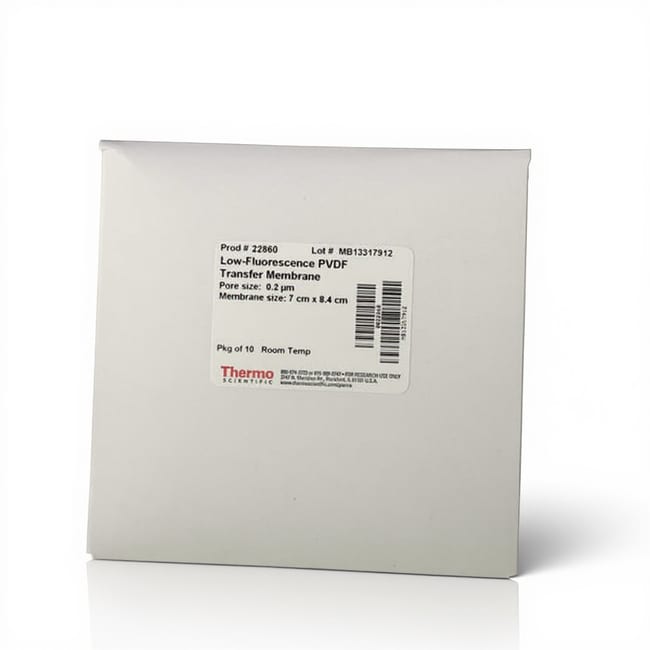
Thermo Scientific™ Low-Fluorescence PVDF Transfer Membranes, 0.2 μmm, 7 x 8.4 cm
Description
Pierce Low-Fluorescence PVDF Transfer Membranes are made of high-quality polyvinylidene difluoride and provide high binding capacity for proteins and nucleic acids for western, southern, and northern blotting methods. This low-fluorescence polyvinylidene difluoride (PVDF) membrane has a 0.2-micron pore size and is ideal for use with fluorescent probes. For best results, preactivate the membrane with 100% alcohol such as methanol, ethanol, or isopropanol.
Low-Fluorescence PVDF Transfer Membranes features include:
- Re-probe characteristics—high mechanical strength makes PVDF an excellent membrane for stripping and re-probing
- Compatibility—compatible with commonly used transfer conditions and detection methods such as staining, immunodetection, chemiluminescence, fluorescence, and radiolabeling
- Durability—compatible with most organic solvents, acids, and mild bases
- High sensitivity—exceptional binding capacity makes PVDF the ultimate choice for low abundance protein
- Hydrophobic binding
Specifications
Specifications
| Length (Metric) | 8.4 cm |
| Width (Metric) | 7 cm |
| Quantity | 10 Pre-cut Membranes |
| Format | Sheet |
| Material | PVDF |
| Pore Size | 0.2 μm |
| Content And Storage | Store membranes flat at ambient temperature and away from chemical vapors. Some solvent vapors may partially dissolve the membranes, which will disrupt the pore structure. |
| Shipping Condition | Room Temperature |
| Dimensions (LxW) | 8.4 x 7 cm |
| Sufficient For | 10 Mini-gel Blots |
| Show More |
Frequently Asked Questions (FAQs)
For nitrocellulose or PVDF membrane following Western blot detection using a chemiluminescent or fluorescent substrate system: Following transfer, air dry the membrane and place in an envelope, preferably on top of a supported surface to keep the membrane flat. The blot can be stored indefinitely at -80 degrees C. When ready to reprobe, prewet the PVDF blot with alcohol for a few seconds, followed by a few rinses with pure water to reduce the alcohol concentration. Then proceed as normal with blocking step.
FOR STRIPPING/REPROBING OF MEMBRANES:
Harsh protocol (see NOTE below for modifications)
1) Submerge the membrane in stripping buffer (100 mM BME, 2% SDS, 62.5 mM Tris-HCl, pH 6.7) and incubate at 50 degrees C for 30 min with occasional agitation. If more stringent conditions necessary, incubate at 70 degrees C.
2) Wash 2 x 10 min in TBS-T/PBS-T at room temperature.
3) Block the membrane by immersing in 5% blocking reagent TBS-T or PBS-T for 1 hr at room temperature.
4) Immunodetection
NOTE: Often you don't need such harsh conditions to remove antibodies from their proteins. The stringency of one or several of the variables can be decreased: lower the temperature, decrease the time, less BME, less SDS, etc. An especially mild but still often effective stripping protocol is lower pH incubation. Example: pH 2.0 Tris 50-100 mM, 30-60 min incubation (you may do two incubations if you wish). Then rinse and block as usual. If you do not wish to re-use the membrane immediately after stripping, you can store the membrane in plastic wrap (wet, you do not want it to dry out). Another simple, mild stripping buffer is 0.1 M glycine•HCl (pH 2.5-3.0), incubation 30 min to 2 hrs room temperature or 37 degrees C, depending on the antibody.
Here are possible causes and solutions:
- The membrane may not be properly treated prior to transfer: Make sure that the membrane is pre-wetted with a polar organic solvent such as methanol or ethanol.
- There may be poor gel to membrane contact: Ensure that the filter paper and blotting pads are well saturated with transfer buffer, taking care to remove any bubbles during the assembly of the membrane sandwich. The gel/membrane sandwich must fit securely in the two halves of the blot module. Try adding another pad or replace any pads that have lost their resiliency with fresh ones.
- Over-compression of the gel: A good indication of over-compression is if the gel has been excessively flattened. In the event that the sandwich is over-compressed, remove enough pads so that the blotter can be closed without exerting excess pressure on the gel and the membrane.
Yes, both our PVDF and nitrocellulose membranes are compatible with the Li-COR instrument.
Our PVDF can tolerate acetonitrile but our nitrocellulose cannot.
PVDF membranes require more stringent blocking steps. This can be achieved by increasing the concentration of the blocking agent 2-5 fold, increasing the blocking time, and performing the procedure at 37 degrees C. Blocking agents bind to unoccupied sites to prevent background staining and also to membrane-bound proteins, reducing non-specific interactions with the primary antibody. Examples of blocking agents are nonfat dry milk, BSA, and Casein.
For Research Use Only. Not for use in diagnostic procedures.