missing translation for 'onlineSavingsMsg'
Learn More

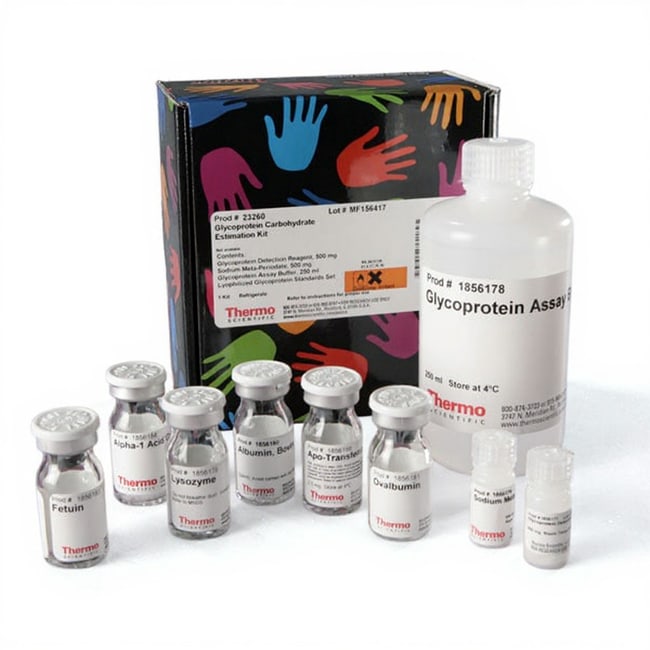
Thermo Scientific™ Pierce™ Glycoprotein Carbohydrate Estimation Kit

Catalog No. PI23260
Change view
Click to view available options
Quantity:
500 mg
1 product options available for selection
Product selection table with 1 available options. Use arrow keys to navigate and Enter or Space to select.
Catalog No. Quantity
PI23260 500 mg
Use arrow keys to navigate between rows. Press Enter or Space to select a product option. 1 options available.
1 options
Catalog No. PI23260 Supplier Thermo Scientific™ Supplier No. LSG23260
Only null left

Measure protein glycosylation as the percent of purified protein mass compared to included glycoprotein standards; uses periodic acid Schiff-base reagents (PAS).

Thermo Scientific™ Pierce Glycoprotein Carbohydrate Estimation Kit enables the amount of protein glycosylation to be measured as the percent of total purified protein mass.

The Glycoprotein Carbohydrate Estimation Kit includes six purified glycoprotein standards and the required assay reagents to effectively estimate the amount of oxidizable glycosylation (% carbohydrate by weight) of purified protein samples. Sugar groups in the glycoprotein sample are first oxidized with sodium meta-periodate to produce detectable aldehyde groups. Then the sample is reacted with the colorimetric Glycoprotein Detection Reagent. Absorbance at 550nm of the resulting purple reaction product is measured with a spectrophotometer or plate reader. Finally, the carbohydrate content in the glycoprotein is calculated by comparison to results from the five glycoprotein standards that are included in the kit.

Highlights:

  • Qualitative – easily identifies purified proteins as glycoproteins or samples as contaminated with sugars

  • Semi-quantitative – estimates the percent carbohydrate content (w/w) of purified glycoprotein by comparison to the included set of glycoprotein standards

  • Simple procedure – completed in less than 75 minutes; instructions include microplate and test tube protocols

  • Adaptable – standard curve format allows for the design of alternative tests for aldehydes and carbohydrate components

Includes:

Sodium periodate, assay buffer, detection reagent and a 5-vial set of glycoprotein standards

Recommended for:

Determine if a purified polyclonal antibody or other protein is glycosylated before attempting to perform carbohydrate-based conjugation or immobilization chemistries with hydrazide reagents; Characterize and classify purified protein fractions from an affinity procedure; Assess sugar and carbohydrate contamination in non-glycosylated protein samples

Specifications

Content And Storage Sufficient For: 60 tube assays or 250 microplate assays
• Sodium meta-Periodate, 500 mg
• Pierce Glycoprotein Detection Reagent, 500 mg
• Glycoprotein Assay Buffer, 250 mL
• Glycoprotein Standards Set, 5-protein set
Description Pierce Glycoprotein Carbohydrate Estimation Kit
Assay Glycoprotein Carbohydrate Estimation
Detection Method Colorimetric
Product Line Pierce
Product Type Glycoprotein Carbohydrate Estimation
Specificity Not Target-Specific
Sufficient For 60 Tube Assays or 250 Microplate Assays
For Use With (Application) Solution-based Detection, Absorbance
For Use With (Equipment) Spectrophotometer, Microplate Reader
Quantity 500 mg
Show More Show Less
Will the reducing agent in my sample interfere with the Glycoprotein Carbohydrate Estimation assay?

Yes. Reducing agents interfere with this assay. Please see the list of compatibility of other commonly used reagents below: Compatible: EDTA, Urea (<1.0M), Guanidine HCl (<1.0M), DMSO (<10%), PBS Not Compatible: Reducing Agents, Tris, Glycerol

Will the detergent in my sample interfere with the Glycoprotein Carbohydrate Estimation assay?

Most commonly used detergents do not interfere; however, detergents with sugar derivatives, such as octyl-b-glusoside (OG) and octyl-b-thioglucopyranoside (OTG), can contribute to the signal, resulting in an erroneously high percent carbohydrate value.

What is the difference between Glycoprotein Carbohydrate Estimation Kit and the Thermo Scientific Glycoprotein Staining Kit (#24562)?

Glycoprotein Carbohydrate Estimation Kit estimates the carbohydrate content of glycoproteins in solution; however, the Thermo Scientific Glycoprotein Stain directly stains oxidized glycoprotein on gels and nitrocellulose membranes and does not estimate carbohydrate content.

Can I use this kit to estimate the carbohydrate content of cell lysates or do I need to purify the protein?

The kit is designed for purified proteins but can also estimate the w/w percentage of carbohydrate in total protein.

Can I use the Glycoprotein Carbohydrate Estimation Kit to estimate free sugars?

Yes. Free sugars form aldehydes when oxidized, which react with the Glycoprotein Detection Reagent.

Can I measure the absorbance at a wavelength different than 550 nm when using the Glycoprotein Carbohydrate Estimation Kit?

Yes. The purple solution produced when oxidized carbohydrates react with the Aldehyde Detection Reagent can be measured at 530 nm and 560 nm.

How many samples can be processed with the Glycoprotein Carbohydrate Estimation Kit?

The kit contains sufficient reagents for processing 250 microplate assays or 60 test tube assays and includes negative and positive controls.

What is the detection range of the Glycoprotein Carbohydrate Estimation Kit assay?

The assay's estimation range is 3.2% (ovalbumin) to 41.4% (a1-acid glycoprotein). The protein concentration required for the assay is based on the percent carbohydrate (w/w). Highly glycosylated proteins are assayed at 0.25mg/mL. Less glycosylated proteins are assayed at 2.5 mg/mL. Researchers with unknown samples should test them at both concentrations to ensure the sample is within the absorbance range for the standard curve.

Why does the Glycoprotein Carbohydrate Estimation Kit assay estimate rather than quantify carbohydrates?

The results produced by this assay are an approximation of carbohydrate content, because the assay detects sialic acid, galactose and mannose. Therefore, sialic acid-rich glycoproteins will produce a higher absorbance than glycoproteins with a similar percentage of glycosylation but with fewer sialic acid residues.

How does the Glycoprotein Carbohydrate Estimation Kit work?

Glycoprotein is oxidized with sodium meta-periodate, which forms aldehydes. When reacted with aldehydes, the proprietary Aldehyde Detection Reagent becomes purple with an absorption maximum at 550 nm. The color intensity is proportional to the percentage of carbohydrate (aldehyde) component in the glycoproteins.

Do you have products to quantitate the degree of glycosylation or phosphorylation of my protein?

The Glycoprotein Carbohydrate Estimation Kit (Cat. No.23260) enables the amount of protein glycosylation to be measured as the percent of total purified protein mass.

The Phosphoprotein Phosphate Estimation Kit (Cat. No. 23270) enables classification and identification of proteins as phosphorylated serine and threonine, as well as semi-quantitative assessment of the phosphorylation level.

Do you offer any protein assays that are protein specific?

We offer several “specialty” protein assays including: Protease assay kits (Cat. Nos. 23263 and 23266), Glycoprotein Carbohydrate Estimation Kit (Cat. No. 23260), Phosphoprotein Phosphate Estimation Kit (Cat. No. 23270), Quantitative Peroxide assay kits (Cat. Nos. 23280 and 23285), and Easy-Titer Assay kits for IgG and IgM.


For Research Use Only. Not for use in diagnostic procedures.