missing translation for 'onlineSavingsMsg'
Learn More
Learn More
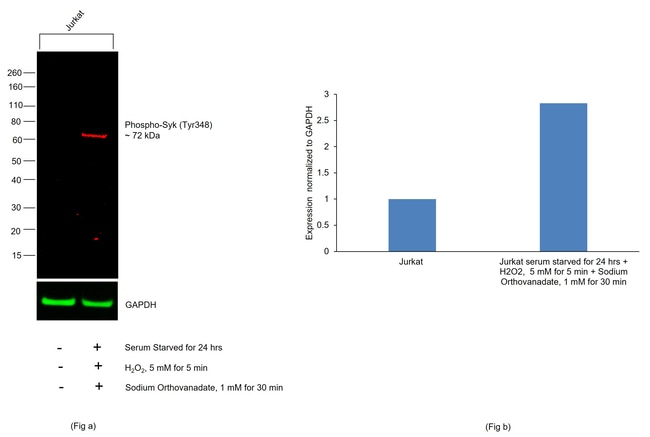
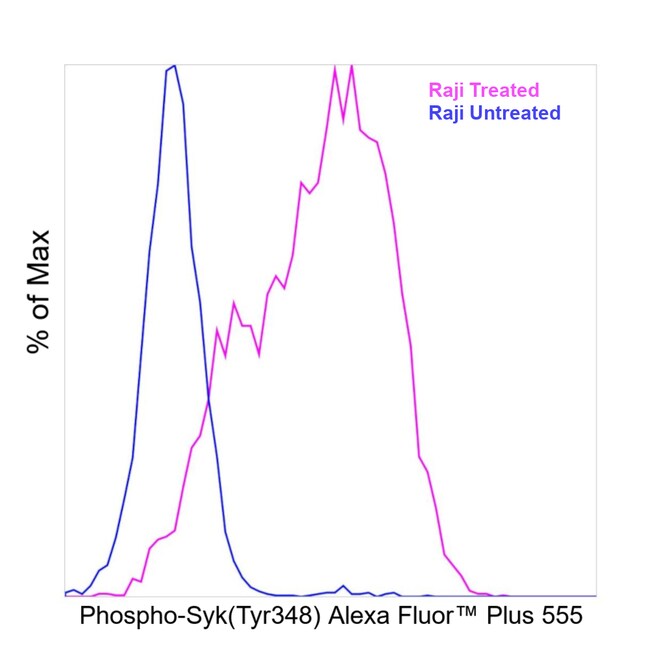
Invitrogen™ Phospho-Syk (Tyr348) Recombinant Mouse Monoclonal Antibody (moch1ct), Alexa Fluor™ Plus 555
Mouse Recombinant Monoclonal Antibody
$607.04 - $960.35
Specifications
| Antigen | Phospho-Syk (Tyr348) |
|---|---|
| Clone | moch1ct |
| Concentration | 1 mg/mL |
| Content And Storage | 4°C, store in dark, DO NOT FREEZE! |
| Applications | Flow Cytometry, Western Blot |
| Catalog Number | Mfr. No. | Quantity | Price | Quantity | |||||
|---|---|---|---|---|---|---|---|---|---|
| Catalog Number | Mfr. No. | Quantity | Price | Quantity | |||||
|
740053MP555
|
Invitrogen™
740053MP555 |
50 μL |
Each for $960.35
|
|
|||||
|
5000102335
|
Invitrogen™
740053MP555XS |
20 μL |
Each for $607.04
|
|
|||||
Description
Alexa Fluor™ Plus recombinant antibodies are conjugated using new, proprietary dye chemistry so you can generate stunning data. Alexa Fluor™ Plus antibodies represent an advancement in fluorescent conjugate technology. Alexa Fluor™ Plus antibodies provide brighter signal compared to leading Alexa Fluor™ antibodies, providing you with better signal-to-noise for your critical experiments. These antibodies show better specificity and lot-to-lot consistency as these are recombinant antibodies, generated by cloning specific genes for the desired antibodies into an expression vector and expressed in vitro. Using conjugate solutions: Centrifuge the protein conjugate solution briefly in a microcentrifuge before use; add only the supernatant to the experiment. This step will help eliminate any protein aggregates that may have formed during storage, thereby reducing nonspecific background staining. It is recommended that the antibody be carefully titrated for optimal performance in the assay of interest. Excitation: 553 nm; Emission: 568 nm; Laser: Yellow Laser Filtration: 0.2 μm post-manufacturing filtered.
Spleen tyrosine kinase (SYK), along with ZAP70, are cytoplasmic tyrosine kinases that are viewed as potential druge targets for allergic disorders and autoimmune diseases. SYK may also play a role in cancer. Syk translocates to the plasma membrane upon B cell antigen receptor (BCR) or the high-affinity IgE receptor (FcepsilonRI) triggering, and phosphorylates downstream adaptor proteins, thereby providing docking sites for initiation of subsequent signaling pathways, such as calcium mobilization, cytoskeleton remodeling, or transcription of specific genes. Syk binds to the receptor assemblies through interactions of its pair of SH2 domains with ITAM motives of the receptor, which have been phosphorylated by Src-family kinases. These kinases also help to activate Syk by phosphorylation of its activation loop.Specifications
| Phospho-Syk (Tyr348) | |
| 1 mg/mL | |
| Flow Cytometry, Western Blot | |
| Alexa Fluor Plus 555 | |
| Mouse | |
| RUO | |
| Proprietary buffer with 0.008% Bromonitrodioxane, 0.008% Methylisothiazolone; pH 6.3-7.3 | |
| P43405 | |
| 6850 | |
| Primary | |
| Protein A/G |
| moch1ct | |
| 4°C, store in dark, DO NOT FREEZE! | |
| Recombinant Monoclonal | |
| Liquid | |
| IgG1 κ | |
| Human | |
| Syk | |
| DKFZp313N1010; EC 2.7.10.2; FLJ25043; FLJ37489; HGNC:11205; kinase Syk; KSYK; p72Syk; p72-Syk; ptk72; SP1; spleen associated tyrosine kinase; spleen tyrosine kinase; SYK; syk signaling; Sykb; tyrosine-kinase syk; tyrosine-protein kinase SYK | |
| Syk | |
| Antibody |