missing translation for 'onlineSavingsMsg'
Learn More
Learn More
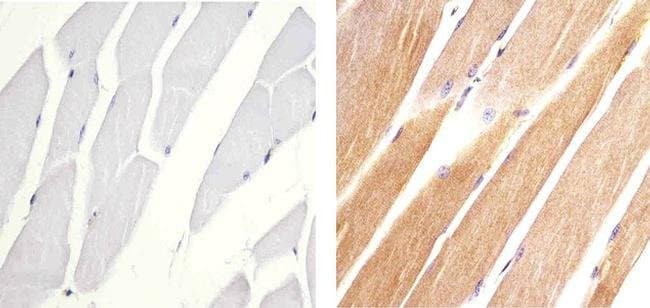
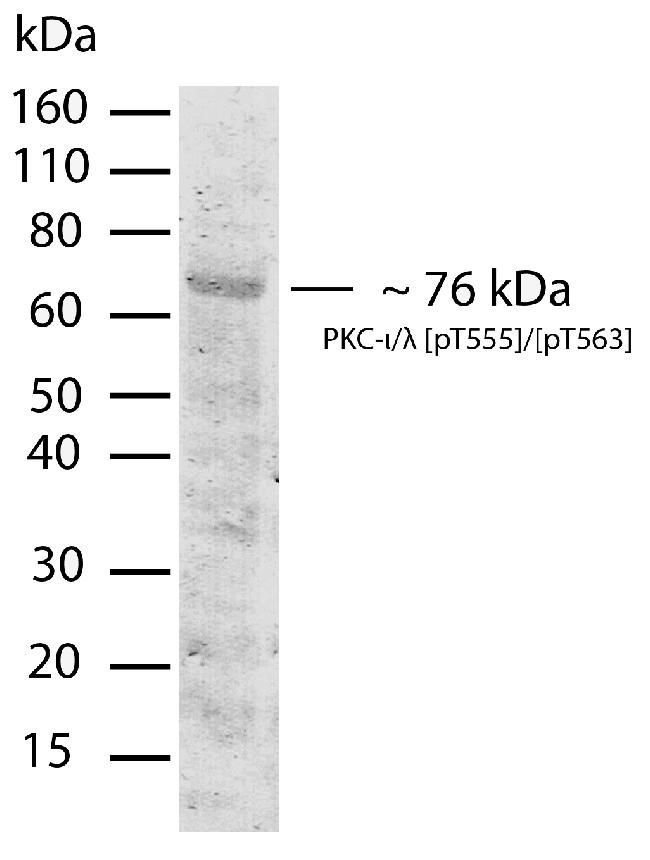
Invitrogen™ Phospho-PKC lambda/iota (Thr555, Thr563) Recombinant Rabbit Monoclonal Antibody (31H34L29)
Rabbit Recombinant Monoclonal Antibody
Supplier: Invitrogen™ LS700582

Description
This antibody is predicted to react with mouse, rat, primate, canine, chicken, equine, bovine, porcine, zebrafish and Xenopus based on sequence homology. Intact IgG appears on a non-reducing gel as ~150 kDa band and upon reduction generating a ~25 kDa light chain band and a ~50 kDa heavy chain. Recombinant rabbit monoclonal antibodies are produced using in vitro expression systems. The expression systems are developed by cloning in the specific antibody DNA sequences from immunoreactive rabbits. Then, individual clones are screened to select the best candidates for production. The advantages of using recombinant rabbit monoclonal antibodies include: better specificity and sensitivity, lot-to-lot consistency, animal origin-free formulations, and broader immunoreactivity to diverse targets due to larger rabbit immune repertoire.
The PKC family of serine/threonine kinases, including PRKCI (PKC iota), is activated intracellularly by signal transduction pathways. In humans, at least 12 different PKC polypeptides have been identified. These isoforms differ in primary structure, tissue distribution, subcellular localization, mode of action in vitro, response to extracellular signals, and substrate specificity. PKC alpha, beta I, beta II and gamma form the conventional family; their activities are Ca2+- and phospholipid-dependent. The PKC family comprises at least eight members, which are differentially expressed and are involved in a wide variety of cellular processes. This protein kinase is calcium-independent and phospholipid-dependent. It is not activated by phorbolesters or diacylglycerol. This kinase can be recruited to vesicle tubular clusters (VTCs) by direct interaction with the small GTPase RAB2, where this kinase phosphorylates glyceraldehyde-3-phosphate dehydrogenase (GAPD/GAPDH) and plays a role in microtubule dynamics in the early secretory pathway. This kinase is found to be necessary for BCL-ABL-mediated resistance to drug-induced apoptosis and therefore protects leukemia cells against drug-induced apoptosis. There is a single exon pseudogene mapped on chromosome X.Chemical Identifiers
| Phospho-PKC lambda/iota (Thr555, Thr563) | |
| 0.5 mg/mL | |
| Immunohistochemistry (Paraffin), Western Blot | |
| Unconjugated | |
| Rabbit | |
| RUO | |
| PBS with 0.09% sodium azide | |
| P41743, Q62074 | |
| 18759, 5584 | |
| proprietary. | |
| Antibody |
| 31H34L29 | |
| Store at 4°C short term. For long term storage, store at -20°C, avoiding freeze/thaw cycles. | |
| Recombinant Monoclonal | |
| Liquid | |
| IgG | |
| Human, Mouse | |
| PRKCI | |
| 2310021H13Rik; AI427505; aPKClambda; aPKC-lambda/iota; atypical protein kinase C-lambda/iota; DXS1179E; hypothetical protein; mKIAA4165; nPKC-iota; Pkci; Pkcl; PKClambda; PRKCI; Prkcl; PRKC-lambda/iota; protein kinase C iota; protein kinase C iota type; protein kinase C, iota; protein kinase C, lambda | |
| PRKCI | |
| Primary | |
| Protein A |
Specifications
| Phospho-PKC lambda/iota (Thr555, Thr563) | |
| Recombinant Monoclonal | |
| 0.5 mg/mL | |
| PBS with 0.09% sodium azide | |
| P41743, Q62074 | |
| PRKCI | |
| proprietary. | |
| 100 μg | |
| Primary | |
| Human, Mouse | |
| Antibody | |
| IgG |
| Immunohistochemistry (Paraffin), Western Blot | |
| 31H34L29 | |
| Unconjugated | |
| PRKCI | |
| 2310021H13Rik; AI427505; aPKClambda; aPKC-lambda/iota; atypical protein kinase C-lambda/iota; DXS1179E; hypothetical protein; mKIAA4165; nPKC-iota; Pkci; Pkcl; PKClambda; PRKCI; Prkcl; PRKC-lambda/iota; protein kinase C iota; protein kinase C iota type; protein kinase C, iota; protein kinase C, lambda | |
| Rabbit | |
| Protein A | |
| RUO | |
| 18759, 5584 | |
| Store at 4°C short term. For long term storage, store at -20°C, avoiding freeze/thaw cycles. | |
| Liquid |