missing translation for 'onlineSavingsMsg'
Learn More
Learn More
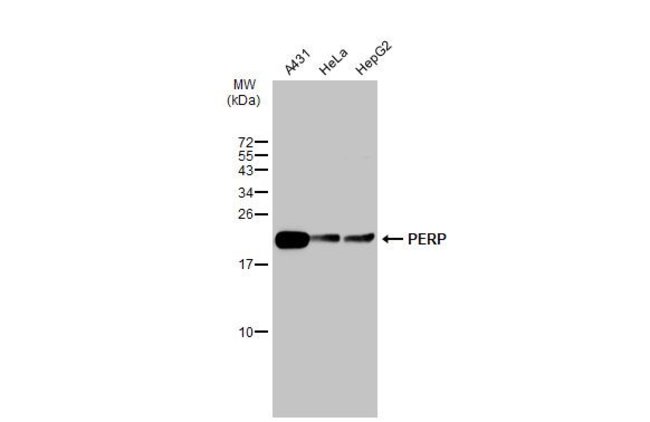
Invitrogen™ PERP Polyclonal Antibody

Description
Centrifuge briefly prior to opening.
The p53 tumor-suppressor gene integrates numerous signals that control cell life and death. Several novel molecules involved in p53 network, including Chk2, p53R2, p53AIP1, Noxa, PIDD, PID/MTA2, MTBP and PERP, were identified and their genes were cloned recently. PERP, also termed PIGPC1 and THW, is a plasma membrane protein. p53 binds to the promoter of PERP and transcriptionally activates PERP gene then the translated PERP protein mediates the p53 induced apoptosis. The expression of PERP causes cell death. PERP is a mediator of p53 induced apoptosis. PERP has sequence similarity to PMP-22/gas3 and is a new member of the PMP-22/gas3 family.
Specifications
Specifications
| Antigen | PERP |
| Applications | Western Blot |
| Classification | Polyclonal |
| Concentration | 1.58 mg/mL |
| Conjugate | Unconjugated |
| Formulation | PBS with 20% glycerol and 0.025% ProClin 300; pH 7 |
| Gene | PERP |
| Gene Accession No. | Q96FX8 |
| Gene Alias | 1110017A08Rik; dJ496H19.1; HGNC:17637; KCP1; KCP-1; keratinocyte associated protein 1; keratinocyte-associated protein 1; keratinocytes associated protein 1; KRTCAP1; p53 apoptosis effector related to PMP22; p53 apoptosis effector related to PMP-22; p53 apoptosis-associated target; p53-induced protein PIGPC1; PERP; PERP, TP53 apoptosis effector; PIGPC1; RP3-496H19.1; THW; Transmembrane protein THW |
| Gene Symbols | PERP |
| Show More |