Learn More
Invitrogen™ PD-L1 (CD274) Recombinant Rabbit Monoclonal Antibody (RM320), Alexa Fluor™ Plus 647
Description
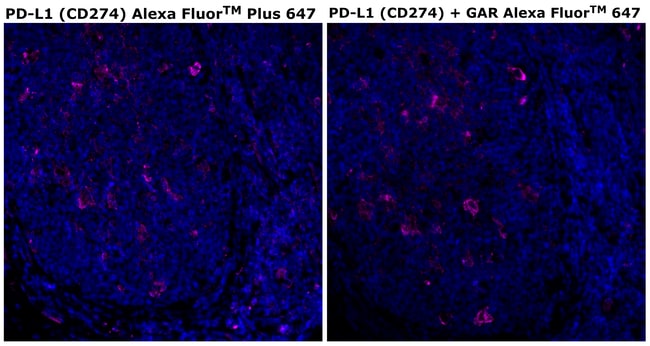
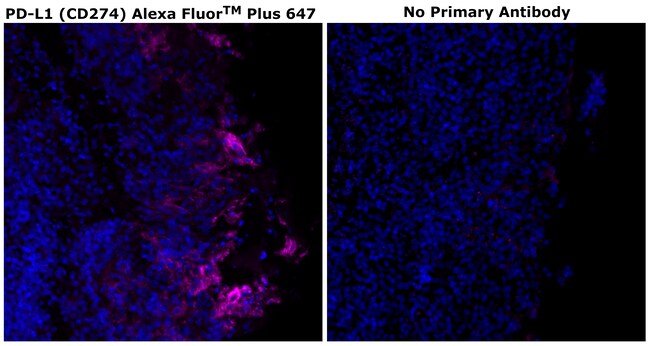
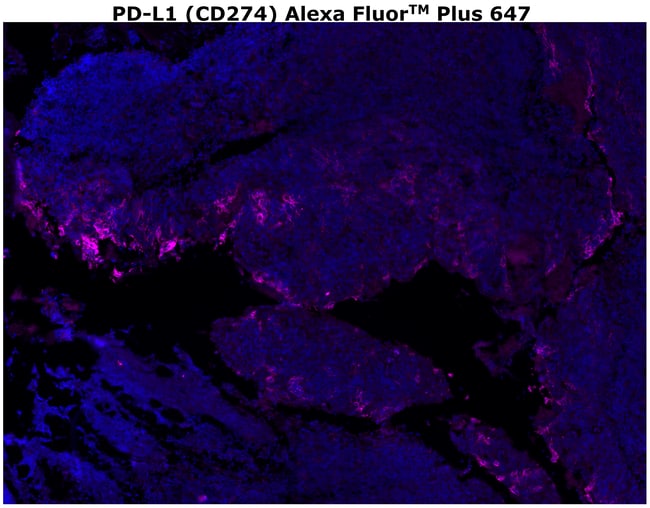
Description: The RM320 monoclonal antibody reacts with human B7-H1, also known as PD-L1. B7-H1, a member of the B7 family, has a predicted molecular weight of approximately 40 kDa and belongs to the Ig superfamily. B7-H1 is expressed on a majority of leukocytes. B7-H1 is a ligand for PD-1. Interaction of PD-1 with either PD-L1 (B7-H1) or PD-L2 (B7-DC) results in inhibition of T and B cell responses. MIH1 is reported to be a blocking antibody. Applications Reported: This RM320 antibody has been tested by immunoblotting, immunohistochemistry, immunocytochemistry and flow cytometry. Applications Tested: This RM320 antibody has been tested by immunohistochemical staining of formalin-fixed paraffin embedded human tissue using low pH antigen retrieval and can be used at 5 μg/mL. It is recommended that the antibody be carefully titrated for optimal performance in the assay of interest. Using conjugate solutions: Centrifuge the protein conjugate solution briefly in a microcentrifuge before use; add only the supernatant to the experiment. This step will help eliminate any protein aggregates that may have formed during storage, thereby reducing nonspecific background staining.
Specifications
Specifications
| Antigen | PD-L1 (CD274) |
| Applications | Immunohistochemistry (Paraffin), Multiplex Immunohistochemistry |
| Classification | Recombinant Monoclonal |
| Clone | RM320 |
| Concentration | 0.2 mg/mL |
| Conjugate | Alexa Fluor Plus 647 |
| Formulation | PBS with 0.5% BSA, 10% proprietary stabilizer and 0.05% sodium azide; pH 7.2 |
| Gene | Cd274 |
| Gene Accession No. | Q9NZQ7 |
| Gene Alias | A530045L16Rik; B7 homolog 1; B7-H; B7h1; B7-H1; Cd274; CD274 antigen; CD274 molecule; PDCD1 ligand 1; Pdcd1l1; Pdcd1lg1; Pdl1; PD-L1; pdl-1; Programmed cell death 1 ligand 1; programmed death ligand 1; RGD1566211; sCD274; soluble CD274; soluble PD L1; sPD L1 |
| Show More |