missing translation for 'onlineSavingsMsg'
Learn More

Invitrogen™ PCNA Monoclonal Antibody (PC10), Alexa Fluor™ Plus 555

Catalog No. 754991082
Change view
Click to view available options
Quantity:
100 μg
1 product options available for selection
Product selection table with 1 available options. Use arrow keys to navigate and Enter or Space to select.
Catalog No. Quantity
754991082 100 μg
Use arrow keys to navigate between rows. Press Enter or Space to select a product option. 1 options available.
1 options
Catalog No. 754991082 Supplier Invitrogen™ Supplier No. 754991082
Only null left

Mouse Monoclonal Antibody

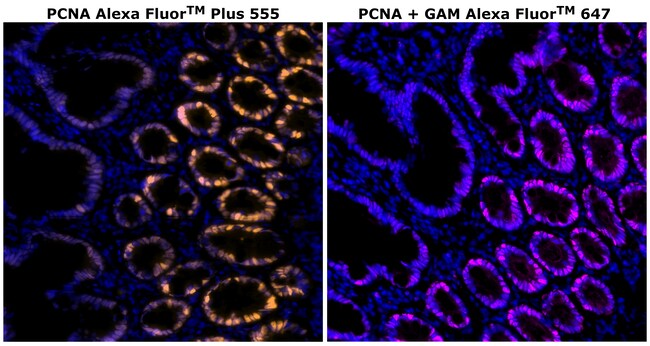
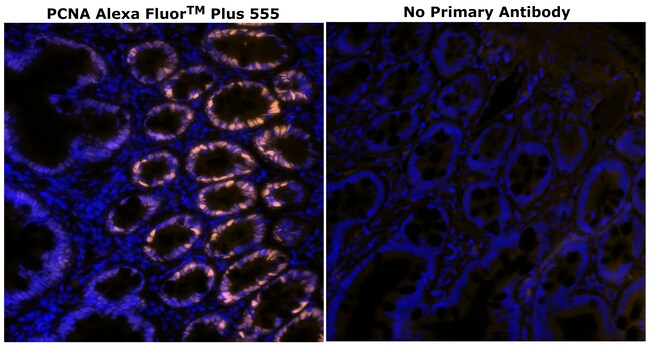
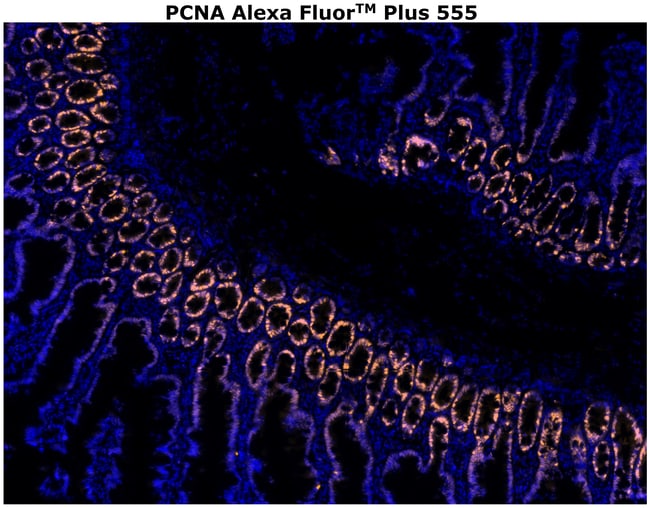
Description: The PC10 antibody reacts with human PCNA which is involved in the control of eukaryotic DNA replication and found in the nucleus. Applications Reported: This PC10 antibody has been reported for use in flow cytometric analysis, immunocytochemistry, western blotting, immunohistochemical staining of formalin-fixed paraffin embedded tissue sections. Applications Tested: This PC10 antibody has been tested by immunohistochemistry of formalin-fixed paraffin embedded tissue using high pH antigen retrieval and can be used at 20 μg/mL. It is recommended that the antibody be carefully titrated for optimal performance in the assay of interest. Using conjugate solutions: Centrifuge the protein conjugate solution briefly in a microcentrifuge before use; add only the supernatant to the experiment. This step will help eliminate any protein aggregates that may have formed during storage, thereby reducing nonspecific background staining.

PCNA (polymerase delta auxiliary protein) is essential for DNA replication and is involved in DNA excision and mismatch repair pathways. PCNA binds to the CDK inhibitor p21, the structure-specific endonucleases Fen1 and XPG, and DNA cytosine 5-methyltransferase (MCMT). PCNA is a potentially useful marker of cells with proliferative potential and for identifying the proliferation status of tumor tissue (i.e. relevant to prognosis). PCNA is a marker for cells in early G1 phase and S phase of the cell cycle. PCNA is found in the nucleus and is a cofactor of DNA polymerase delta, and acts as a homotrimer and helps increase the processing of leading strand synthesis during DNA replication. In response to DNA damage, PCNA is ubiquitinated and is involved in the RAD6-dependent DNA repair pathway. Two transcript variants encoding the same protein have been found for PCNA. Pseudogenes of PCNA have been described on chromosome 4 and on the X chromosome.

Specifications

Antigen PCNA
Applications Immunohistochemistry (Paraffin), Multiplex Immunohistochemistry
Classification Monoclonal
Clone PC10
Concentration 0.2 mg/mL
Conjugate Alexa Fluor Plus 555
Formulation PBS with 0.5% BSA, 10% proprietary stabilizer and 0.05% sodium azide; pH 7.2
Gene Pcna
Gene Accession No. P12004
Gene Alias ATLD2; cb16; Cyclin; DNA polymerase delta auxiliary protein; etID36690.10; fa28e03; fb36g03; HGCN8729; hypothetical protein LOC515499; MGC8367; Pcna; pcna protein; Pcna/cyclin; PCNAR; POL30; Proliferating cell nuclear antigen; wu:fa28e03; wu:fb36g03; YBR0811; YBR088C
Gene Symbols Pcna
Host Species Mouse
Immunogen Rat recombinant PCNA polypeptides.
Purification Method Purified
Quantity 100 μg
Regulatory Status RUO
Primary or Secondary Primary
Gene ID (Entrez) 5111
Target Species Human
Content And Storage 4°C, store in dark
Product Type Antibody
Form Liquid
Isotype IgG2a
Show More Show Less