Learn More
Invitrogen™ PARP1 (cleaved Asp214) Monoclonal Antibody (HLNC4), eFluor™ 450, eBioscience™


Description
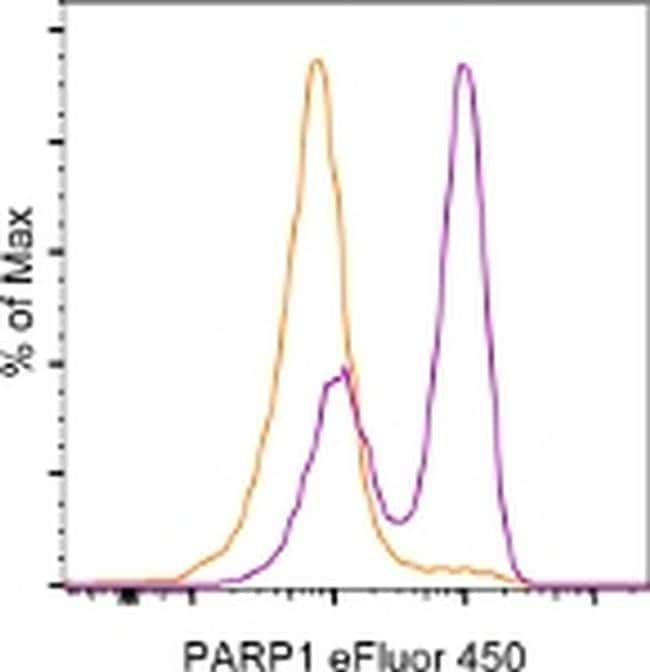
Description: This HLNC4 monoclonal antibody reacts with human poly (ADP-ribose) polymerase (PARP1). This ubiquitous 116 kDa nuclear enzyme is involved in DNA repair. During apoptosis, active caspases -3, -6 and -7 cleave PARP1 after Asp214, thereby inactivating PARP1 and generating two apoptotic fragments sized 85 kDa and 25 kDa. The HLNC4 antibody specifically recognizes the 85 kDa PARP1 fragment produced after cleavage and does not recognize the full-length 116 kDa protein. The following peptide was used as the immunogen: NH2-GVDEVAKKKSKKEKDC-COOH. Applications Reported: This HLNC4 antibody has been reported for use in intracellular staining followed by flow cytometric analysis. Applications Tested: This HLNC4 antibody has been pre-titrated and tested by intracellular staining and flow cytometric analysis of Jurkat cells using the Foxp3/Transcription Factor Staining Buffer Set (Product # 00-5523-00) and protocol. Please refer to BestProtocols®: Protocol B: One step protocol for (nuclear) intracellular proteins located under the Resources Tab online. This can be used at 5 μL (0.06 μg) per test. A test is defined as the amount (μg) of antibody that will stain a cell sample in a final volume of 100 μL. Cell number should be determined empirically but can range from 10^5 to 10^8 cells/test. eFluor® 450 is an alternative to Pacific Blue®. eFluor® 450 emits at 445 nm and is excited with the Violet laser (405 nm). Please make sure that your instrumen...
Specifications
Specifications
| Antigen | PARP1 (cleaved Asp214) |
| Applications | Flow Cytometry |
| Classification | Monoclonal |
| Clone | HLNC4 |
| Concentration | 5 μL/Test |
| Conjugate | eFluor 450 |
| Formulation | PBS with BSA and 0.09% sodium azide; pH 7.2 |
| Gene | PARP1 |
| Gene Accession No. | P09874 |
| Gene Alias | 5830444G22Rik; ADP-ribosyltransferase (NAD+; ADP-ribosyltransferase (NAD+) poly (ADP-ribose) polymerase); ADP-ribosyltransferase (NAD+, poly (ADP-ribose) polymerase) 1; ADP-ribosyltransferase (NAD+; poly (ADP-ribose) polymerase); ADP-ribosyltransferase (NAD+; poly (ADP-ribose) polymerase) 1; ADP-ribosyltransferase 1; ADP-ribosyltransferase diphtheria toxin-like 1; ADP-ribosyltransferase NAD(+); Adprp; Adprt; ADPRT 1; ADPRT1; AI893648; ARTD1; C80510; DNA ADP-ribosyltransferase PARP1; msPARP; NAD(+) ADP-ribosyltransferase 1; pADPRT-1; PARP; Parp1; PARP-1; poly (ADP-ribose) polymerase 1; poly (ADP-ribose) polymerase family, member 1; poly (ADP-ribose) polymerase); poly [ADP-ribose] polymerase 1; poly(ADP-ribose) polymerase; poly(ADP-ribose) polymerase 1; poly(ADP-ribose) polymerase PARP-1; poly(ADP-ribose) synthetase; poly(ADP-ribosyl)transferase; poly[ADP-ribose] synthase 1; poly[ADP-ribose] synthetase 1; PPOL; Protein poly-ADP-ribosyltransferase PARP1; sPARP-1; synthetase fragment (AA 67); Unknown (protein for IMAGE:8023736); unnamed protein product |
| Show More |