missing translation for 'onlineSavingsMsg'
Learn More

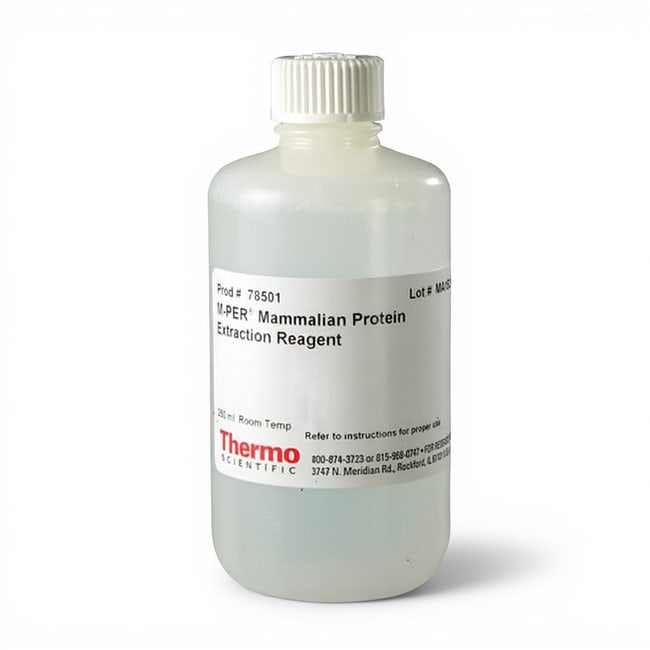
Thermo Scientific™ M-PER™ Mammalian Protein Extraction Reagent

Catalog No. PI78501
Change view
Click to view available options
Quantity:
25 mL
250 mL
1 L
3 product options available for selection
Product selection table with 3 available options. Use arrow keys to navigate and Enter or Space to select.
Catalog No. Quantity
PI78501 250 mL
PI78503 25 mL
PI78505 1 L
Use arrow keys to navigate between rows. Press Enter or Space to select a product option. 3 options available.
3 options
Catalog No. PI78501 Supplier Thermo Scientific™ Supplier No. 78501
Only null left

Isolate total protein from cultured mammalian cells with this highly efficient lysis and extraction reagent.

Thermo Scientific M-PER Mammalian Protein Extraction Reagent is designed to provide highly efficient total soluble protein extraction from cultured mammalian cells.

Features of M-PER Mammalian Protein Extraction Reagent:

  • Gentle—mild detergent lysis, yielding extracts that are immediately compatible with coomassie (Bradford) and BCA protein assays or SDS-PAGE
  • Compatible—extracts soluble proteins in nondenatured state, enabling direct use in immunoprecipitation and other affinity purification procedures
  • Amine-free and dialyzable—formulation ensures compatibility with subsequent assay systems
  • Convenient—lyse adherent cells directly in plate or after scraping and washing in suspension
  • Non-denaturing—maintain activity of luciferase, beta-galactosidase, CAT and other reporter genes as well or better than other suppliers' products and freeze/thaw methods

Product Details

The complete cell lysis reagent contains a mild, nondenaturing detergent that dissolves cell membranes to extract and solubilize total protein from most cellular compartments. Extraction is accomplished in only 5 minutes and requires little or no additional mechanical disruption. M-PER reagent is formulated for minimal interference with downstream biological applications. The reagent has been validated for use with several cell lines, including primary, suspension and adherent cell types; the resulting cell lysates are compatible with many downstream assays including immunoassays, enzyme assays and a variety of common reporter assays.

Cellular protein extraction—cell lysis to release the proteins of interest—is a key first step in many proteomics analysis procedures. M-PER reagent is designed to efficiently extract soluble protein from a variety of cell types, including primary cells and cells grown in suspension or adherent culture conditions. Performance of M-PER reagent was evaluated for yields of both total protein and specific target proteins from the various cellular compartments. Additionally, because M-PER reagent is formulated with dialyzable components that are devoid of primary amines, it is more compatible with certain downstream applications, such as luciferase, beta-galactosidase, and CAT assays, than other protein extraction methods.

Related Products

  • T-PER™ Tissue Protein Extraction Reagent (Cat. No. 78510)

Specifications

Quantity 250 mL
Format Liquid
Product Type Protein Extraction Reagent
Volume (Metric) 250 mL
Content And Storage Upon receipt store product at room temperature.
Product Line M-PER
What are the standard lysis buffers used with mammalian cells for detection of protein expression by immunoprecipitation (IP) or Western blot analysis?

The most commonly used buffer is RIPA Buffer with SDS. We offer RIPA Buffer (Cat. Nos. 89900 and 89901). We also offer the Pierce IP Lysis buffer (Cat. Nos. 87787 and 87788) as well as M-PER (Cat. Nos. 78501, 78503, and 78505).

Is the M-PER Mammalian Protein Extraction Reagent (Cat. No. 78501, 78503, 78505) compatible with Mass spectrometry (MS)?

As any other lysis reagent, M-PER has detergent and salts in its composition, and both type of components need to be removed before the MS analysis, as they will interfere with the analysis. According to the workflow used in the MS analysis, those might be removed before the MS analysis. We recommend removing detergents at the protein level. Both detergent and salts can be removed by dialysis.

Can you provide the shelf-life for the M-PER Mammalian Protein Extraction Reagent?

The M-PER Mammalian Protein Extraction Reagent is covered under our general 1-year warranty and is guaranteed to be fully functional for 12 months from the date of shipment, if stored as recommended (room temperature). Please see section 8.1 of our Terms & Conditions of Sale (https://www.thermofisher.com/content/dam/LifeTech/Documents/PDFs/Terms-and-Conditions-of-Sale.pdf) for more details.

Will M-PER Mammalian Protein Extraction Reagent extract membrane or cytoskeletal proteins?

M-PER Mammalian Protein Extraction Reagent can extract some membrane or cytoskeletal proteins, but the extraction efficiency is not consistent. The reagent was not intended to specifically extract these proteins. We recommend using Mem-PER Plus Membrane Protein Extraction Kit (Cat. No. 89842) for membrane protein extraction or Subcellular Protein Fractionation Kit for Cultured Cells (Cat. No. 78840) for compartmental extraction.

When using the M-PER Mammalian Protein Extraction Reagent, is it necessary to remove cells from the plate? Should I use scraping or trypsinization to remove the cells from the plate?

M-PER reagent works very well with adherent and suspension cells, making it unnecessary to separate the cells from the plate. However, if cell removal is desired, scraping is the recommended procedure for removing cells from the plate. Trypsinization is not recommended as the free trypsin left behind in the lysis solution can damage lysed proteins.

Can I separate out the nuclear and cytoplasmic proteins using M-PER Mammalian Protein Extraction Reagent?

M-PER Mammalian Protein Extraction Reagent is not suitable for cell fractionation. We recommend using NE-PER Nuclear and Cytoplasmic Extraction Reagents (Cat. No. 78833, 78835).

I only want to buy one reagent for extraction of protein from both mammalian cells and tissues. Will M-PER Mammalian Protein Extraction Reagent work for protein extraction from tissue samples?

For extraction of protein from tissue samples as well as some difficult-to-lyse mammalian cells, we recommend using T-PER Tissue Protein Extraction Reagent (Cat. No. 78510) with homogenization.

How do I increase lysis efficiency with M-PER Mammalian Protein Extraction Reagent?

If the lysis efficiency for the specific cell line is not optimal, we suggest increasing the time of incubation and the amount of M-PER reagent used. It can also help to shake the samples more vigorously during the incubation.

When using M-PER Mammalian Protein Extraction Reagent, would the DNA be localized in the supernatant or the pellet?

The DNA would most likely be localized in the pellet but it would depend on the robustness of the nucleus in the particular cell type.

Which protein assays are recommended to determine the protein concentration of the M-PER lysate?

M-PER Reagent is compatible with the Thermo Scientific Coomassie Plus (Bradford) Assay (Cat. No. 23236) and the Thermo Scientific BCA Protein Assay (Cat. No. 23225) without the need to further dilute the sample for interfering substances.

What is the basic protocol for using M-PER Mammalian Protein Extraction Reagent with suspension cells?

Add M-PER Reagent to the cell pellet that has been washed once in PBS. Use at least 1 mL of M-PER Reagent for each 100 mg (~100 µL) of wet cell pellet. For example, 2 × 10⁶ HeLa cells is equal to ~20 mg of cells and requires 200 µL of M-PER Reagent. Shake mixture gently for 10 minutes. Remove cell debris by centrifugation at ~14,000 × g for 15 minutes. Transfer the supernatant to a new tube for analysis.

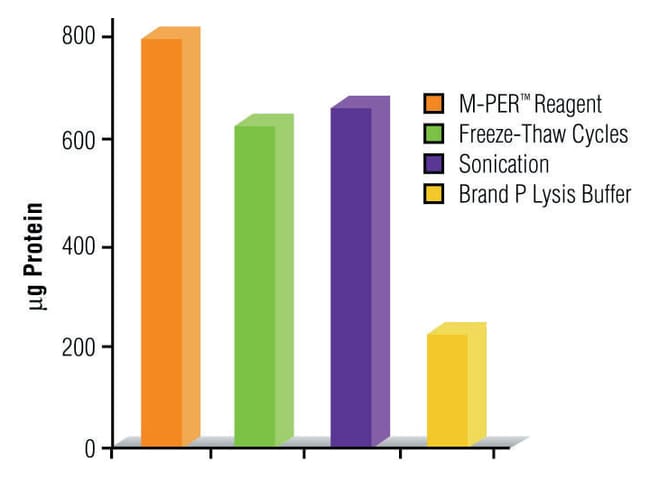
What is the protein yield when using M-PER Mammalian Protein Extraction Reagent as compared to using a freeze/thaw method?

For direct, in-plate lysis of adherent cells, protein extraction efficiency using M-PER Reagent is similar to freeze/thaw methods. For lysis of pelleted cells, either from cell suspension or scraped adherent cells, protein extraction efficiency is typically 25% higher than that achieved with freeze -thaw (three cycles) and 20% higher than sonication (2 minutes with 50% pulse) methods.

Which applications have been validated using M-PER Mammalian Protein Extraction Reagent ?

The cell lysates prepared using M-PER Mammalian Protein Extraction Reagent are compatible with many downstream assays including immunoassays, enzyme assays and a variety of common reporter assays. Additionally, because M-PER reagent is formulated with dialyzable components that are devoid of primary amines, it is more compatible with certain downstream applications, such as luciferase, beta-galactosidase, and CAT assays, than other protein extraction methods. The reagent extracts soluble proteins in a non-denatured state, enabling direct use in immunoprecipitation and other affinity purification procedures and is also compatible with Western Blot, ELISA and RIA.

Which cell types can be processed with M-PER Mammalian Protein Extraction Reagent?

M-PER Reagent efficiently extracts soluble protein from a variety of cell types, including primary cells (heart and neuron) and cells grown in suspension or adherent culture conditions (HeLa, CHO, Jurkat, NIH3T3, FM2, MCF-7, COS-7). Performance of M-PER Reagent was evaluated for yields of both total protein and specific target proteins from the various cellular compartments.

What is the advantage of using M-PER Mammalian Protein Extraction Reagent (Cat. No. 78501)?

The complete cell lysis reagent contains a mild, non-denaturing detergent in 25 mM Bicine buffer (pH 7.6), that dissolves cell membranes to extract and solubilize total protein from most cellular compartments. Extraction is accomplished in only 5 minutes and requires little or no additional mechanical disruption. M-PER Reagent is formulated for minimal interference with downstream biological applications.

What lysis buffers do you offer for mammalian cells?

Please see the various lysis buffers we offer (https://www.thermofisher.com/us/en/home/life-science/protein-biology/protein-purification-isolation/cell-lysis-fractionation/cell-lysis-total-protein-extraction.html) for total protein extraction from mammalian cells.


For Research Use Only. Not for use in diagnostic procedures.