Learn More

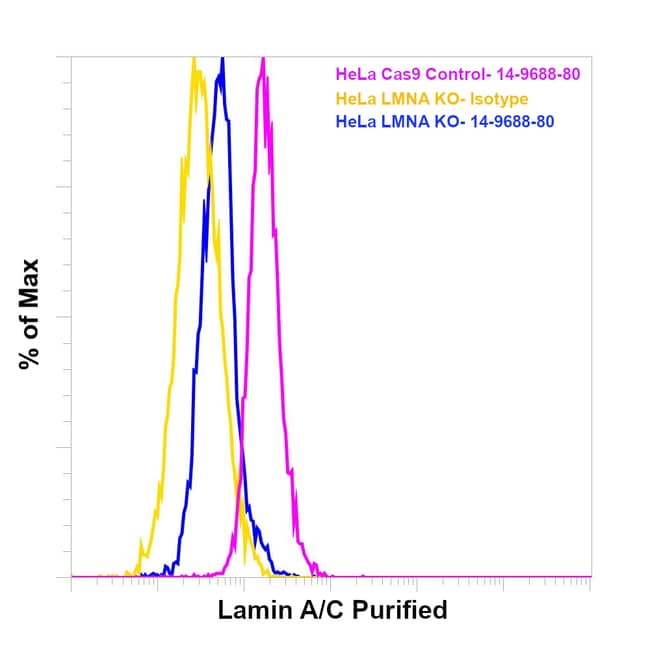
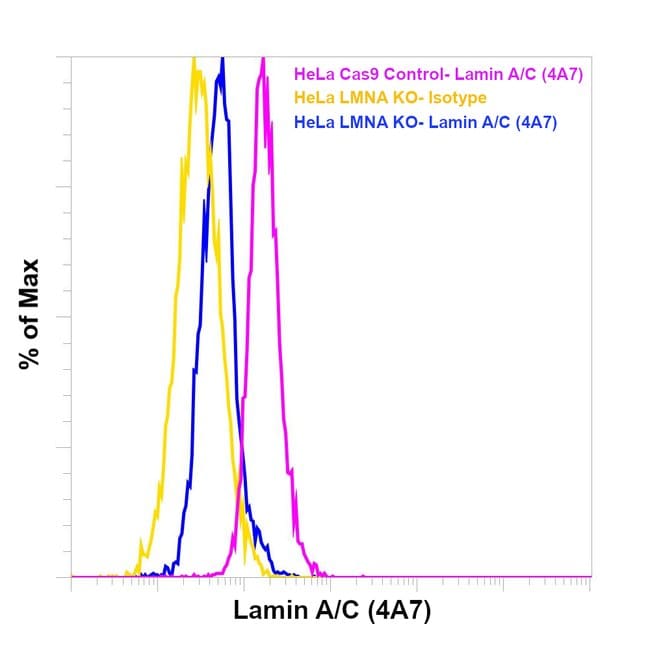
Invitrogen™ Lamin A/C Monoclonal Antibody (4A7), eBioscience™, Invitrogen™

Description
The monoclonal antibody 4A7 recognizes human, mouse, rabbit and hamster lamin A/C. Lamins are nuclear intermediate filament proteins that provide framework for the nuclear envelope, maintain cell morphology, and protect the nucleus from mechanical, thermal, and oxidative stresses. Lamins also play a role in nuclear assembly, chromatin organization, DNA replication, RNA transcription, cell signaling, and apoptosis. Lamin C is a splice variant of Lamin A and both are A-type lamins. Lamin A and C are crucial for skeletal and cardiac development and function. Defects in A-type lamins result in cardiomyopathy, muscular dystrophy, peripheral neuropathy, lipodystrophy, restrictive dermopathy, and progeroid disorders. This 4A7 antibody has been tested by immunocytochemistry of methanol-fixed and permeabilized cells and can be used at less than or equal to 10 μg/mL. It is recommended that the antibody be carefully titrated for optimal performance in the assay of interest. Purity: Greater than 90%, as determined by SDS-PAGE. Aggregation: Less than 10%, as determined by HPLC. Filtration: 0.2 μm post-manufacturing filtered.
Specifications
Specifications
| Antigen | Lamin A/C |
| Applications | ELISA, Flow Cytometry, Immunohistochemistry (Frozen), Western Blot, Immunocytochemistry |
| Classification | Monoclonal |
| Clone | 4A7 |
| Concentration | 0.5 mg/mL |
| Conjugate | Unconjugated |
| Formulation | PBS with 0.09% Sodium Azide; pH 7.2 |
| Gene | LMNA |
| Gene Accession No. | P02545, P48678 |
| Gene Alias | 70 kDa lamin; cb948; CDCD1; CDDC; CMD1A; CMT2B1; Dhe; EMD2; FPL; FPLD; FPLD2; HGPS; I79_009616; IDC; lamin; lamin A; lamin A/C; lamin A/C L homeolog; lamin A/C-like 1; Lamin A+C mutant; Lamin AC; lamin a-c; lamin C; lamin C2; lamin-A; Lamin-A/C; LDP1; LFP; LGMD1B; LMN1; lmna; LMNA protein; lmna.L; lmna-A; LMNC; LMNL1; mutant 453W; Mutant lamin A/C; nuclear intermediate filament protein; nuclear lamin A; prelamin-A/C; PRO1; progerin mutant; Renal carcinoma antigen NY-REN-32; RP11-54H19.1; unnamed protein product; wu:fk66d12; XELAEV_18040808mg |
| Show More |