missing translation for 'onlineSavingsMsg'
Learn More

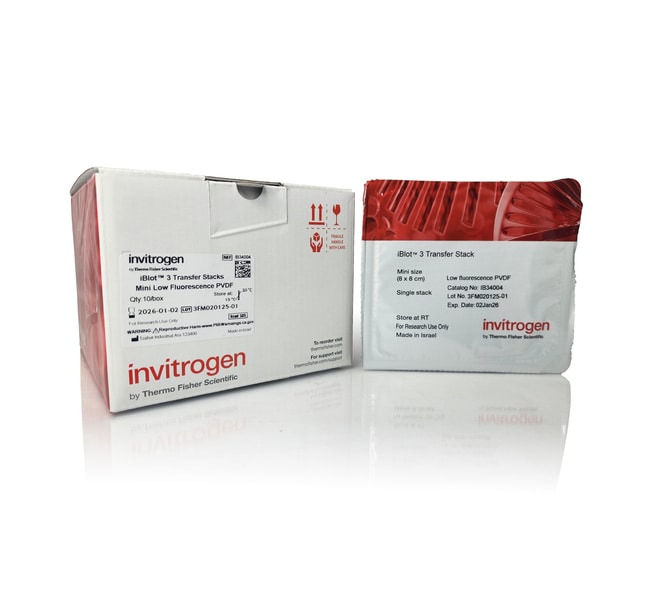
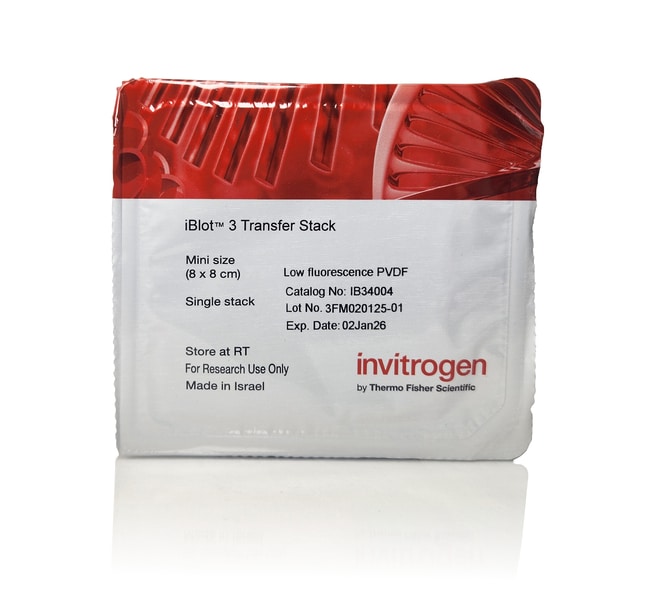
Invitrogen™ iBlot™ 3 Transfer Stacks, mini, low-fluorescence PVDF
GREENER_CHOICE

Catalog No. IB34004
Change view
Click to view available options
Quantity:
10 Stacks
1 product options available for selection
Product selection table with 1 available options. Use arrow keys to navigate and Enter or Space to select.
Catalog No. Quantity
IB34004 10 Stacks
Use arrow keys to navigate between rows. Press Enter or Space to select a product option. 1 options available.
1 options
Catalog No. IB34004 Supplier Invitrogen™ Supplier No. IB34004
Only null left

Invitrogen Low Fluorescence PVDF Membranes exhibit exceptionally low autofluorescence across all commonly used fluorescent imaging channels. Low fluorescent background enhances signal-to-noise ratios, resulting in more sensitive, higher quality and more reliable western blot data.

Invitrogen iBlot 3 Transfer Stacks are used with the iBlot 3 Western Blot Transfer Device to transfer proteins from an SDS-PAGE gel to a membrane when performing western blotting experiments. These pre-assembled, single-use consumables utilize copper-fiber electrode sheets and optimized cathode and anode solid buffer gels to eliminate several sources of variability—helping ensure consistent and repeatable results compared with classical methods.

The Low Fluorescence PVDF membranes exhibit exceptionally low autofluorescence across all commonly used fluorescent imaging channels. Low fluorescent background enhances signal-to-noise ratios, resulting in more sensitive, higher quality, and more reliable western blot data.

iBlot 3 Transfer Stacks allow you to:

  • Boost signal-to-noise-ratio—low autofluorescence enhances signal clarity
  • Expand multiplexing capability—low fluorescent background across channels broadens fluorophore options allowing users to detect more targets or minimize spectral cross-talk
  • Minimize variability—single-use copper electrodes prevent salt build-up from impacting results over time
  • Expedite setup—pre-assembled transfer stacks contain solid gel ion matrix, which replaces traditional transfer buffer
  • Simplify clean up—transfer stack is self-contained within a disposable tray, simplifying cleanup to one step (wiping the blotting surface of the transfer device)

Compatibility

Although optimized for fluorescent detection, Low Fluorescence PVDF membranes perform similarly to standard PVDF when used in chemiluminescent detection.

All iBlot 3 transfer stacks are compatible with common commercially available protein gels, including Bis-Tris, Tris-Glycine, Tris-Acetate, and Tricine chemistries. They are intended for use on the iBlot 3 Transfer Device only.

Use

Mini-size transfer stacks (8 x 8 cm) can be used with one mini-size gel. To enable optimal performance in fluorescent applications, Low Fluorescence PVDF membranes are provided dry, in a separate pouch within the box. Activate the membrane before use by soaking in 100% methanol or ethanol, followed by a quick rinse with distilled water. Once activated, simply assemble the transfer stack, choose a transfer method, and press Go.

The iBlot 3 Western Blot Transfer System

The iBlot 3 Western Blot Transfer System, which includes iBlot 3 Transfer Stacks and the iBlot 3 Western Blot Transfer Device, utilizes dry blotting technology to produce higher quality and more reliable western blot data while reducing protein transfer to 3–8 minutes.

The iBlot 3 system features two independently controlled transfer stations, allowing the device to be shared with coworkers and simultaneously running up to four mini gels or two midi gels with two different programs. In addition, the robust design and adjustable cooling function reduces heat buildup, facilitating better run-to-run consistency.

How dry blotting technology works

Buffer ion reservoirs are incorporated into the gel matrix of transfer stacks instead of buffer tanks or soaked filter papers. The high density of ions in the gel matrix enables rapid protein transfer. During blotting, the copper anode does not generate oxygen gas as a result of water electrolysis, reducing blot distortion. (Conventional protein transfer techniques, including wet, semi-wet, and semi-dry, use inert electrodes that generate oxygen.)

With the iBlot dry blotting system, transfer time is reduced by the shortened distance between electrodes, high field strength, and high current. Trapped air bubbles, often created during the manual preparation of the blotting sandwich layers, are easy to avoid due to our exceptional de-bubbling design that promotes even and complete transfer. With the iBlot 3 system, there is no need to prepare buffers or clean up after blotting. The total preparation and run time is normally less than ten minutes per blot.

Specifications

Length (Metric) 8 cm
Width (Metric) 8 cm
For Use With (Application) Western Blotting
For Use With (Equipment) iBlot 3
Quantity 10 Stacks
Format Transfer Stack
Material PVDF
Pore Size 0.3 μm
Content And Storage 10 transfer stacks, 10 Low Fluorescence PVDF Membranes, 10 Absorbent Pads, 10 Filter Papers; Store at room temperature
Dimensions (LxW) 8 x 8 cm (Mini)
Product Line iBlot
Sufficient For 10 Blots
Green Features Less waste, sustainable packaging, sustainable disposal
Show More Show Less
Can I use the low fluorescence PDVF membranes that are provided with the iBlot 3 Transfer Stacks, low fluorescence, PVDF (Cat. No. IB34003 (midi) and Cat. No. IB34004 (mini)) in a chemiluminescent western blot?

Yes, the low fluorescence PVDF membrane included with the iBlot 3 Transfer Stacks, low fluorescence, PVDF (Cat. No. IB34003 (midi) and Cat. No. IB34004 (mini)) performs similarly to standard PVDF in chemiluminescent applications.

Why aren't the membranes in the iBlot 3 Transfer Stacks, low fluorescence, PVDF (Cat. No. IB34003 (midi) and Cat. No. IB34004 (mini)) pre-activated?

To minimize membrane autofluorescence, the PVDF membranes are packaged dry. Hence, an activation step must be performed prior to use. If autofluorescence is not a concern, we recommend using iBlot 3 Transfer Stacks, PVDF (Cat. No. IB34001 (midi) or Cat. No. IB34002 (mini)) which contain pre-activated PVDF membranes already incorporated into the transfer stack.

In the iBlot 3 Transfer Stacks, low fluorescence, PVDF (Cat. No. IB34003 (midi) and Cat. No. IB34004 (mini)), why is the membrane packaged outside of the transfer stack?

To minimize membrane autofluorescence, the PVDF membranes are packaged dry. Hence, an activation step must be performed prior to use. If autofluorescence is not a concern, we recommend using iBlot 3 Transfer Stacks, PVDF (Cat. No. IB34001 (midi) or Cat. No. IB34002 (mini)) which contain pre-activated PVDF membranes already incorporated into the transfer stack.

How long should I activate PVDF membrane in methanol?

We recommend wetting PVDF in 100% methanol or ethanol for 3 min and then rinsing with deionized (DI) water before use. Wetting for shorter times can result in incomplete activation, leading to inconsistent protein binding. Wetting for a longer time will not have a negative impact.

Why does PVDF need to be activated?

PVDF is a hydrophobic membrane that will not readily interact or wet in water. To allow protein transfer and binding, the membrane must be initially wetted in methanol or ethanol and then rinsed with deionized (DI) water to allow protein binding to occur during transfer.

My PVDF membrane has dried out. What should I do?

If the PVDF membrane dries out after transfer and before immunodetection, the membrane can be re-wetted by soaking the membrane in 100% methanol or ethanol for 3 min and then rinsing with deionized (DI) water before proceeding to the blocking step. This re-wetting will generally not negatively impact protein binding.

If the PVDF membrane dries out before imaging, for fluorescent western blots, it can typically be imaged dry without re-wetting. However, note that some fluorescent dyes are prone to degradation which can accelerate when the membrane is dry. If wetting is desired, soak the membrane in 100% methanol or ethanol for 3 min and then rinse with DI water and proceed to imaging.

Can Invitrogen Low Fluorescence PVDF Membranes be stripped and re-probed, and if yes, how do I get the best results?

Yes. For best stripping and re-probing results, we recommend air drying the membrane after the transfer prior to immunoblotting (it will require rehydration in 100% methanol or ethanol prior to immunoblotting). Drying helps to fix the transferred proteins onto the membrane, helping ensure they remain immobilized and do not diffuse or wash away during subsequent steps. Drying the membrane can improve the binding efficiency of antibodies during the blocking and probing stages, resulting in better signal detection and stronger, clearer bands.

How should I store Invitrogen Low Fluorescence PVDF Membranes to maintain their performance?

We recommend storing Invitrogen Low Fluorescence PVDF Membranes in the original container at room temperature, kept dry and away from moisture.

What are the recommended blocking agents and conditions for minimizing background noise when using Invitrogen Low Fluorescence PVDF Membranes?

We recommend using Blocker FL Fluorescent Blocking Buffer (10X) (Cat. No. 37565) and Fluorescent Compatible Sample Buffer (Cat. No. LC2570) for fluorescent western blots. We also recommend loading 5- to 10-fold less pre-stained molecular weight markers to avoid oversaturating the blot with fluorescent signal from the protein ladder.

Can Invitrogen Low Fluorescence PVDF Membranes be used for both chemiluminescent and fluorescent detection methods?

Yes, Invitrogen Low Fluorescence PVDF Membranes perform very well for both fluorescent and chemiluminescent detection.

What is the optimal protein loading capacity for Invitrogen Low Fluorescence PVDF Membranes?

The optimal protein load amount is dependent on the target protein and expression abundance. To be in the linear range in a western blot, we typically recommend cell lysate load amounts of 1-5 µg for higher-abundance targets, and 3-30 µg for low-abundance targets. Note: For quantitative analysis, it is important that western blot results are in a linear range without membrane saturation.

How should I prepare and handle Invitrogen Low Fluorescence PVDF Membranes before use in western blotting?

We recommend handling Invitrogen Low Fluorescence PVDF Membranes with gloves. Activate the membrane in 100% methanol or ethanol for 3 min, followed by a rinse with deionized (DI) water or transfer buffer.

What is the pore size of Invitrogen Low Fluorescence PVDF Membranes?

Invitrogen Low Fluorescence PVDF Membranes have a narrow distribution 0.3 µm pore size which is effective for transfer of both small and large molecular weight proteins with the appropriate transfer conditions and gel types.

Are Invitrogen Low Fluorescence PVDF Membranes compatible with all types of fluorescent dyes and detection systems?

Yes. Invitrogen Low Fluorescence PVDF Membranes exhibit low background when excited with wavelengths ranging from UV to IR, making them compatible with fluorescent detection from 280 to 800 nm.

How does low background autofluorescence improve the quality of fluorescent western blotting results?

By reducing membrane background noise, signal-to-noise ratio is increased, allowing more accurate data and less data correction. The low autofluorescence of the membrane also allows for longer exposure times, which improves the limit of detection.

How do Invitrogen Low Fluorescence PVDF Membranes compare to other types of membranes, such as nitrocellulose, in terms of performance and application?

Invitrogen Low Fluorescence PVDF membranes exhibit lower autofluorescence than nitrocellulose membranes for exceptional signal-to-noise and LOD, especially in lower wavelength channels such as 555 and 488 nm. The choice between PVDF and nitrocellulose will be protein dependent, as certain proteins may bind more strongly to one membrane type over the other.


For Research Use Only. Not for use in diagnostic procedures.