missing translation for 'onlineSavingsMsg'
Learn More
Learn More
Invitrogen™ HYD Polyclonal Antibody

Description
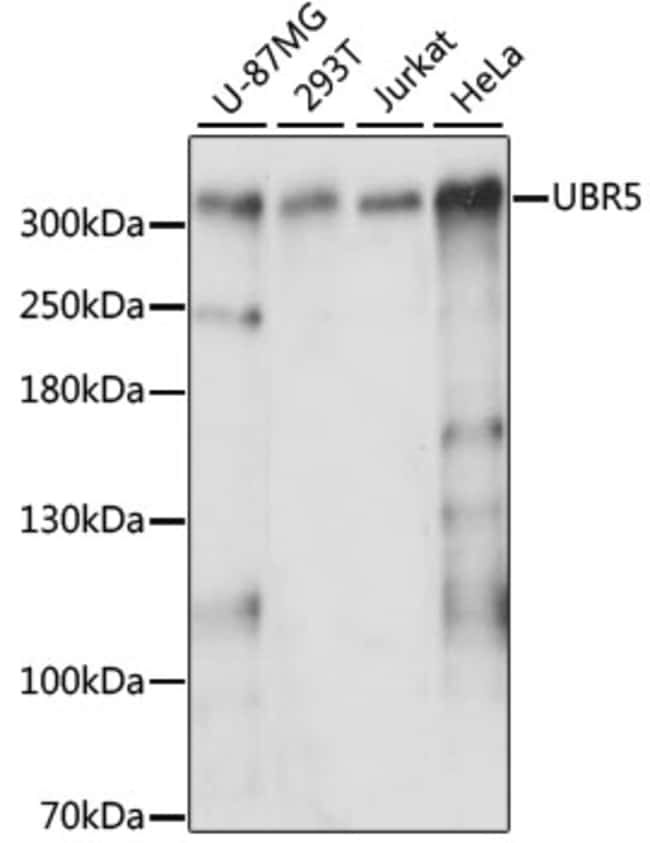
Immunogen sequence: SISAGIPKVG VLMESVWNMN DSCRFQLRSP ESLKNMEKAS KTTEAKPESK QEPVKTEMGP PPSPASTCSD ASSIASSASM PYKRRRSTPA PKEEEKVNEE QWSLREVVFV EDVKNVPVGK VLKVDGAYVA VKFPGTSSNT NCQNSSGPDA DPSSLLQDCR LLRIDELQVV KTGGTPKVPD CFQRTPKKLC IPEKTEILAV NVDSKGVHAV L; Positive Samples: U-87MG, 293T, Jurkat, HeLa; Cellular Location: Nucleus.
EDD (for E3 identified by Differential Display) is a progestin-regulated gene that was isolated from T-47D human breast cancer cells. Based on sequence homology, EDD appears to be a human homolog of the Drosophila hyperplastic discs (hyd) gene, a tumor suppressor gene that is required for control of imaginal disc growth. EDD contains a HECT domain in the carboxy terminus. HECT domain-containing proteins function as ubiquitin-protein ligases, or E3 enzymes. EDD has been shown to bind to ubiquitin, and like other HECT family proteins, may function as an E3 ubiquitin-protein ligase.
Specifications
Specifications
| Antigen | HYD |
| Applications | ELISA, Western Blot |
| Classification | Polyclonal |
| Concentration | 1.92 mg/mL |
| Conjugate | Unconjugated |
| Formulation | PBS with 50% glycerol and 0.01% thimerosal; pH 7.3 |
| Gene | UBR5 |
| Gene Accession No. | O95071 |
| Gene Alias | CH D1S3362; DD5; E3 identified by differential display; E3 ubiquitin-protein ligase UBR5; E3 ubiquitin-protein ligase, HECT domain-containing 1; ECGF1; Edd; Edd1; EDG1; EDG-1; extraembryonic development; HECT-type E3 ubiquitin transferase UBR5; hHYD; HYD; Hyperplastic discs protein homolog; KIAA0896; Progestin-induced protein; Rat100; S1P receptor 1; S1P receptor Edg-1; S1P1; S1PR1; ubiquitin protein ligase E3 component n-recognin 5; Ubr5 |
| Gene Symbols | UBR5 |
| Show More |