Learn More
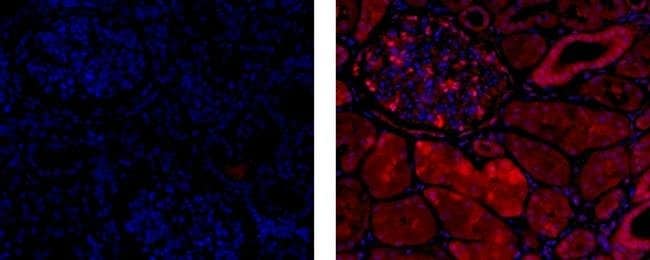
Invitrogen™ HSP70 Monoclonal Antibody (1B2hsp70), eFluor™ 660, eBioscience™


Description
Description: The monoclonal antibody 1B2hsp70 recognizes HSP (heat shock protein) 70. Hsps are highly conserved molecular chaperones that associate with proteins to stabilize or aid in the folding of new proteins or denatured proteins following chemical or physical stress. Hsp expression is both constitutive and inducible depending on the cell and its surrounding conditions. Hsps have been known to be upregulated in conditions such as cancer, ischemic injury, inflammatory, and demyelinating disease. This antibody recognizes the Hsp70 family member 1A found in the cytoplasm and nucleus of numerous cell types. Given the high degree of conservation of this protein across species, the 1B2hsp70 clone is expected to recognize canine and monkey HSP70 1a. Applications Reported: This 1B2 antibody has been reported for use in immunohistochemical staining of formalin-fixed paraffin embedded tissue sections, and microscopy. Applications Tested: This 1B2 antibody has been tested by immunohistochemistry on formalin-fixed paraffin embedded human tissue using low or high pH antigen retrieval and can be used at less than or equal to 10 μg/mL. It is recommended that the antibody be carefully titrated for optimal performance in the assay of interest. eFluor® 660 is a replacement for Alexa Fluor® 647. eFluor® 660 emits at 659 nm and is excited with the red laser (633 nm). Please make sure that your instrument is capable of detecting this fluorochome. Excitation: 633-647 nm; Emi...
Specifications
Specifications
| Antigen | HSP70 |
| Applications | Immunohistochemistry (Paraffin), Immunocytochemistry |
| Classification | Monoclonal |
| Clone | 1B2hsp70 |
| Concentration | 0.2 mg/mL |
| Conjugate | eFluor 660 |
| Formulation | PBS with 0.09% sodium azide; pH 7.2 |
| Gene | Hspa1l |
| Gene Accession No. | P0DMV8, P0DMV9, P34931, P34932, P54652 |
| Gene Alias | 68 kDa heat shock protein; 70 kda heat shock protein-2; 70 kilodalton heat shock protein; 87A; 87A locus; 87C locus; Bb; CG18743; CG31359; CG31359-PA; CG31366; CG31366-PA; CG31449; CG6489; chaperone; dHSP70; dhsp70Aa; Dmel\CG31359; Dmel\CG31366; Dmel_CG31359; Dmel_CG31366; Dm-hsp70; DmHSP70AA; DMHSP7D1; dnaK-type molecular chaperone HSP70-1; epididymis secretory protein Li 103; Hcp70.1; heat shock 10kDa protein 1-like; heat shock 70; heat shock 70 kD protein 1; heat shock 70 kD protein 2; heat shock 70 kDa protein 1; heat shock 70 kDa protein 1/2; heat shock 70 kDa protein 1A; heat shock 70 kDa protein 1A/1B; heat shock 70 kDa protein 1B; Heat shock 70 kDa protein 1-Hom; Heat shock 70 kDa protein 1L; heat shock 70 kDa protein 1-like; heat shock 70 kDa protein 2; Heat shock 70 kDa protein 3; heat shock 70 kDa-like protein 1; heat shock 70kD protein 1A; heat shock 70kD protein 1B; heat shock 70kD protein 1B (mapped); heat shock 70kD protein-like 1; heat shock 70kDa protein 1A; heat shock 70kDa protein 1B; heat shock 70kDa protein 1-like; heat shock cognate 70-kd protein, tandem duplicate 2; Heat shock protein; heat shock protein 1A; heat shock protein 1B; heat shock protein 1-like; heat shock protein 70; heat shock protein 70.1; heat shock protein 70.2; heat shock protein 70-1; Heat shock protein 70-1l; Heat shock protein 70Aa; Heat shock protein 70Ab; Heat shock protein 70Ba; Heat shock protein 70Bb; Heat shock protein 70Bc; heat shock protein cognate 70, testis; heat shock protein family A (Hsp70) member 1 like; heat shock protein family A (Hsp70) member 1A; heat shock protein family A (Hsp70) member 1B; heat shock protein, 70 kDa 1; heat shock protein, 70 kDa 3; heat shock protein-70; heat shock-induced protein; heat shock-related protein hsc70t; heat-shock 70-kilodalton protein 1A; heat-shock 70-kilodalton protein 1B; heat-shock protein 70; Heat-shock-protein-70Aa; Heat-shock-protein-70Bb; HEL S 103; HEL-S-103; hs70; Hsc70t; HSP; Hsp 70; hsp68; Hsp70; Hsp-70; HSP70 1; HSP70 1B; HSP70 2; hsp70 87A; hsp70 87C; hsp70 Aa; HSP70 AceyltK77; hsp70(87A); Hsp70(87C); HSP70.1; HSP70.1/2; HSP70.1/HSP70.2; HSP70.2; Hsp70.3; HSP70-1; HSP70-1/HSP70-2; HSP70-1A; HSP70-1B; HSP70-1L; HSP70-2; Hsp70-3; HSP70-87A7; HSP70-87C1; hsp70a; hsp70A1; Hsp70A7d; Hsp70Aa; Hsp-70Aa; Hsp70Aa-PA; Hsp70Ab; Hsp70B; Hsp70Ba; Hsp70Bb; Hsp70Bbc; Hsp70Bb-PA; Hsp70Bc; HSP70-HOM; HSP70I; HSP70T; HSP72; Hspa1; Hspa1a; HSPA1B; Hspa1l; Hspa2; HSPA4; Hspa70; HSX70; hum70t; inducible heat shock protein 70; LP05203p; LP05233p; LP08776p; Major heat shock 70 kDa protein Aa; Major heat shock 70 kDa protein Ab; Major heat shock 70 kDa protein Ba; Major heat shock 70 kDa protein Bb; Major heat shock 70 kDa protein Bc; Msh5; protein 70; si:ch73-46h18.6; si:dkeyp-69e1.1; Spermatid-specific heat shock protein 70; zgc:174006 |
| Show More |