Learn More
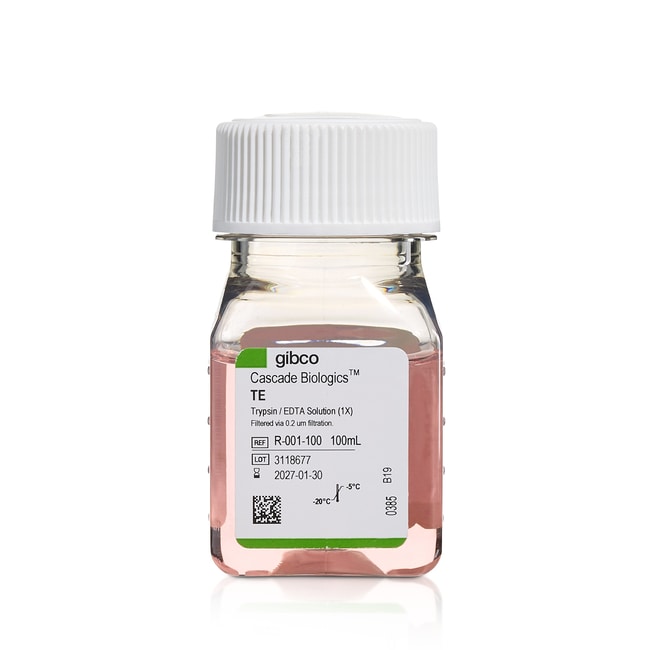
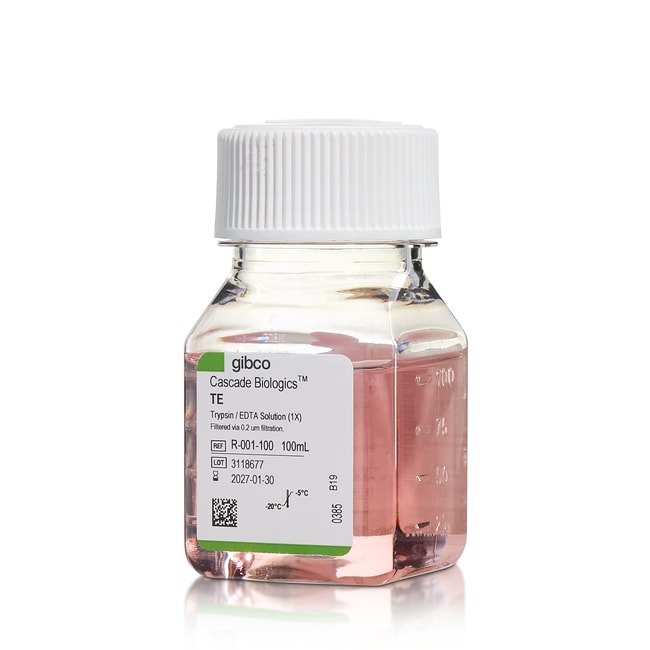
Gibco™ Trypsin/EDTA Solution (TE)


Description
Made from trypsin powder, an irradiated mixture of proteases derived from porcine pancreas. Widely used for cell dissociation, during routine cell culture passaging and primary tissue dissociation due to its digestive strength. Solution formulated as 0.025% trypsin and 0.01% EDTA in Phosphate Buffered Saline (PBS).
Sustainable packaging
Cell Culture, Corneal Epithelial Cell Culture, Fibroblast Culture, Keratinocyte Culture, Large Vessel Endothelial Cell Culture, Mammalian Cell Culture, Mammary Epithelial Cell Culture, Melanocyte Culture, Microvascular Endothelial Cell Culture, Primary Cell Culture, Smooth Muscle Cell Culture
Order Info
Shipping Condition: Room Temperature
Compliance
Manufactured at a cGMP compliant facility that is registered with the FDA as a medical device manufacturer and is certified to ISO 13485 standards.
Specifications
Specifications
| Chelators | EDTA |
| Content And Storage | Storage conditions: -5 to -20°C Shipping conditions: Ambient Shelf life: 18 months from date of manufacture |
| Cell Type | Mammalian Cells |
| Classification | Animal Origin-free |
| Concentration | 1 X |
| Form | Liquid |
| Product Type | Cell Culture Dissociation Reagent |
| Sterility | Sterile-filtered |
| With Additives | Phenol Red, EDTA |
| pH | 7.4 |
| Show More |
Frequently Asked Questions (FAQs)
Generally speaking, trypsin can be stored refrigerated for up to a week. However, this may vary depending on how often it is warmed up and used during that week. It may also depend on how tightly the cells are attached, because there will be some loss of activity each day the trypsin is not frozen.
Yes, the TrypLE products contain rProtease, a non-animal, trypsin-like enzyme used for the dissociation of attachment dependent cell lines. TrypLE enzyme has demonstrated the ability to dissociate cells cultured both in serum-free and serum-supplemented systems. The catalog numbers for TrypLE Select are 12563-011 (100 mL) and 12563-029 (500 mL). Some example catalog numbers for TrypLE Express include 12604-013 without Phenol red (100 mL) and 12605-010 with Phenol red (100 mL). Both formulations are also available in additional sizes. All these products are animal origin-free.
All the above products contain rProtease, a non-animal, trypsin-like enzyme formulation used for the dissociation of attachment-dependent cell lines. This alternative for porcine trypsin is a recombinant enzyme derived from microbial fermentation.
The TrpLE Express, TrypLE Select, and CTS TrypLE Select products differ in their production and testing methods and in the documentation provided.
TrypLE Select is for the industrial market and has release-testing both for endotoxins and enzyme activity. This material also has a Drug Master File on record. It is manufactured in AOF-dedicated equipment and is intended for Research Use/Further Cell Culture Manufacturing.
TrypLE Express is manufactured without use of dedicated equipment and is intended for Research Use Only. Not for use in diagnostic procedures.
CTS TrypLE Select is manufactured under scalable cGMP conditions using dedicated equipment and is designed for clinical applications. This product has a Drug Master File on record and is intended for Research Use or Manufacturing of Cell, Gene, or Tissue-Based Products. Not intended for direct administration into humans or animals.
To read more about TrypLE and cell release times using this reagent, please go here (https://www.thermofisher.com/us/en/home/life-science/cell-culture/mammalian-cell-culture/reagents/trypsin/tryple-express.html#1).
TrypLE reagent is free of animal- and human-derived components, producing an exceptionally pure reagent that is gentle on cells. Inactivation with trypsin inhibitors is not required. TrypLE reagent is ideal for dissociating a variety of attachment-dependent mammalian cell lines both in serum and in serum-free conditions, and can be directly substituted for trypsin in your current protocol. TrypLE reagent is room-temperature stable and ready to use when you need it. TrypLE cell dissociation reagents remain stable for 24 months at room temperature, making storage and handling easier and more convenient.
Please use this selection chart that compares our cell dissociation reagents (https://www.thermofisher.com/us/en/home/life-science/cell-culture/mammalian-cell-culture/reagents/trypsin.html).
For Research Use Only. Not for use in diagnostic procedures.