missing translation for 'onlineSavingsMsg'
Learn More
Learn More
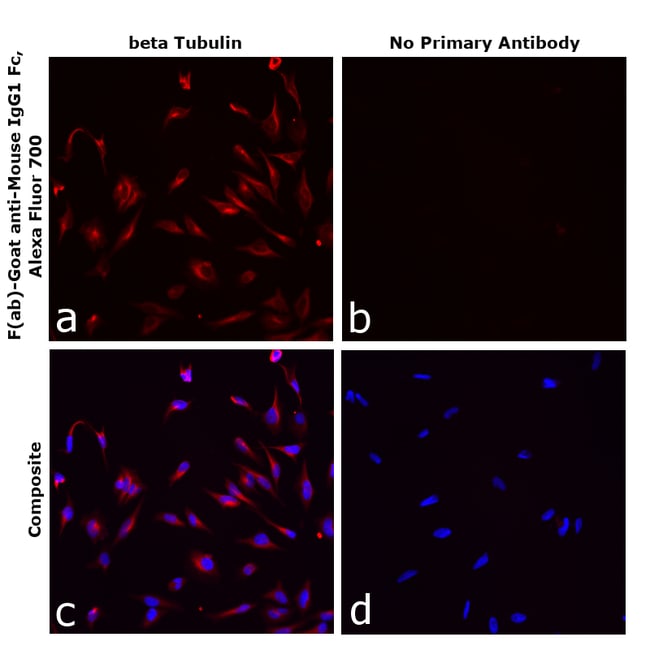
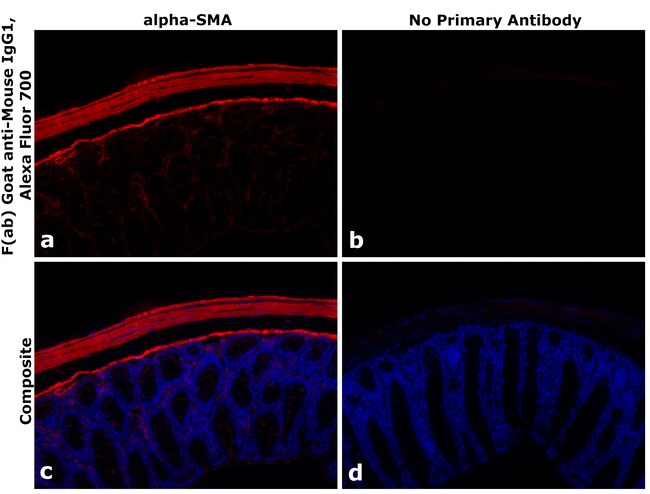
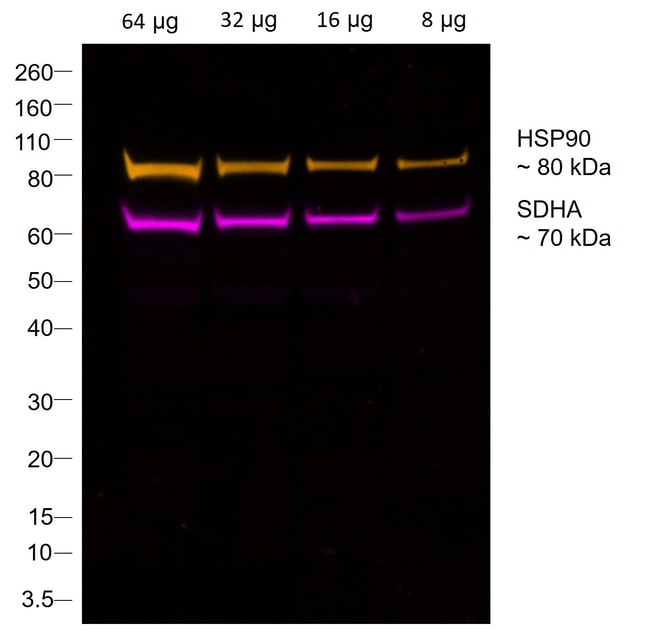
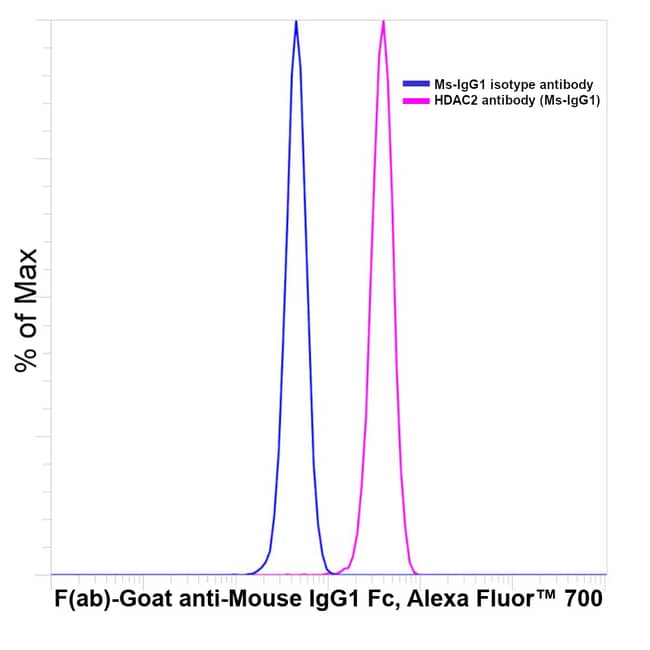
Invitrogen™ F(ab)-Goat anti-Mouse IgG1 Fc Secondary Antibody, Alexa Fluor™ 700
F(ab)-Goat Polyclonal Secondary Antibody
Supplier: Invitrogen™ A66791
Description
This F(ab)-Goat anti-Mouse IgG1 Fc specific antibody product is a goat polyclonal antibody F(ab) fragment that is specific to the Fc region of mouse IgG1 isotype. The product has minimal to no cross-reactivity towards mouse IgG2a, mouse IgG2b, mouse IgG3, polyclonal rat, rabbit, guinea pig, bovine, hamster, horse, sheep, human, monkey, donkey IgG, and chicken IgY as tested by direct ELISA. May show mild cross-reactivity with rat IgG2a. Cross-reactivity towards other immunoglobulins has not been tested. It is recommended that the antibody be carefully titrated for optimal performance in the assay of interest. F(ab) antibody fragment offer several benefits over whole IgGs, due to their smaller size (~50 kD vs. ~150 kD) and the absence of the Fc region. The smaller size is expected to allow better penetration into tissue sections and improved staining in applications such as IHC. The lack of Fc region results in reduced nonspecific background staining when staining cells/ tissues with Fc receptors (such as immune cells) and other Fc interaction-related interference. Fc specific F(ab) fragments provide a range of multiplexing options beyond what is possible with whole IgGs for applications such as immunocytochemistry, immunohistochemistry, flow cytometry, and western blotting. Using conjugate solutions: Centrifuge the protein conjugate solution briefly in a microcentrifuge before use; add only the supernatant to the experiment. This step will help eliminate any protein aggrega...
Anti-Mouse secondary antibodies are affinity-purified antibodies with well-characterized specificity for mouse immunoglobulins and are useful in the detection, sorting or purification of its specified target. Secondary antibodies offer increased versatility enabling users to use many detection systems (e.g. HRP, AP, fluorescence). They can also provide greater sensitivity through signal amplification as multiple secondary antibodies can bind to a single primary antibody. Most commonly, secondary antibodies are generated by immunizing the host animal with a pooled population of immunoglobulins from the target species and can be further purified and modified (i.e. immunoaffinity chromatography, antibody fragmentation, label conjugation, etc.) to generate highly specific reagents.Specifications
| Mouse IgG1 Fc | |
| Polyclonal | |
| Alexa Fluor 700 | |
| Goat | |
| Size-exclusion chromatography | |
| RUO | |
| Mouse | |
| Secondary Antibody | |
| IgG F(ab) |
| Peptide Array, Flow Cytometry, Immunohistochemistry (Paraffin), Immunohistochemistry (PFA fixed), Western Blot, Immunocytochemistry | |
| 0.2 mg/mL | |
| PBS with 5mM sodium azide; pH 7.5 | |
| Mouse IgG1 Fc. | |
| 50 μg | |
| Secondary | |
| 4°C, store in dark, DO NOT FREEZE! | |
| Liquid |