Learn More
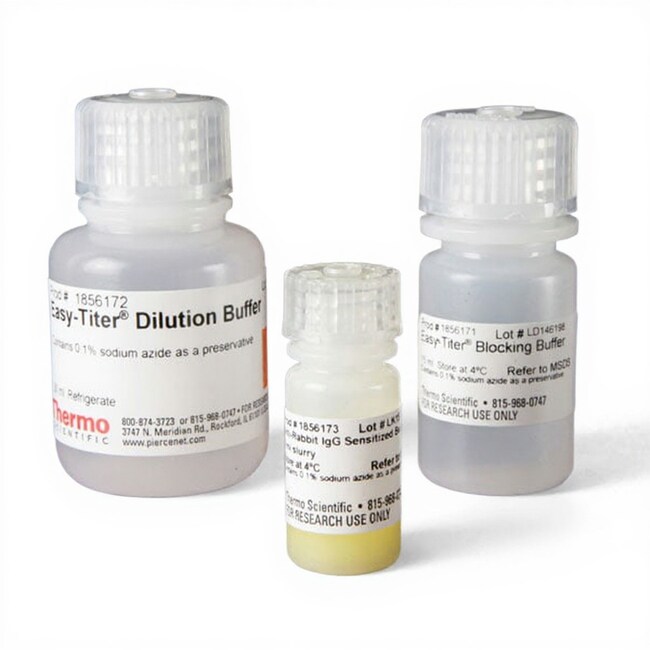
Thermo Scientific™ Easy-Titer™ Trousse d’analyse IgG pour le lapin
Description
Thermo Scientific™ Easy-Titer Les kits d’analyse d’anticorps permettent de déterminer avec précision la concentration d’anticorps dans le surnageant sérique et en culture, et incluent des kits spécifiques pour l’IgG de souris, l’IgG de lapin, l’IgG humain (H+L), l’IgG humain (Fc) ou l’IgM humain.
Points clés :
Les kits pour cinq cibles – populaires choisissent un kit spécifique à une espèce et une classe particulière d’immunoglobulines; pas de réaction croisée avec d’autres espèces et classes de l’anticorps cible
La spécificité – basée sur les anticorps mesure la concentration de l’anticorps cible dans un échantillon, pas seulement la protéine totale; pas besoin de purifier l’anticorps pour évaluer sa concentration
Plus rapide et plus facile que ELISA – le test homogène à trois composantes; Temps total d’incubation de 10 minutes
Aucun équipement spécial n’utilise – un mélangeur de vortex standard, une pipette, une microplaque à 96 puits, un secoueur de plaques et un lecteur (mesurer l’absorption à 340 nm ou 400 nm)
Plage de test sensible – (courbe standard) de 8 à 500 ng/mL; nécessite un échantillon de départ d’au moins 300 ng/mL
Coefficient de variation reproductible – inférieur à 5%; l’erreur dépend de la dilution et de la technique de pipetage
Les normes d’anticorps vendues séparément – utilisent tout standard d’anticorps ayant une identité cible appropriée et une concentration connue (supérieure à 10 μg/mL)
Easy-Titer Les tests d’anticorps sont plus rapides et plus faciles que l’ELISA :
1. Préparer des étalons (5 à 500 ng/mL) en diluant les anticorps purifiés dans un tampon de dilution en kit
2. Préparez les échantillons en diluant au moins 20 fois dans le tampon de dilution jusqu’à la plage du test (8 à 500 ng/mL).
3. Fiole vortex de billes de microsphère pour créer une suspension homogène.
4. Pipette de 20 μL de suspension à billes et 20 μL de chaque échantillon standard dans des puits de microplaques à 96 puits.
5. Incuber la microplaque pendant 5 minutes avec un mélange vigoureux.
6. Ajouter 100 μL de réactif bloquant le kit.
7. Incuber la microplaque pendant 5 minutes avec un mélange vigoureux.
8. Mesurer l’absorbance sur un lecteur de plaques standard (340 nm ou 405 nm).
9. Tracer la courbe standard et interpoler les échantillons pour déterminer la concentration.
Comprend :
Chaque kit contient des microsphères IgG sensibilisées spécifiques à la cible, un tampon de dilution et un tampon de blocage
Spécifications
Spécifications
| Aperçu général | Easy-Titer Trousse d’analyse IgG pour le lapin |
| À utiliser avec (application) | Détection basée sur la solution, absorbance |
| Méthode de détection | Colorimétrique |
| Essai | Test de quantification des protéines, dosage d’isotypage, immunotest |
| Contenu et stockage | Suffisant pour : 96 tests au total (dont 9 standards par utilisation) • billes anti-lapins sensibilisées à l’IgG de chèvre, tampon de dilution de 2 mL • Easy-Titer, tampon de blocage de 30 mL • Easy-Titer, stockage de 15 mL à 4 °C (ne pas congeler). |
| Quantité | 96 Tests |
| Gamme de produit | Easy-Titer |
| À utiliser avec (équipement) | Spectrophotomètre, lecteur de microplaques |
| Spécificité de la cible | Cible spécifique |
Usage exclusivement réservé à la recherche. Ne pas utiliser dans des procédures de diagnostic.