Learn More
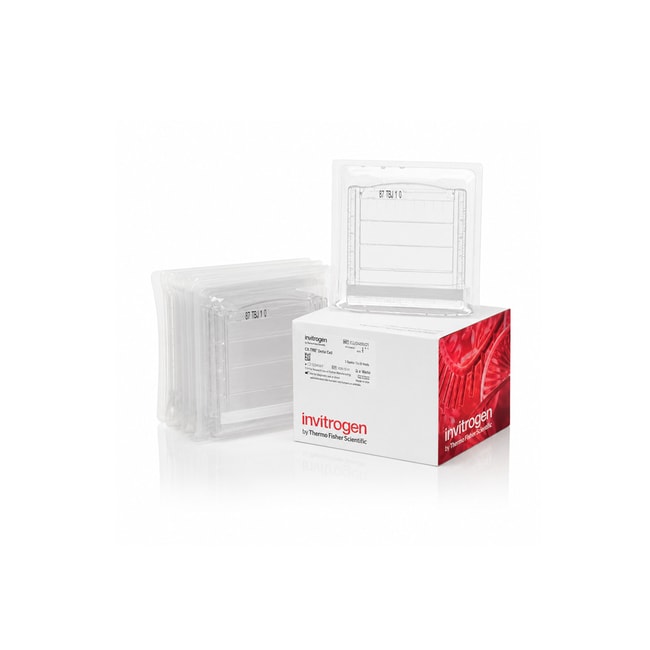
Invitrogen™ Gels de retardation de l’ADN (6%), 1,0 mm

Description
Comprend
Les numéros de catalogue des gels correspondent à une seule boîte. Une boîte contient 10 gels
Novex™ Les gels de retardation de l’ADN sont du polyacrylamide à 6% préparé avec un tampon gel TBE 0,5X, offrant une résolution claire des fragments utilisés pour les tests de retard de l’ADN à partir de 60 –2500 pb. Cette préparation est bonne pour la séparation électrophorétique, mais suffisamment faible pour favoriser les interactions ADN-protéine. Novex Les gels de retardation de l’ADN sont conçus pour fonctionner sur la XCell SureLock™ Mini-Cellule et sont disponibles en formats à 10, 12 ou 15 puits.
• Fragments d’ADN allant de 60 à 2 500 pb
• Préparés avec 0,5X TBE comme tampon
• gel Conçus pour fonctionner sur la mini-cellule
• XCell SureLock Disponible en formats
• 10, 12 et 15 puits Fabriqués avec une base tris de haute pureté, de l’acide borique, de l’EDTA, de l’acrylamide, de la bisacrylamide, du TEMED, et APS
Pour assurer les meilleurs résultats possibles, ces gels sont à usage unique et emballés individuellement. La détection se fait par coloration à l’ADN au bromure d’ethidium ou, pour une plus grande sensibilité, par radiomarquage de l’ADN ou de la protéine.
Formulation
Novex Les gels de retardation de l’ADN sont fabriqués avec des bases tris de haute pureté, de l’acide bolique, de l’EDTA, de l’acrylamide, de la bisacrylamide, du TEMED et APS
des tampons
recommandés. Pour des performances optimales, Novex™ le tampon TBE Running Buffer et Novex™ le tampon d’échantillon TBE à haute densité sont fortement recommandés pour ces gels. Novex Le tampon d’échantillon TBE à haute densité contient les colorants de suivi Bromophénol Blue et Xylène Cyanol ainsi que l’agent Ficoll™ densité , qui donne des bandes plus nettes et plus droites que les agents de densité conventionnels.
Order Info
Condition d’expédition : glace humide
Spécifications
Spécifications
| Contenu et stockage | • Le numéro de catalogue fait référence à une seule boîte de 10 gels à Stocker à 4 °C. |
| Aperçu général | Gels de retardation de l’ADN, 10 puits |
| Pourcentage de gel | 6% |
| Épaisseur du gel | 1 mm |
| Type de gel | Retard de l’ADN |
| Plage de séparation | 60 à 2500 pb |
| Puits | 10 puits |
| Quantité | 10 gels/boîte |
| Type de tampon d'échantillon | Tampon d’échantillon TBE à haute densité (5X) |
| Type d’échantillon | ADN double brin (dsDNA) |
| Afficher plus de résultats |