Learn More
PeproTech CXCL14 Polyclonal Antibody, Biotin, PeproTech®, Invitrogen™

Description
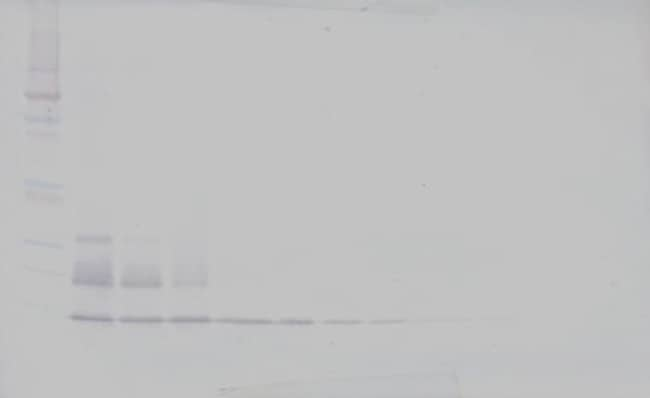
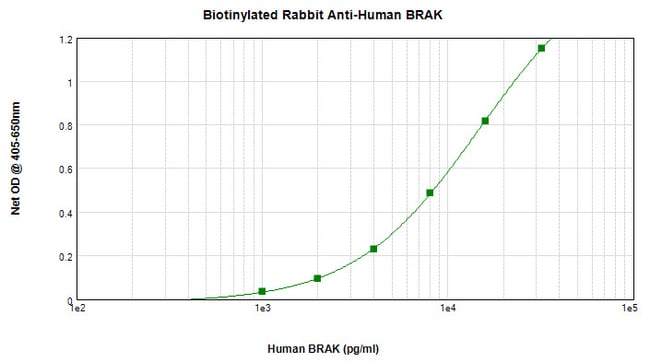
AA Sequence of recombinant protein: SKCKCSRKGP KIRYSDVKKL EMKPKYPHCE EKMVIITTKS VSRYRGQEHC LHPKLQSTKR FIKWYNAWNE KRRVYEE. Preparation: Produced from sera of rabbits immunized with highly pure Recombinant Human BRAK (CXCL14). Anti-Human BRAK (CXCL14)-specific antibody was purified by affinity chromatography and then biotinylated. Sandwich ELISA: To detect hBRAK by sandwich ELISA (using 100 μL/well antibody solution) a concentration of 0.25-1.0 μg/mL of this antibody is required. This biotinylated polyclonal antibody, in conjunction with PeproTech Polyclonal Anti-Human BRAK (500-P237) as a capture antibody, allows the detection of at least 0.2-0.4 ng/well of Recombinant hBRAK. Western Blot: To detect hBRAK by Western Blot analysis this antibody can be used at a concentration of 0.1-0.2 μg/mL. Used in conjunction with compatible secondary reagents the detection limit for Recombinant hBRAK is 1.5-3.0 ng/lane, under either reducing or non-reducing conditions. 500-P237BT-1MG will be provided as 2 x 500 μg
Specifications
Specifications
| Antigen | CXCL14 |
| Applications | ELISA, Western Blot |
| Classification | Polyclonal |
| Concentration | 0.1-1.0 mg/mL |
| Conjugate | Biotin |
| Formulation | PBS with no preservative |
| Gene | Cxcl14 |
| Gene Accession No. | O95715 |
| Gene Alias | 1110031L23Rik; 1200006I23Rik; AI414372; B-cell and monocyte-activating chemokine; BMAC; bolekine; BRAK; breast and kidney; C Cmotif chemokine; C X C motif chemokine; CC motif chemokine; CCmotif chemokine; chemokine (C-X-C motif) ligand 14; chemokine BRAK; CXC; CXC chemokine in breast and kidney; CXC motif chemokine; C-X-C motif chemokine 14; C-X-C motif chemokine ligand 14; CXCL; Cxcl14; hypothetical protein LOC511771; Kec; Kidney-expressed chemokine CXC; KS1; MGC10687; MIP-2 gamma; MIP2G; MIP-2g; MIP2gamma; musculus CXC chemokine MIP-2gamma; NJAC; PSEC0212; SCYB14; small inducible cytokine B14; small inducible cytokine subfamily B (Cys-X-Cys), member 14; small inducible cytokine subfamily B (Cys-X-Cys), member 14 (BRAK); small-inducible cytokine B14; tumor-suppressing chemokine; UNQ240/PRO273 |
| Gene Symbols | Cxcl14 |
| Show More |