Learn More
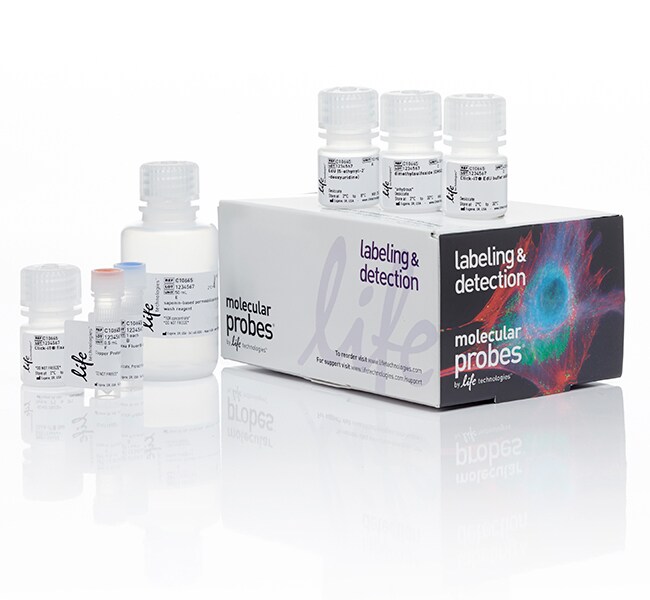
Invitrogen™ Click-iT™ Plus EdU Alexa Fluor™ 350 Flow Cytometry Assay Kit

Description
The Click-iT Plus EdU Alexa Fluor 350 Flow Cytometry Assay Kit provides a simplified, more robust assay for analyzing DNA replication in proliferating cells compared to traditional BrdU methods. Newly synthesized DNA is analyzed using the UV laser of the flow cytometer. The Click-iT Plus formulation is compatible with standard fluorophores, including R-PE and R-PE tandems, as well as fluorescent proteins.
- Multiplexable—compatible with R-PE (and tandems) and fluorescent proteins
- Accurate—superior results compared to BrdU assays
- Fast—results in as little as 60 minutes
Multiplexable
Click-iT Plus Alexa Fluor 350 EdU assays can be used in conjunction with R-PE and R-PE tandems, as well as fluorescent proteins such as GFP and mCherry. The Alexa Fluor 350 labeling reagent is excited readily at 350 nm with a UV laser and emits at 438 nm.
An Advanced Method Giving You Results Superior to BrdU
The most accurate method of proliferation analysis is direct measurement of DNA synthesis. Originally, this was performed through incorporation of radioactive nucleosides. This method was replaced by antibody-based detection of the nucleoside analog bromodeoxyuridine (BrdU). The Click-iT Plus EdU Flow Cytometry assay is a novel alternative to the BrdU assay. EdU (5-ethynyl-2´-deoxyuridine) is a thymidine analog that is incorporated into DNA during active DNA synthesis. Detection is based on click chemistry, which is a copper-catalyzed covalent reaction between an azide and an alkyne. In this application, the alkyne is found in the ethynyl moiety of EdU, while the azide is coupled to the Alexa Fluor dye. Standard flow cytometry methods are used for determining the percentage of S-phase cells in the population.
Mild Conditions Allow Use with Cell Cycle Dyes and Antibodies
The small size of the dye azide allows for efficient detection of the incorporated EdU using mild conditions, while standard aldehyde-based fixation and detergent permeabilization are sufficient for the Click-iT Plus detection reagent to gain access to the DNA. This is in contrast to BrdU assays that require DNA denaturation (using HCl, heat, or digestion with DNase) to expose the BrdU so that it can be detected with an anti-BrdU antibody. Sample processing for the BrdU assay can result in signal alteration of the cell cycle distribution, as well as destruction of antigen recognition sites when using the HCl method. In contrast, the easy-to-use Click-iT Plus EdU assay is compatible with cell cycle dyes. The Click-iT Plus EdU assay can also be multiplexed with antibodies against surface and intracellular markers, as well as conjugates labeled with standard fluorophores including R-PE, R-PE tandems, and fluorescent proteins (GFP and mCherry).
Quick and Simple Protocol
The Click-iT Plus EdU protocol is based on the aldehyde fixation and detergent permeabilization steps for immunohistochemical antibody labeling. However, EdU is compatible with other fixation/permeabilization agents including saponin and methanol. In just five steps you'll be ready to analyze your cell proliferation data:
- Treat cells with EdU
- Fix and permeabilize cells
- Detect S-phase cells with Click-iT Plus detection cocktail for 30 min.
- Wash once
- Analyze
Results can be seen in as little as 60 minutes in some circumstances, but we recommend 90 minutes for all applications.
Specifications
Specifications
| Content And Storage | • EdU (5-ethynyl-2'-deoxyuridine) • AlexaFluor 350 picolyl azide • Anhydrous dimethylsulfoxide (DMSO) • Click-iT fixative • Click-iT saponin-based permeabilization • Wash buffer • Copper Protectant • Click-iT EdU buffer additive Store at 2°C to 8°C, dessicate, and protect from light. |
| For Use With (Equipment) | Flow Cytometer |
| Product Type | Reagent |
| Format | Kit |
| Product Line | Alexa Fluor, Click-iT |
| Quantity | 50 assays |
| Shipping Condition | Room Temperature |
| Emission Wavelength Range | 350/438 |
Frequently Asked Questions (FAQs)
We do not recommend using phalloidin conjugates for staining actin in combination with traditional Click-iT or Click-iT Plus reactions since phalloidin is extremely sensitive to the presence of copper.
For staining actin in combination with traditional Click-iT or Click-iT Plus reactions, we recommend using anti-α-actin antibodies for staining actin in the cytoskeleton. You can find a list of our actin antibodies here.
Another option would be to use the Click-iT Plus Alexa Fluor Picolyl Azide Toolkit (Cat. Nos. C10641, C10642, C10643). These Click-iT Plus toolkits provide Copper and Copper protectant separately which makes it easier to titrate the copper concentration to obtain optimal labeling with minimal copper-mediated damage. You may need to optimize the click reaction with the lowest possible concentration of copper and then perform the phalloidin staining.
The click reaction is only effective when copper is in the appropriate valency. Azides and alkynes will not react with each other without copper. Make sure that the click reaction mixture is used immediately after preparation when the copper (II) concentration is at its highest.
Do not use additive buffer that has turned yellow; it must be colorless to be active.
Cells need to be adequately fixed and permeabilized for the TdT enzyme and click reagents to have access to the nucleus. Tissue samples require digestion with proteinase K or other proteolytic enzymes for sufficient TdT access.
Some reagents can bind copper and reduce its effective concentration available to catalyze the click reaction. Do not include any metal chelator (e.g., EDTA, EGTA, citrate, etc.) in any buffer or reagent prior to the click reaction. Avoid buffers or reagents that include other metal ions that may be o xidized or reduced. It may be help to include extra wash steps on the cell or tissue sample before performing the click reaction.
You can repeat the click reaction with fresh reagents to try to improve signal. Increasing the click reaction time longer than 30 minutes will not improve a low signal. Performing a second, 30 minute incubation with fresh click reaction reagents is more effective at improving labeling.
Your cells may not be apoptotic. Prepare a DNase I-treated positive control to verify that the TdT enzymatic reaction and click labeling reaction are working correctly.
The click reaction is very selective between an azide and alkyne. No other side reactions are possible in a biological system. Any non-specific background is due to non-covalent binding of the dye to various cellular components. The Select FX Signal Enhancer is not effective at reducing non-specific charge-based binding of dyes following the click reaction; we do not recommend its use with the Click-iT detection reagents. The best method to reduce background is to increase the number of BSA washes. You should always do a no-dye or no-click reaction control under the same processing and detection conditions to verify that the background is actually due to the dye and not autofluorescence. You should also perform the complete click reaction on a no-TdT enzyme control sample to verify the specificity of the click reaction signal.
The copper in the click reaction denatures DNA to a small extent (although not as much as is required for efficient BrdU detection), which can affect the binding affinity of DNA dyes including DAPI and Hoechst stain. This effect should only be apparent with the classic EdU kits and not the Click-iT Plus EdU kits, which use a lower copper concentration.
The click reaction is only effective when copper is in the appropriate valency. Except for the DIBO alkyne-azide reaction, azides and alkynes will not react with each other without copper. Make sure that the click reaction mixture is used immediately after preparation when the copper (II) concentration is at its highest.
Do not use additive buffer that has turned yellow; it must be colorless to be active.
Cells need to be adequately fixed and permeabilized for the click reagents to have access to intracellular components that have incorporated the click substrate(s).
Some reagents can bind copper and reduce its effective concentration available to catalyze the click reaction. Do not include any metal chelator (e.g., EDTA, EGTA, citrate, etc.) in any buffer or reagent prior to the click reaction. Avoid buffers or reagents that include other metal ions that may be oxidized or reduced. It may be help to include extra wash steps on the cell or tissue sample before performing the click reaction.
You can repeat the click reaction with fresh reagents to try to improve signal. Increasing the click reaction time longer than 30 minutes will not improve a low signal. Performing a second, 30 minute incubation with fresh click reaction reagents is more effective at improving labeling.
Low signal can also be due to low incorporation of EdU, EU, or other click substrates. Other click substrates (e.g., AHA, HPG, palmitic acid, azide, etc.) incorporated into cellular components may have been lost if not adequately cross-linked in place or if the wrong fixative was used. For click substrates that are incorporated into the membrane or lipids, you should avoid the use of alcohol or acetone fixatives and permeabilizing agents.
The incorporated click substrate must be accessible at the time of the click reaction; labeling of incorporated amino acid analogs may be lower in native proteins relative to denatured proteins.
You may need to optimize the metabolic labeling conditions including analog incubation time or concentration. Cells that are healthy, not too high of a passage number and not too crowded may incorporate the analog better. You may create a positive control by including extra doses of the click substrate during multiple time points during an incubation time that spans or closely spans the doubling time of the cell type of interest.
For Research Use Only. Not for use in diagnostic procedures.