missing translation for 'onlineSavingsMsg'
Learn More
Learn More

Invitrogen™ Claudin 4 Monoclonal Antibody (3E2C1)

Mouse Monoclonal Antibody
Supplier: Invitrogen™ LS329400

Description
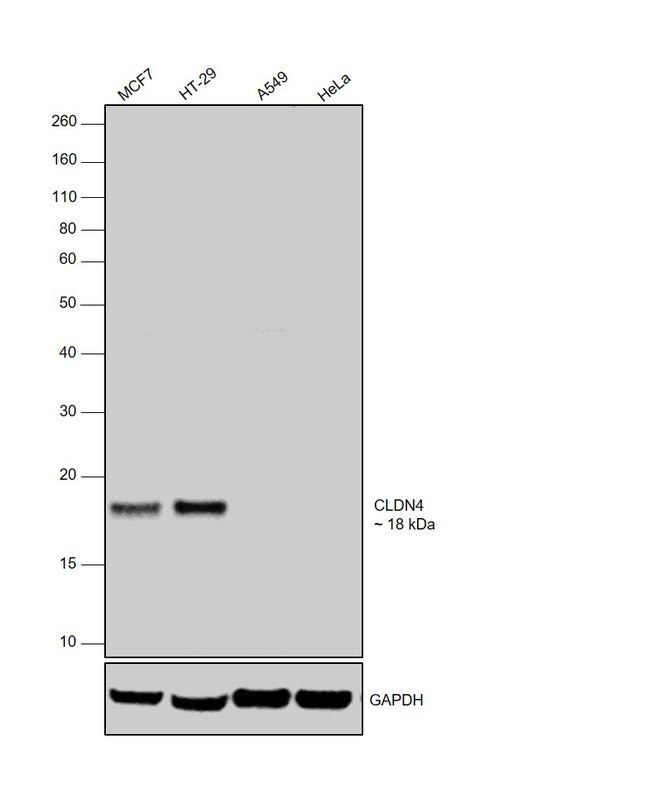
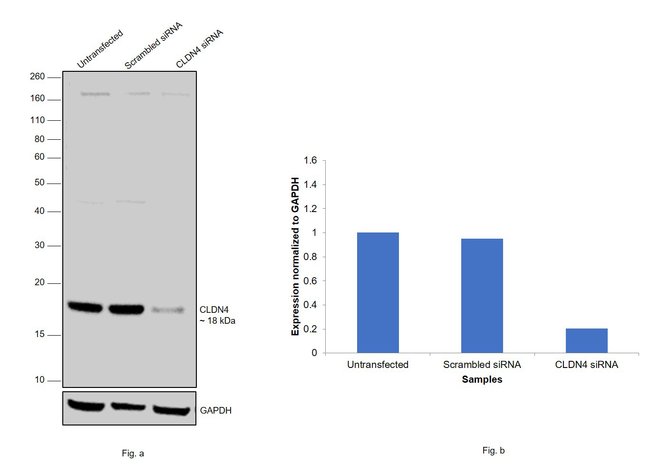
Reactivity has been confirmed with human, rat ileum homogenates, and canine MDCK cell lysates by western blotting and immunofluorescence. Reactivity has also been confirmed with formalin-fixed, paraffin-embedded (FFPE) human normal colon and colon cancer tissues by immunohistochemistry. For best results in immunohistochemistry with formalin-fixed, paraffin-embedded (FFPE) tissues, heat induced epitope retrieval (HIER) with citrate buffer, pH 6.0, is required prior to staining. This antibody reacts specifically with the ~ 22 kDa Claudin-4 protein and does not cross-react with the protein at 55 kDa.
Claudin-4 belongs to the 20-member family of claudins, transmembrane cellular adhesion proteins localized at epithelial and endothelial tight junctions. Claudins demonstrate distinct, tissue-specific expression patterns, and are essential components of tight junction charge-specific channels that regulate paracellular ion flux. Claudin-4 is a component of tight junction strands and may play a role in internal organ development and function during pre- and postnatal life. The overexpression of Claudin-4 has been shown to decrease paracellular electrical conductance due to a selective decrease in Na+ permeability, with no significant decrease in Cl- permeability. In ovarian carcinoma cells, Claudin-3 and Claudin-4 exhibit upregulation at both mRNA and protein levels. Claudin-4 is also overexpressed in pancreatic cancer tissues and cell lines, and in other epithelial cancers. The Claudin-4 gene is deleted in Williams-Beuren syndrome, a neurodevelopmental disorder affecting multiple systems.Chemical Identifiers
| Claudin 4 | |
| 0.5 mg/mL | |
| Immunohistochemistry, Western Blot | |
| Unconjugated | |
| Mouse | |
| RUO | |
| PBS with 0.1% sodium azide; pH 7.4 | |
| O14493, O35054 | |
| 100856416, 12740, 1364, 304407 | |
| Synthetic peptide corresponding to a 22 amino acid sequence derived from the C-terminal region of human Claudin-4. | |
| Antibody |
| 3E2C1 | |
| -20°C | |
| Monoclonal | |
| Liquid | |
| IgG1 | |
| Human, Mouse, Rat, Canine | |
| Cldn4 | |
| Cep-r; claudin 4; CLAUDIN4; claudin-4; CLDN4; Clostridium perfringens enterotoxin receptor; Clostridium perfringens enterotoxin receptor 1; CPER; CPE-R; CPE-receptor; Cpetr; CPETR1; h CPE-receptor; hCPE-R; WBSCR8; Williams-Beuren syndrome chromosomal region 8 protein | |
| Cldn4 | |
| Primary | |
| Protein A |
Specifications
| Claudin 4 | |
| Monoclonal | |
| 0.5 mg/mL | |
| PBS with 0.1% sodium azide; pH 7.4 | |
| O14493, O35054 | |
| Cldn4 | |
| Synthetic peptide corresponding to a 22 amino acid sequence derived from the C-terminal region of human Claudin-4. | |
| 100 μg | |
| Primary | |
| Human, Mouse, Rat, Canine | |
| Antibody | |
| IgG1 |
| Immunohistochemistry, Western Blot | |
| 3E2C1 | |
| Unconjugated | |
| Cldn4 | |
| Cep-r; claudin 4; CLAUDIN4; claudin-4; CLDN4; Clostridium perfringens enterotoxin receptor; Clostridium perfringens enterotoxin receptor 1; CPER; CPE-R; CPE-receptor; Cpetr; CPETR1; h CPE-receptor; hCPE-R; WBSCR8; Williams-Beuren syndrome chromosomal region 8 protein | |
| Mouse | |
| Protein A | |
| RUO | |
| 100856416, 12740, 1364, 304407 | |
| -20°C | |
| Liquid |