Learn More
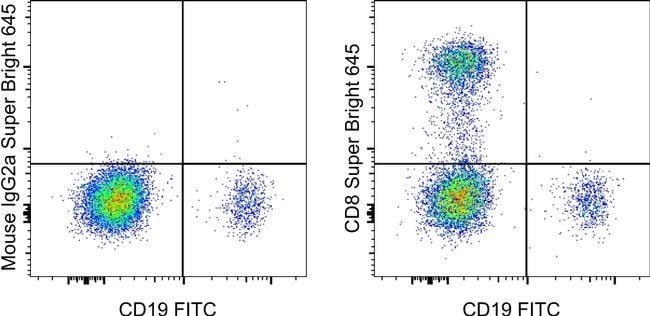
Invitrogen™ CD8a Monoclonal Antibody (OKT8 (OKT-8)), Super Bright™ 645, eBioscience™, Invitrogen™


Description
Description: The RPA-T8 monoclonal antibody reacts with the human CD8a molecule, an approximately 32-34 kDa cell surface receptor expressed either as a heterodimer with the CD8 beta chain (CD8 alpha/beta) or as a homodimer (CD8 alpha/alpha). A majority of thymocytes and a subpopulation of mature T cells and NK cells express CD8a. CD8 binds to MHC class I and through its association with protein tyrosine kinase p56lck plays a role in T-cell development and activation of mature T cells. Applications Reported: This RPA-T8 antibody has been reported for use in flow cytometric analysis. Applications Tested: This RPA-T8 antibody has been pre-titrated and tested by flow cytometric analysis of normal human peripheral blood cells. This can be used at 5 μL (0.125 μg) per test. A test is defined as the amount (μg) of antibody that will stain a cell sample in a final volume of 100 μL. Cell number should be determined empirically but can range from 10^5 to 10^8 cells/test. Super Bright 645 is a tandem dye that can be excited with the violet laser line (405 nm) and emits at 645 nm. We recommend using a 660/20 bandpass filter. Please make sure that your instrument is capable of detecting this fluorochrome. When using two or more Super Bright dye-conjugated antibodies in a staining panel, it is recommended to use Super Bright Staining Buffer (cat. SB-4400) to minimize any non-specific polymer interactions.
Specifications
Specifications
| Antigen | CD8a |
| Applications | Flow Cytometry |
| Classification | Monoclonal |
| Clone | OKT8 (OKT-8) |
| Concentration | 5 μL/Test |
| Conjugate | Super Bright 645 |
| Formulation | PBS with BSA and 0.09% sodium azide; pH 7.2 |
| Gene | Cd8a |
| Gene Accession No. | P01732, P10966 |
| Gene Alias | BB154331; CD8; CD8 alpha; CD8 alpha chain; CD8 alpha chain precursor; CD8 antigen; CD8 antigen 32 kDa chain; CD8 antigen 37 kDa chain; CD8 antigen alpha polypeptide; CD8 antigen alpha protein; CD8 antigen alpha protein precursor; CD8 antigen alpha-chain; CD8 antigen beta polypeptide; CD8 antigen beta polypeptide precursor; CD8 antigen beta-chain; CD8 antigen, alpha chain; CD8 antigen, alpha polypeptide; CD8 antigen, alpha polypeptide (p32); CD8 antigen, alpha-chain; CD8 antigen, beta chain; CD8 antigen, beta chain 1; CD8 antigen, beta polypeptide; CD8 antigen, beta polypeptide 1 (p37); CD8 antigen, beta-chain; CD8 beta; CD8 beta chain; CD8 beta-2; CD8a; CD8A antigen alpha; CD8a molecule; CD8A; T-cell surface glycoprotein; CD8alpha; CD8B; CD8b antigen; CD8b molecule; CD8b molecule pseudogene; Cd8b1; CD8beta; CD8BP; fCD8; LEU2; Leu-2; Leu2 T-lymphocyte antigen; leu-2a; Ly-2; LY3; Ly-3; Ly-35; Ly-B; Ly-C; Lymphocyte antigen 3; Lyt2; Lyt-2; Lyt-2.1 lymphocyte differentiation antigen (AA at 100); Lyt3; Lyt-3; MAL; membrane glycoprotein; membrane protein; OKT8 T-cell antigen; OX-8 membrane antigen; p32; P37; RHACD8-4; T cell co-receptor; T lymphocyte surface glycoprotein beta chain; T8 T-cell antigen; T-cell antigen Leu2; T-cell membrane glycoprotein Ly-3; T-cell surface glycoprotein; T-cell surface glycoprotein CD8 alpha chain; T-cell surface glycoprotein CD8 beta chain; T-cell surface glycoprotein Lyt-2; T-cell surface glycoprotein Lyt-3; T-cell surface molecule; T-lymphocyte differentiation antigen T8/Leu-2; type I transmembrane glycoprotein |
| Show More |