missing translation for 'onlineSavingsMsg'
Learn More
Learn More
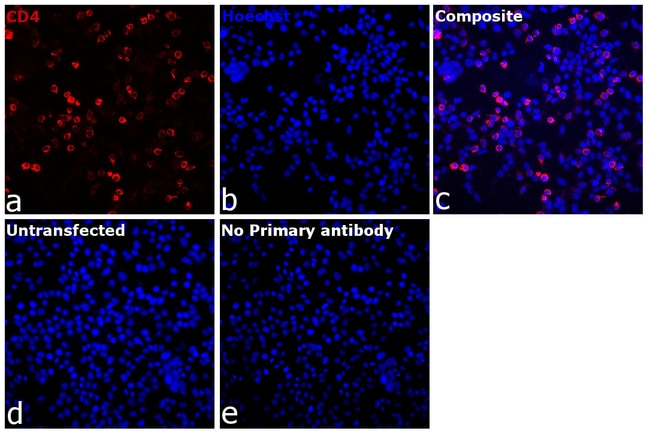
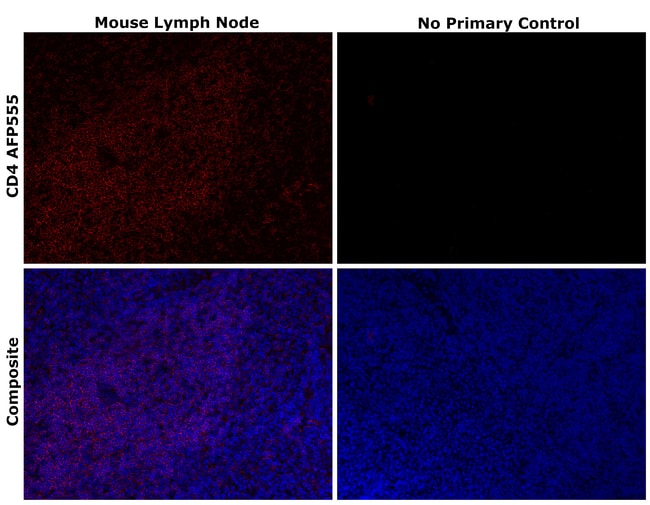
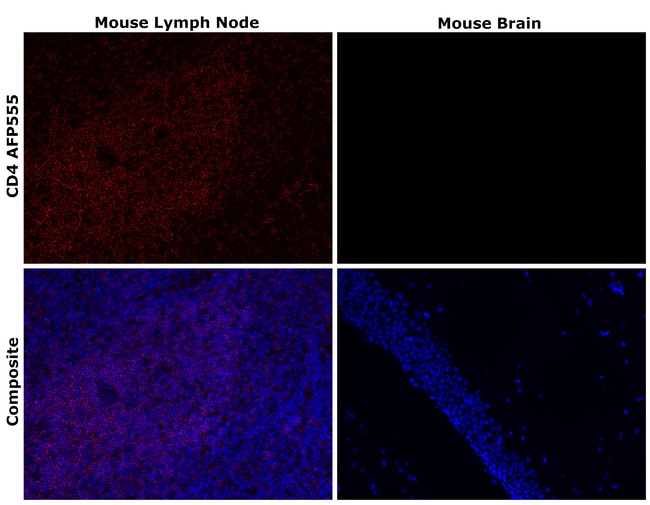
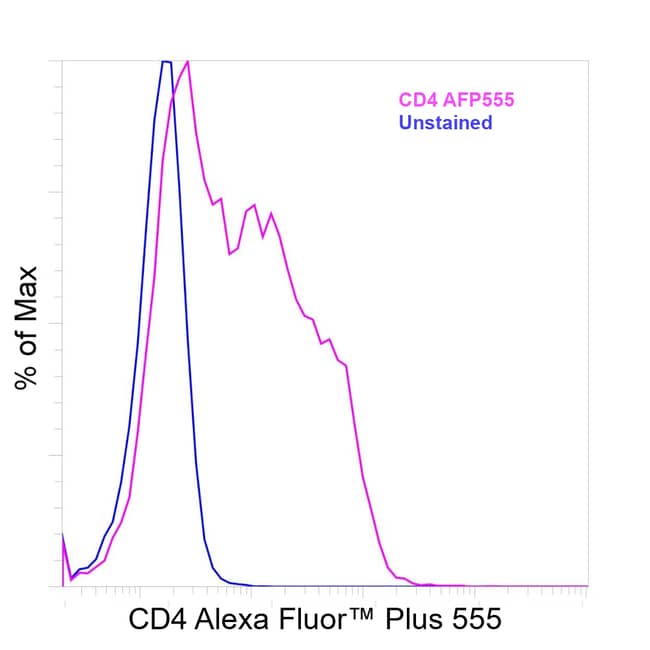
Invitrogen™ CD4 Recombinant Rat Monoclonal Antibody (4SM95), Alexa Fluor™ Plus 555
Rat Recombinant Monoclonal Antibody
$607.04 - $960.35
Specifications
| Antigen | CD4 |
|---|---|
| Clone | 4SM95 |
| Concentration | 1 mg/mL |
| Content And Storage | 4°C, store in dark, DO NOT FREEZE! |
| Applications | Flow Cytometry, Immunohistochemistry (Paraffin), Immunocytochemistry |
| Catalog Number | Mfr. No. | Quantity | Price | Quantity | |||||
|---|---|---|---|---|---|---|---|---|---|
| Catalog Number | Mfr. No. | Quantity | Price | Quantity | |||||
|
740028TP555
|
Invitrogen™
740028TP555 |
50 μL |
N/A
|
|
|||||
|
5000102339
|
Invitrogen™
740028TP555XS |
20 μL |
N/A
|
|
|||||
Description
Alexa Fluor™ Plus recombinant antibodies are conjugated using new, proprietary dye chemistry so you can generate stunning data. Alexa Fluor™ Plus antibodies represent an advancement in fluorescent conjugate technology. Alexa Fluor™ Plus antibodies provide brighter signal compared to leading Alexa Fluor™ antibodies, providing you with better signal-to-noise for your critical experiments. These antibodies show better specificity and lot-to-lot consistency as these are recombinant antibodies, generated by cloning specific genes for the desired antibodies into an expression vector and expressed in vitro. Using conjugate solutions: Centrifuge the protein conjugate solution briefly in a microcentrifuge before use; add only the supernatant to the experiment. This step will help eliminate any protein aggregates that may have formed during storage, thereby reducing nonspecific background staining. It is recommended that the antibody be carefully titrated for optimal performance in the assay of interest. Excitation: 553 nm; Emission: 568 nm; Laser: Yellow Laser Filtration: 0.2 μm post-manufacturing filtered.
The CD4 antigen is involved in the recognition of MHC class II molecules and is a co-receptor for HIV. CD4 is primarily expressed in a subset of T-lymphocytes, also referred to as T helper cells, but may also be expressed by other cells in the immune system, such as monocytes, macrophages, and dendritic cells. At the tissue level, CD4 expression may be detected in thymus, lymph nodes, tonsils, and spleen, and also in specific regions of the brain, gut, and other non-lymphoid tissues. CD4 functions to initiate or augment the early phase of T-cell activation through its association with the T-cell receptor complex and protein tyrosine kinase, Lck. It may also function as an important mediator of direct neuronal damage in infectious and immune-mediated diseases of the central nervous system. Multiple alternatively spliced transcripts have been identified in this gene [RefSeq, July 2017].Specifications
| CD4 | |
| 1 mg/mL | |
| Flow Cytometry, Immunohistochemistry (Paraffin), Immunocytochemistry | |
| Alexa Fluor Plus 555 | |
| Rat | |
| RUO | |
| Proprietary buffer with 0.008% Bromonitrodioxane, 0.008% Methylisothiazolone; pH 6.3-7.3 | |
| P06332 | |
| 12504 | |
| Primary | |
| Affinity chromatography |
| 4SM95 | |
| 4°C, store in dark, DO NOT FREEZE! | |
| Recombinant Monoclonal | |
| Liquid | |
| IgG1 κ | |
| Mouse | |
| CD4 | |
| Activation B7-1 antigen; B7; B7.1; B7-1; BB1; B-lymphocyte activation antigen B7; CD28LG; CD28LG1; CD4; CD4 antigen; CD4 antigen (p55); CD4 antigen p55; Cd4 molecule; CD4 precursor; CD4 receptor; CD4, allele 1; cd4a; CD4mut; CD80; CD80 antigen (CD28 antigen ligand 1, B7-1 antigen); CD80 molecule; cell surface glycoprotein CD4; costimulatory factor CD80; costimulatory molecule variant IgV-CD80; CTLA-4 counter-receptor B7.1; fCD4; L3T4; LAB7; Leu-3; Ly-4; lymphocyte antigen CD4; lymphocyte antigen CD4 precursor; membrane protein; p55; T-cell differentiation antigen L3T4; T-cell surface antigen T4/Leu-3; T-cell surface glycoprotein CD4; T-cell surface glycoprotein CD4 precursor (T-cell surface antigen T4/Leu-3) (T-cell differentiation antigen L3T4); T-lymphocyte activation antigen CD80; W3/25; W3/25 antigen | |
| CD4 | |
| Antibody |