Learn More
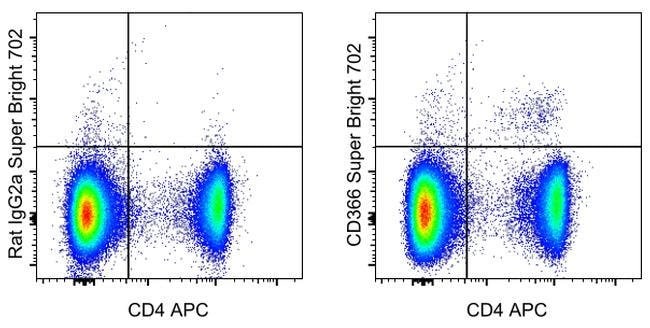
Invitrogen™ CD366 (TIM3) Monoclonal Antibody (RMT3-23), Super Bright™ 702, eBioscience™


Description
The RMT3-23 monoclonal antibody reacts with mouse CD366 (TIM3), a Th1-specific cell surface protein. The RMT3-23 antibody reacts with CD366 protein expressed by both BALB/c and C57BL/6 strains of mice. CD366, a type I transmembrane protein, contains an immunoglobulin and a mucin-like domain in its extracellular portion and a tyrosine phosphorylation motif in its cytoplasmic portion. CD366 is expressed selectively by differentiated CD4^+Th1 and CD8^+Tc1 cells, but is absent on CD4^+Th2 and CD8^+Tc2 cells. Other hematopoietic cell types, including naive T cells, B cells, macrophages and dendritic cells, do not express CD366, at least at the protein level. CD366 expression is upregulated at a late stage of T cell differentiation on Th1 cells after 3 rounds of in vitro polarization suggesting a role for this molecule in the transport or effector function of Th1 cells rather than a contribution to T cell differentiation. In an experimental autoimmune encephalomyelitis (EAE) model, CD366 was shown to be expressed on most CD4^+ and CD8^+ T cells in the central nervous system at the onset of clinical signs of disease, while less than 2% of CD4^+ cells in the periphery expressed CD366 after immunization. Applications Reported: This RMT3-23 antibody has been reported for use in flow cytometric analysis. Applications Tested: This RMT3-23 antibody has been tested by flow cytometric analysis of mouse splenocytes. This may be used at less than or equal to 0.5 μg per test...
Specifications
Specifications
| Antigen | CD366 (TIM3) |
| Applications | Flow Cytometry |
| Classification | Monoclonal |
| Clone | RMT3-23 |
| Concentration | 0.2 mg/mL |
| Conjugate | Super Bright 702 |
| Formulation | PBS with BSA and 0.09% sodium azide; pH 7.2 |
| Gene | Havcr2 |
| Gene Accession No. | Q8VIM0 |
| Gene Alias | CD366; FLJ14428; Havcr2; HAVcr-2; Hepatitis A virus cellular receptor 2; hepatitis A virus cellular receptor 2 homolog; kidney injury molecule-3; KIM-3; sCD366; soluble CD366; soluble TIM 3; T cell immunoglobulin mucin 3; T cell immunoglobulin mucin-3; T-cell immunoglobulin and mucin domain containing 3; T-cell immunoglobulin and mucin domain-containing protein 3; T-cell immunoglobulin mucin family member 3; T-cell immunoglobulin mucin receptor 3; T-cell membrane protein 3; Tim3; TIM-3; TIMD3; TIMD-3 |
| Show More |