missing translation for 'onlineSavingsMsg'
Learn More
Learn More

Invitrogen™ CD305 (LAIR1) Monoclonal Antibody (NKTA255), NovaFluor™ Red 700, eBioscience™
Mouse Monoclonal Antibody
$571.71 - $1,268.69
Specifications
| Antigen | CD305 (LAIR1) |
|---|---|
| Clone | NKTA255 |
| Concentration | 0.4 μg/Test |
| Content And Storage | 4°C, store in dark, DO NOT FREEZE! |
| Applications | Flow Cytometry |
| Catalog Number | Mfr. No. | Quantity | Price | Quantity | |||||
|---|---|---|---|---|---|---|---|---|---|
| Catalog Number | Mfr. No. | Quantity | Price | Quantity | |||||
|
H081T02R03A
|
Invitrogen™
H081T02R03A |
25 Tests |
N/A
|
|
|||||
|
H081T03R03A
|
Invitrogen™
H081T03R03A |
100 Tests |
N/A
|
|
|||||
Description
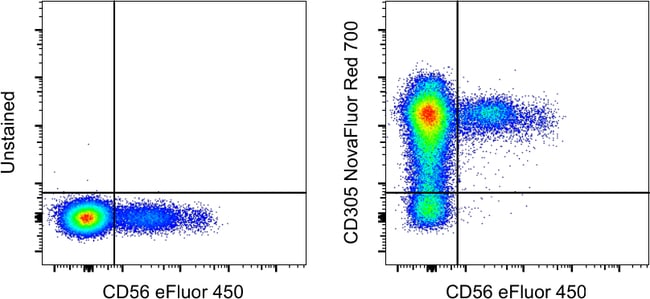
Description: This NKTA255 monoclonal antibody reacts with human CD305, which is also known as leukocyte-associated Ig-like receptor (LAIR) 1. The NKTA255 antibody has been reported to inhibit NK cytolytic activity. This product contains 1 vial of NovaFluor conjugate and 1 vial of CellBlox Plus Blocking Buffer. Applications Tested: This NKTA255 antibody has been pre-titrated and tested by flow cytometric analysis of human peripheral blood cells. This can be used at 5 μL (0.4 μg) per test. A test is defined as the amount (μg) of antibody that will stain a cell sample in a final volume of 100 μL. Cell number should be determined empirically but can range from 10^5 to 10^8 cells/test Master mixes. Whole Blood compatibility: When utilizing whole blood (as opposed to density-gradient-purified PBMC), we recommend lysing red blood cells in bulk prior to staining with NovaFluor conjugates.
CD305, also known as LAIR1, is a type I transmembrane glycoprotein with an extracellular Ig-like domain and two intracellular ITIMs. It is expressed on a wide range of immune cells, including T, NK, and B cells, monocytes, dendritic cells, eosinophils, basophils, and mast cells. In humans, CD305 is also present on CD34+ hematopoietic progenitor cells and thymocytes. Several isoforms exist due to alternative splicing, with expression varying between cell types. CD305 functions as an inhibitory receptor, playing a key role in regulating immune responses. It blocks cytokine-mediated signaling, cell proliferation, and apoptosis. In NK, B, and T cells, CD305 modulates cytolytic functions and cytokine production, down-regulating IL2 and IFNG in CD4+ T cells while inducing transforming growth factor beta. In B cells, it reduces IgG and IgE production and decreases IL8, IL10, and TNF secretion. Activation of CD305 through tyrosine phosphorylation recruits phosphatases PTPN6 and PTPN11, although it may also function independently of SH2-containing phosphatases. It inhibits differentiation of peripheral blood precursors into dendritic cells and has been shown to induce apoptosis in myeloid leukemia cell lines. Collagens are identified as ligands for CD305, underscoring its role in immune regulation.Specifications
| CD305 (LAIR1) | |
| 0.4 μg/Test | |
| Flow Cytometry | |
| NovaFluor Red 700 | |
| Mouse | |
| RUO | |
| PBS with BSA and 0.09% sodium azide; pH 7.2 | |
| Q6GTX8 | |
| 3903 | |
| Primary | |
| Affinity chromatography |
| NKTA255 | |
| 4°C, store in dark, DO NOT FREEZE! | |
| Monoclonal | |
| Liquid | |
| IgG1 | |
| Human | |
| LAIR1 | |
| 5133400O11Rik; BB115266; CD305; D7Bwg0421e; immunoglobulin heavy chain variable region; Lair1; Lair-1; leukocyte associated immunoglobulin like receptor 1; leukocyte-associated Ig-like receptor 1; leukocyte-associated Ig-like receptor-1; leukocyte-associated immunoglobulin-like receptor 1; rLAIR1 | |
| LAIR1 | |
| Antibody |